ESG in Procurement: what has to change in the department, and what it costs From principles to goals, measurement, tools and regulation
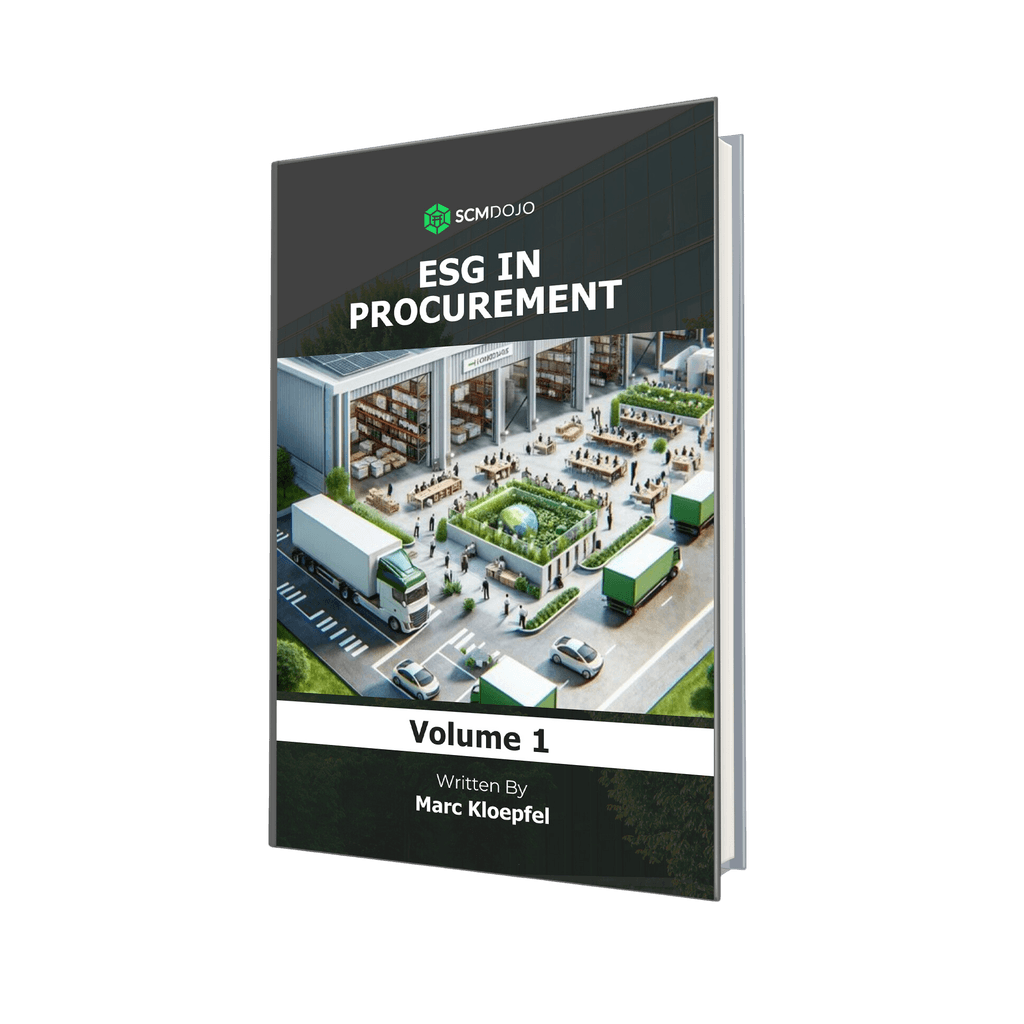
Environmental, Social and Governance principles are no longer a reporting exercise: they land in procurement, where suppliers are selected, contracts are written and spend is committed. This e-book by Marc Kloepfel covers the importance of ESG in procurement, the benefits and the challenges of implementing it, practical advice on achieving ESG goals in the department, how to monitor and measure the result, and the regulatory landscape across the EU, USA, Asia and the Middle East. Eleven chapters and 53 pages, Volume 1 as printed on the cover.
Instant download · E-Book (PDF) · 53 pages · Lifetime access

ESG is decided in procurement
long before it appears in a report.
From the principles to the suppliers, the measurement and the regulation
ESG in Procurement delves into the critical integration of Environmental, Social and Governance principles within procurement processes. It is written for procurement professionals seeking to enhance sustainability, ethical practices and governance in their operations, and it covers the importance of ESG, the benefits and challenges of implementing these strategies, and practical advice on achieving ESG goals in the department.
The book opens on the foundations: what ESG means inside a procurement function and why it matters in modern practice. It then states the case honestly. The advantages include competitive advantage and quality improvement; the challenges include cost implications and supplier uncertainties. A guide that only listed the benefits would not survive contact with a budget review.
The middle of the book is the work itself. How to effectively achieve ESG goals in procurement, how to monitor and measure ESG implications constructively, what those goals should look like in the department, and what it costs a company to become ESG compliant. Chapter nine covers the amalgamation of AI tools and ESG practices, and chapter ten the various tools used for monitoring ESG in the supply chain.
It closes on the regulatory landscape, which is where the ambiguity is greatest: whether countries without ESG regulations hold a competitive advantage in procurement, whether uniform global ESG standards are needed to improve sustainability in supply chain operations, and where the USA, the EU and other nations actually stand.
Environmental
Sustainability in supply chain operations, and the emissions and resource decisions that procurement commits to on the company's behalf.
Social
Ethical practices across the supplier base, and how a department incentivizes suppliers to meet them rather than only auditing them.
Governance
The controls, standards and regulatory compliance that make an ESG claim defensible rather than promotional.
Measurement
Two chapters on monitoring and measuring ESG implications, with the tools used to track performance across the supply chain.
Eleven chapters, fifty-three pages,
from the concept to the regulation
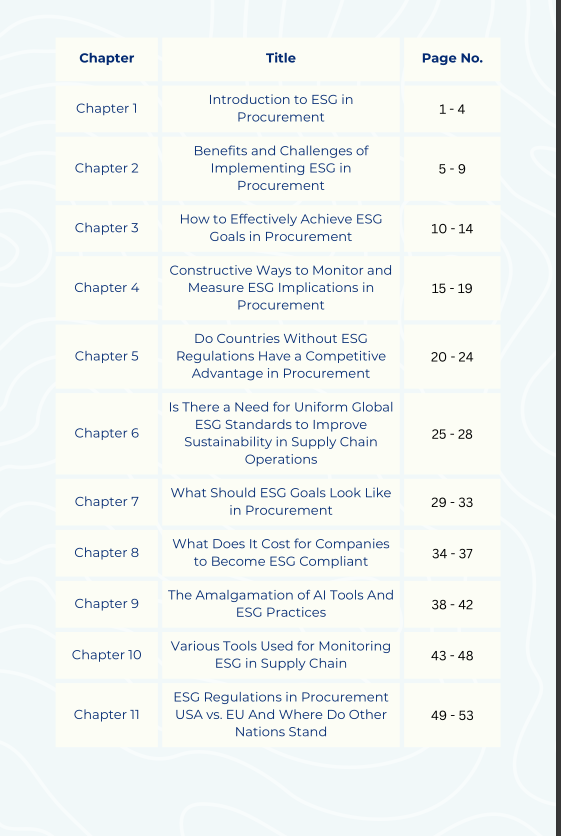
The chapter list and page ranges exactly as printed in the book's own contents table. Chapters one to four run the department, five to eight ask the hard questions, nine and ten cover the tools, eleven covers the law.
Introduction to ESG in Procurement (pages 1-4)
The foundational concepts of ESG and their significance in modern procurement practice.
Benefits and Challenges of Implementing ESG in Procurement (pages 5-9)
Competitive advantage and quality improvement against cost implications and supplier uncertainties, stated on the same page.
How to Effectively Achieve ESG Goals in Procurement (pages 10-14)
Step-by-step strategies for embedding ESG principles into procurement processes, from aligning goals to incentivizing suppliers.
Constructive Ways to Monitor and Measure ESG Implications in Procurement (pages 15-19)
How monitoring is done constructively, so measurement drives improvement rather than only producing a report.
Do Countries Without ESG Regulations Have a Competitive Advantage in Procurement (pages 20-24)
The uncomfortable question, argued directly rather than dismissed.
Is There a Need for Uniform Global ESG Standards to Improve Sustainability in Supply Chain Operations (pages 25-28)
Whether a common standard is the answer, and what it would have to cover to change supplier behaviour.
What Should ESG Goals Look Like in Procurement (pages 29-33)
What a usable goal looks like when it is written into a category plan rather than a corporate report.
What Does It Cost for Companies to Become ESG Compliant (pages 34-37)
The cost side of compliance, which is the question a procurement lead is asked first.
The Amalgamation of AI Tools And ESG Practices (pages 38-42)
Where artificial intelligence meets ESG practice in the function, and what each adds to the other.
Various Tools Used for Monitoring ESG in Supply Chain (pages 43-48)
The monitoring tools available, and how they are used to track and assess performance across the supply chain.
ESG Regulations in Procurement USA vs. EU And Where Do Other Nations Stand (pages 49-53)
The varying regulatory landscape across the EU, USA, Asia and the Middle East, and its impact on procurement practices.
The e-book as delivered, by Marc Kloepfel
ESG in Procurement, Volume 1. Eleven chapters and 53 pages, delivered as a single PDF.
The benefits, the costs and the law,
in one procurement document.
Comprehensive and procurement-specific
The full picture of ESG inside the department: importance, benefits, challenges, implementation, measurement and regulation.
Step-by-step implementation
Strategies for embedding ESG principles into procurement processes, from aligning goals through to incentivizing suppliers.
Monitoring and measurement included
Two chapters on tracking and assessing ESG performance in the supply chain, so the programme can show ongoing improvement and compliance.
The cost question answered
A chapter on what it costs companies to become ESG compliant, alongside the cost implications named as a challenge.
Regulation across four regions
The varying landscape of ESG regulation across the EU, USA, Asia and the Middle East, and its impact on procurement practices.
Where AI and ESG meet
A chapter on the amalgamation of AI tools and ESG practices, from an author who invests in both fields.
Six moves from the principle
to a defensible ESG position in procurement
Settle the foundations
Chapters one and two cover what ESG means in procurement and both sides of the case: competitive advantage and quality improvement against cost and supplier uncertainty.
Write goals the department can actually own
Chapter three sets out how to effectively achieve ESG goals in procurement; chapter seven defines what those goals should look like.
Put measurement in from the start
Chapter four gives constructive ways to monitor and measure ESG implications, so the programme is evidenced rather than asserted.
Price the compliance before you commit
Chapter eight covers what it costs companies to become ESG compliant, which is the number you will be asked for first.
Choose the tools deliberately
Chapters nine and ten cover the amalgamation of AI tools with ESG practice, and the various tools used for monitoring ESG across the supply chain.
Know where the regulation stands
Chapters five, six and eleven cover countries without ESG regulation, the case for uniform global standards, and the USA versus EU position with other nations.
For the people who have to turn
an ESG commitment into supplier reality
Build the case and defend it
Benefits, challenges and compliance cost in one document, with the competitive-advantage question argued rather than avoided.
Embed ESG in the process, not the policy
Step-by-step implementation, goal setting and supplier incentives that work inside the category plan you already run.
Give the targets a supply chain mechanism
How sustainability in supply chain operations is monitored and measured, and which tools are used to do it.
Track the regulation across regions
The EU, USA, Asia and the Middle East compared, and what the differing standards mean for procurement practice.
The questions procurement teams ask
before committing to an ESG programme
Each of these is a chapter title in the book, which is the clearest evidence that the guide answers it rather than skirts it.
The integration of Environmental, Social and Governance principles within procurement processes: sustainability, ethical practices and governance applied where the organization commits spend to suppliers. Chapter one introduces the concepts and their significance.
Chapter two covers both. The benefits include competitive advantage and quality improvement; the challenges include cost implications and supplier uncertainties across the base.
Chapter three sets out step-by-step strategies for embedding ESG principles into procurement processes, from aligning goals with organizational priorities to incentivizing suppliers to meet them.
Chapters four and ten cover constructive ways to monitor and measure ESG implications, and the various tools used for monitoring ESG in the supply chain, so improvement and compliance can be evidenced over time.
Chapter eight addresses the cost to companies directly, which is the number that decides whether a programme is funded or shelved.
Yes. Chapter eleven compares ESG regulation in the USA and the EU and where other nations stand, and chapters five and six ask whether countries without ESG regulation hold a competitive advantage and whether uniform global standards are needed.

Before you buy
What exactly is included in this purchase?
The complete e-book, ESG in Procurement, 53 pages across eleven chapters: the introduction to ESG in procurement, benefits and challenges, achieving ESG goals, monitoring and measurement, the competitive-advantage and global-standard questions, what ESG goals should look like, the cost of compliance, AI tools and ESG practice, monitoring tools, and USA versus EU regulation.
What format is the e-book in?
PDF, delivered as a single file of about 42 MB. It is illustrated throughout, which is why the file is larger than a text-only e-book, and it reads on a laptop, tablet or phone.
Is this about ESG reporting or about procurement?
About procurement. Every chapter is framed on the department: supplier selection and incentives, category goals, measurement inside the process, the cost of compliance and the regulation a buyer has to operate under.
Does it cover regulation outside Europe?
Yes. Chapter eleven compares ESG regulation in the USA and the EU and where other nations stand, and the book's stated scope covers the varying landscape across the EU, USA, Asia and the Middle East.
Is this Volume 1 of a series?
The cover is printed as Volume 1. It stands alone as a complete eleven-chapter guide to ESG in procurement.
How long is the e-book?
Fifty-three pages, eleven chapters, structured so the implementation, tooling and regulation chapters can be read separately by whoever owns them.
What will I receive after purchase?
Instant access to the e-book from your account, plus a download link sent to your email address. Lifetime access, no subscription.

Turn ESG from a commitment into a procurement process.
Get the SCMDOJO ESG in Procurement e-book and put implementation, measurement, tooling and regional regulation in front of the people who select the suppliers and sign the contracts.
Instant download · E-Book (PDF) · 53 pages · Lifetime access · No subscription


