Implementation of B2B e-Business Systems An empirical study in a manufacturing environment, two supplier portals and the framework that explains the difference
Academic research has largely overlooked practical e-Business implementations in the global business world, leaving an empirical gap. This Master research closes part of it: an analytical and practical framework for the design of Supply Chain, e-Business and Organisational Change Management, with the inter-relationship between the three areas established explicitly. The framework is built from the Supply Chain Operations Reference (SCOR) model, Critical Success Factors and the DeLone and McLean IS success model, then tested on the ground: a study at Bombardier Transportation's site in Villeneuve (VD), Switzerland, comparing the older SupRailNet supplier portal, deployed at four production sites in France, against the newer SupplyOn portal, rolled out at the Swiss site and planned as the sole global solution across all Bombardier Transportation sites. Six chapters, references and three appendices, by Sanjoy Biswas.
Instant download · PDF · Lifetime access

Organisations ran e-Business portals
for years. The research barely looked at them.
A framework for e-Business design, tested against two real supplier portals
This Master research presents an analytical and practical framework for the design of Supply Chain, e-Business and Organisational Change Management. To achieve that, the study establishes an inter-relationship between the three areas rather than treating them as separate literatures, and draws on work conducted at the University of Manchester and at Bombardier Transportation (Switzerland) SA.
The reason it was worth doing is stated plainly: organisations have implemented e-Business portals for many years, yet academic research has largely overlooked practical implementations in the global business world. That empirical gap is what this study addresses directly, by taking the frameworks to a live production site and comparing two portals that use distinct communication approaches.
Chapter 2 assembles the framework. Supply Chain Management is covered through the Value Chain Model, the Supply Chain Operations Reference (SCOR) model and the Global Supply Chain Forum (GSCF) framework; e-Business is approached through Critical Success Factors, including why CSF efforts fail and how their benefits are implemented; and evaluation of an e-Business or SCM implementation is grounded in three named models, the Use and Value e-Business System model, the DeLone and McLean IS success model and the Model for Web Assimilation.
Chapters 3 to 6 do the fieldwork and the reasoning: methodology, the case study presentations of SupRailNet and SupplyOn, the discussion of findings and their implications for research and management, and the conclusions on contribution to theory, contribution to practice, limitations and future research opportunities. The three appendices carry the instruments themselves, so the evidence can be traced back to what was actually asked.
Three areas, one framework
Supply Chain, e-Business and Organisational Change Management are linked deliberately, with the inter-relationship between them established as part of the design.
Named models, not abstractions
SCOR for supply chain, Critical Success Factors for e-Business, and the DeLone and McLean IS success model for evaluating an implementation.
Tested at a real site
The study was conducted at Bombardier Transportation's site in Villeneuve (VD), Switzerland, comparing the SupRailNet and SupplyOn supplier portals.
The instruments are included
Three appendices print the internal research questions, the phone interview notes and the supplier questionnaire behind the findings.
Six chapters, references and
three appendices, as the contents table prints them
Chapter and section titles with the page numbers listed in the dissertation's own contents table. Front matter is numbered in roman numerals from the Declaration (page I) to the Glossary (page X); the numbered chapters start at page 1 and the References run from page 60.
Front matter (pages I-X)
Declaration, Abstract, Acknowledgement, Table of Contents, List of Figures, List of Tables, List of Abbreviations and Glossary.
1 Introduction (pages 1-6)
Background in supply chain management and e-Business, the aim of the research, the research questions and the research outline.
2 Literature Review: Supply Chain Management (pages 7-16)
The Value Chain Model, the Supply Chain Operations Reference (SCOR) model and the Global Supply Chain Forum (GSCF) framework, with a summary.
2 Literature Review: e-Business systems and SCM (pages 17-23)
Critical Success Factors, then two sub-sections on understanding CSF failures and implementing CSF benefits.
2 Literature Review: evaluating an implementation (pages 24-31)
Models for identifying CSFs: the Use and Value e-Business System model, the DeLone and McLean IS success model and the Model for Web Assimilation.
3 Research Methodology (pages 32-39)
Objectives, strategy and research quality, then the case study approach, survey approach, literature review, data collection, data analysis and the stated limitations.
4 Case Study Presentations (pages 40-47)
Company presentation, then SupRailNet (page 41) and SupplyOn (page 43), followed by the technical framework and the operational framework.
5 Discussion (pages 48-55)
The findings, then their implications for research and for management, and a summary.
6 Conclusions (pages 56-59)
Contribution to theory and research, contribution to practice relevance, and limitations with future research opportunities.
References and Appendices (pages 60-76)
References from page 60, then Appendix I (research questions, Bombardier Transportation internal), Appendix II (recordings and notes of phone interviews) and Appendix III (research questionnaire for suppliers).
The dissertation as delivered, by Sanjoy Biswas
Implementation of B2B e-Business Systems: An Empirical Study in a Manufacturing Environment. MSc dissertation, 2015, delivered as a single PDF.
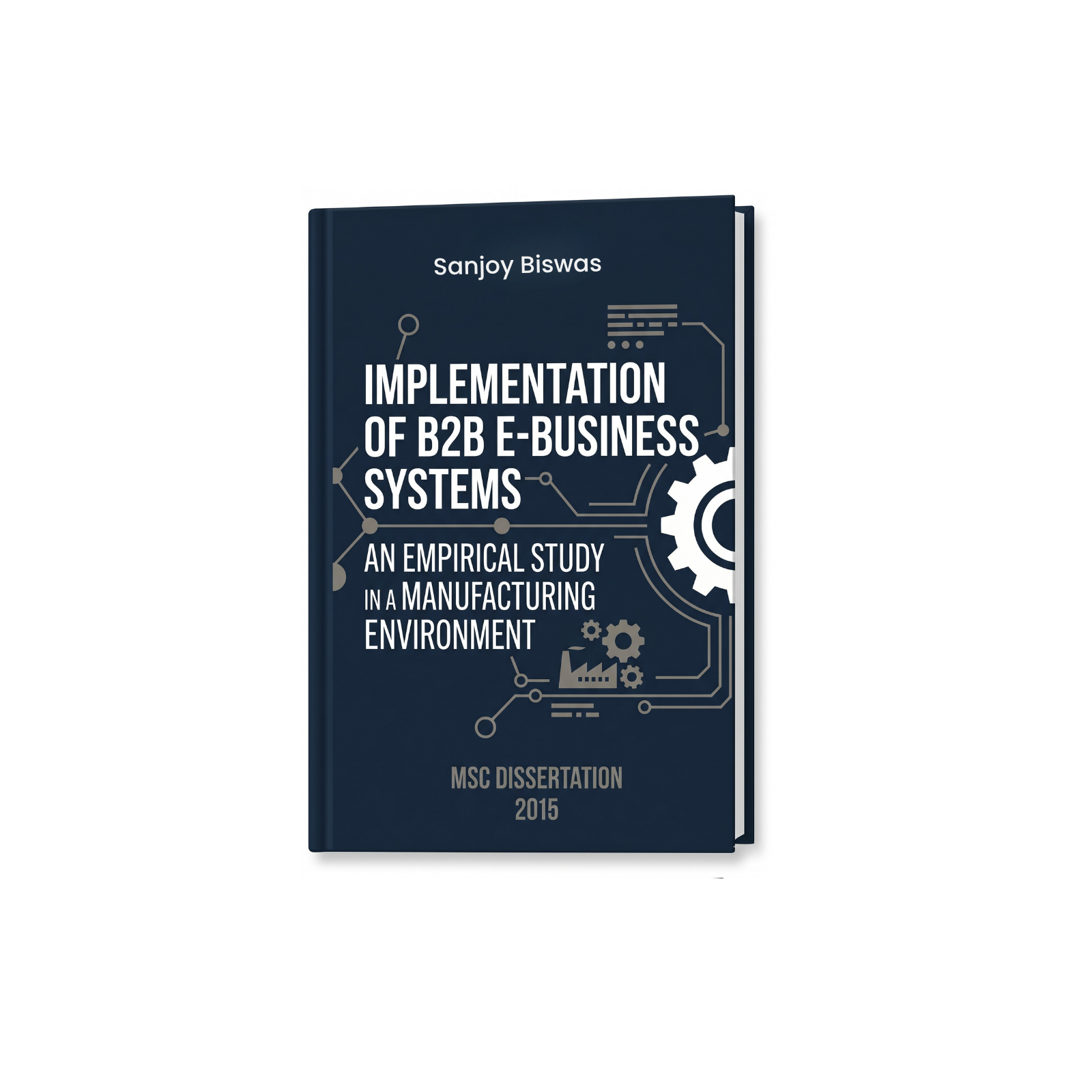


A dissertation that carries its own
evidence in the appendices.
Supply chain, e-Business and change management linked
The stated aim is an analytical and practical framework for the design of all three, with the inter-relationship between them established as part of the study.
Three named frameworks do the work
The SCOR model for supply chain management, Critical Success Factors for e-Business, and the DeLone and McLean IS success model for evaluating an implementation, alongside the Use and Value model and the Model for Web Assimilation.
Methodology with its limits written down
Chapter 3 sets objectives, strategy and research quality, then the case study and survey approaches, data collection and analysis, and a section on limitations before the summary.
A single-site field study
Conducted at Bombardier Transportation's site in Villeneuve (VD), Switzerland, with the company presentation and both portals described in chapter 4.
Two portals compared on three dimensions
SupRailNet, deployed at four production sites in France, against SupplyOn, rolled out at the Swiss site and planned as the sole global solution, compared on internal connectivity, external connectivity and data exchange formats, and communication ways.
Research instruments printed in full
Appendix I carries the Bombardier Transportation internal research questions, Appendix II the recordings and notes of the phone interviews, Appendix III the questionnaire put to suppliers.
Six moves from the framework
to the evidence behind it
Read the aim and the questions first
Section 1.2 states the aim of the research on page 2 and 1.3 lists the research questions from page 4, so chapter 5 can be checked against what was actually asked.
Take chapter 2 as the framework inventory
Pages 7 to 31: the supply chain models, the Critical Success Factors literature and the three evaluation models. Each has its own printed sub-section and page.
Use chapter 3 to judge how much weight to give the findings
Pages 32 to 39 cover strategy, research quality, the case study and survey approaches, data collection and analysis, and the limitations section on page 38.
Compare the two portals in chapter 4
SupRailNet on page 41, SupplyOn on page 43, then the technical framework on page 45 and the operational framework on page 46.
Follow the reasoning in chapters 5 and 6
Findings from page 48 and implications for research and management on page 53; contribution to theory on page 56, to practice on page 57, and limitations and future research opportunities on page 59.
Go back to the raw instruments
References begin on page 60 and the appendices run from page 74: internal research questions, phone interview notes and the supplier questionnaire.
For the people who have to make
a portal change actually work
Design the change, not only the system
The framework links Supply Chain, e-Business and Organisational Change Management, which is where portal projects usually come apart.
See what a rollout looked like end to end
A live comparison of SupRailNet and SupplyOn at one Bombardier Transportation site, across internal connectivity, external connectivity and communication ways.
Evaluate against a named model
Chapter 2 works through the DeLone and McLean IS success model, the Use and Value e-Business System model and the Model for Web Assimilation.
Read the gap being addressed
The study exists because academic research overlooked practical implementations, and it prints the interview and questionnaire material behind its conclusions.
The questions people ask about
a B2B portal implementation
Asked by the leads and project managers who have to justify an e-Business system. Each maps to a chapter in the dissertation.
That inter-relationship is the stated purpose of the research. Chapter 2 builds the three literatures, and chapters 4 to 6 test how they hold together against one site's two portals.
The Supply Chain Operations Reference (SCOR) model for supply chain management, Critical Success Factors for e-Business, and the DeLone and McLean IS success model for evaluating an implementation, with the Value Chain Model, the GSCF framework, the Use and Value e-Business System model and the Model for Web Assimilation also covered.
Three dimensions: internal connectivity with internal information systems, external connectivity with external information systems and data exchange formats, and communication ways, meaning the information flow to and from the web portal.
They use distinct communication approaches. SupRailNet was the older portal, deployed at four production sites in France; SupplyOn was rolled out at the Swiss site and is planned as the sole global solution across all Bombardier Transportation sites worldwide.
Chapter 3 sets out the case study approach, the survey approach, the literature review, data collection and data analysis, and states the limitations on page 38. The instruments themselves are printed in the three appendices.
Yes. Chapter 5 has a section on implications for research and for management, and chapter 6 separates contribution to theory and research from contribution to practice relevance.

Before you buy
What exactly is included in this purchase?
The complete MSc dissertation as a PDF: front matter, six chapters from Introduction to Conclusions, the References, and three appendices carrying the research questions, phone interview notes and supplier questionnaire.
What format and size is the file?
A single PDF of about 1.4 MB. It reads on laptop, tablet or phone with no software required, and the download stays available in your account.
Is this a guide or an academic thesis?
It is a Master research dissertation, dated 2015, with a declared research aim, research questions, a methodology chapter and stated limitations. The practical value is in the framework and the two-portal comparison, not in step-by-step instructions.
Which frameworks does it apply?
The Supply Chain Operations Reference (SCOR) model for supply chain management, Critical Success Factors for e-Business, and the DeLone and McLean IS success model for evaluating an implementation, alongside the Value Chain Model, the GSCF framework, the Use and Value e-Business System model and the Model for Web Assimilation.
What was the case study?
Bombardier Transportation's site in Villeneuve (VD), Switzerland, comparing two supplier web portals: SupRailNet, deployed at four production sites in France, and SupplyOn, rolled out at the Swiss site and planned as the sole global solution across all Bombardier Transportation sites.
Who wrote it?
Sanjoy Biswas, an SCMDOJO expert who was Senior Supply Chain Project Manager at Bombardier Transportation (Switzerland) SA from 2013 to 2016, and who holds MSc degrees from The University of Manchester and Heriot-Watt University.
What will I receive after purchase?
Instant access to the PDF from your account, plus a download link sent to your email address. Lifetime access, no subscription.

Stop treating the portal as only an IT project.
Get the SCMDOJO copy of Implementation of B2B e-Business Systems and read the framework that links supply chain design, e-Business and Organisational Change Management, tested against SupRailNet and SupplyOn at a Bombardier Transportation site, with the methodology, findings and research instruments all printed.
Instant download · PDF · 6 chapters + 3 appendices · Lifetime access · No subscription


