Transform Procurement: The Value of E-Auctions Simple to run, and there are thousands of ways to implement one wrong
An e-auction program fails in the details nobody briefs you on: the scope of work that was never written properly, the executives who were never won over, the suppliers who quietly stop participating. This book works through the whole program in nine chapters, starting with why e-auctions are (not) evil and the objections you will hear from the executive and procurement teams, then the process, timeline and auction types, the psychology behind them, and how teams undermine a program from within. It goes on to the parameters that decide results, ceilings, bid decrements, reserves and tie rules, the metrics that report them back, every supplier behaviour you have to manage, and the bids everyone assumes cannot be auctioned. Written by Janice Marquardt, who built the e-Auction centre of excellence at Berkshire Hathaway Energy.
Instant download · PDF · Lifetime access

Simple to run.
Thousands of ways to implement it wrong.
The few ways an e-auction program is implemented right, written down in order
E-auctions are simple to run. But there are thousands of ways to implement an e-auction program wrong and only a few ways to implement them right. That asymmetry is what this book is for: it covers how to gain buy-in from executives and secure the resources needed, how to strategically manage suppliers and answer their common questions, the psychology behind e-auctions and how to build a winning team, and how to set ceilings, bid decrements, reserves and tie rules to maximise results.
It starts where programs actually stall. Chapter 1 argues why e-auctions are (not) evil, sets out the old way of doing things, then works through scope of work issues and the objections raised by the executive and procurement teams. Chapter 2 gives the process itself, with the timeline and the types of e-auctions, and chapter 3 covers the early lessons, taking the first steps and the psychology of e-auctions.
The middle of the book is the machinery. Chapter 4 looks at how a program gets undermined from within, through the technical team, the procurement team and the executive team. Chapter 5 sets the parameters and metrics: external parameters from page 30, internal parameters from page 37, cost savings and RFP reduction, and the other metrics that report what happened. Chapter 6 is all about suppliers: new suppliers, supplier training, non-participating suppliers, complacent and backpedaling suppliers, and pseudo-e-auctions.
The last three chapters widen the method beyond the standard materials bid. Chapter 7 covers next-level opportunities, from go/no-go criteria and scopes of work to contract terms, bid transformation, second and third-place suppliers and non-monetary e-auctions. Chapter 8 takes on the weird ones: hourly rates, project component pricing, single supplier auctions, seemingly non-auctionable bids, leadership conferences, marketing and creative services, fixed or public budgets and staff augmentation. Chapter 9 concludes with an example scope of work and a sample e-auction program implementation plan.
Buy-in before bidding
Executive and procurement team objections get their own printed section, because that is where a new program is usually stopped.
The parameters that decide results
Ceilings, bid decrements, reserves and tie rules, then external and internal parameters with the metrics to report them.
Supplier behaviour, named
New, non-participating, complacent and backpedaling suppliers, supplier training, and what a pseudo-e-auction actually is.
Beyond materials
Non-monetary e-auctions, hourly rates, single-supplier auctions, leadership conferences, marketing services and staff augmentation.
Nine chapters, in the order
the contents page prints them
Chapter and section titles with the page numbers listed in the book's own contents page. Front matter is numbered in roman numerals, Foreword on page ix through Introduction on page xvii; the numbered chapters start at page 1 and the back matter runs from the Glossary on page 91 to Review This Book on page 103.
Foreword, Preface and Introduction (pages ix-xvii)
Front matter in roman numerals: Foreword on page ix, Preface on page xv, Introduction on page xvii.
1. Why E-Auctions Are (Not) Evil (pages 1-8)
The old way of doing things on page 1, scope of work issues on page 6, and executive and procurement team objections from page 7.
2. The E-Auction Process (pages 9-15)
The process itself from page 9, with the timeline on page 11 and the types of e-auctions from page 12.
3. Early Lessons (pages 16-21)
Taking the first steps on page 16, then the psychology of e-auctions from page 20.
4. Undermining from Within (pages 22-28)
Three named sources of resistance, each with its own section: technical team page 22, procurement team page 23, executive team page 26.
5. Parameters and Metrics (pages 29-46)
External parameters from page 30, internal parameters from page 37, cost savings and RFP reduction on page 41, other metrics on page 42.
6. All About Suppliers (pages 47-54)
New suppliers and supplier training on page 48, non-participating suppliers page 50, complacent and backpedaling suppliers page 51, pseudo-e-auctions page 52.
7. Next-Level Opportunities (pages 55-64)
Go/no-go criteria page 55, scopes of work page 57, contract terms page 58, bid transformation page 59, second and third-place suppliers page 60, non-monetary e-auctions page 62.
8. The Weird Ones (pages 65-72)
Hourly rates page 65, project component pricing and single supplier auctions page 67, non-auctionable and seemingly non-auctionable bids page 68, leadership conferences and marketing and creative services page 69, fixed or public budgets page 70, staff augmentation page 71.
9. Conclusion and Back Matter (pages 73-103)
Conclusion from page 73, with the scope of work on page 75 and the sample e-auction program implementation plan on page 86, then Glossary, Acknowledgments, About the Author, Work With Janice, About our Imprint and Review This Book.
The book as delivered, by Janice Marquardt
Transform Procurement: The Value of E-Auctions. Nine chapters plus front and back matter, delivered as a single PDF.
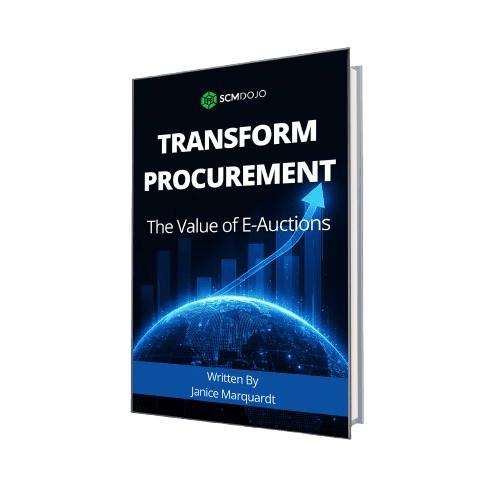


A program book that covers the objections,
the parameters and the odd bids.
Objections handled on their own pages
Executive and procurement team objections are a printed section from page 7, and chapter 4 names the technical, procurement and executive teams as the three places a program gets undermined from within.
The four parameters that move results
Ceilings, bid decrements, reserves and tie rules, set out alongside the external parameters (page 30) and internal parameters (page 37) that frame them.
Cost savings and RFP reduction, measured
Chapter 5 closes with cost savings and RFP reduction on page 41 and other metrics on page 42, so the program can be reported rather than asserted.
Supplier behaviour treated as a workstream
New suppliers, supplier training, non-participating suppliers, complacent and backpedaling suppliers, and pseudo-e-auctions each get their own section in chapter 6.
The bids people assume cannot be auctioned
Chapter 8 covers hourly rates, project component pricing, single supplier auctions, leadership conferences, marketing and creative services, fixed or public budgets and staff augmentation.
Working documents included
An example scope of work with notes on writing good scopes of work, and a sample e-auction program implementation plan printed from page 86.
Six moves from a decision
to run e-auctions to a running program
Settle the argument before the calendar
Chapter 1 (pages 1-8) covers the old way of doing things, the scope of work issues behind most bad first auctions, and the objections you will be given.
Learn the process and pick the type
Chapter 2 gives the process from page 9, the timeline on page 11 and the types of e-auctions from page 12; chapter 3 adds the early lessons and first steps.
Build the team you actually need
The psychology of e-auctions from page 20, then chapter 4 on how the technical, procurement and executive teams each undermine a program from within.
Set parameters and define the metrics
Chapter 5: ceilings, bid decrements, reserves and tie rules, external and internal parameters, and the cost savings, RFP reduction and other metrics on pages 41-42.
Work the supplier side deliberately
Chapter 6 (pages 47-54) covers onboarding new suppliers, training them, non-participation, complacency and backpedaling, and spotting a pseudo-e-auction.
Extend the method, then copy the plan
Chapters 7 and 8 take the approach to non-monetary and unusual bids, and chapter 9 finishes with the scope of work and the sample implementation plan on page 86.
For the people who have to make
an e-auction program stick
Find the value the usual process leaves behind
The book is written for leaders tasked with finding more value and more savings, and it starts with the executive buy-in that decision depends on.
Add a tool to the negotiation toolbox
Chapter 7 moves from go/no-go criteria to contract terms and bid transformation, so an auction sits inside the negotiation rather than replacing it.
Optimise value without losing the supplier
Chapter 6 is devoted to supplier behaviour, including training, non-participation and complacency, which is where value and relationships diverge.
Understand the mechanics from the other side
Written for suppliers asked to participate who want to understand the intricacies, and for those studying procurement or supply chain management.
The questions people ask
before launching an e-auction program
Asked by the leaders, category managers and suppliers who have to live with the results. Each maps to a chapter in the book.
Chapter 1 is titled Why E-Auctions Are (Not) Evil and spends its pages on the old way of doing things, the scope of work issues that make first auctions go badly, and the objections raised by executives and the procurement team.
Executive and procurement team objections are their own section from page 7, and chapter 4 returns to the same three teams, technical, procurement and executive, as the places a program gets undermined from within.
Ceilings, bid decrements, reserves and tie rules, each set to maximise results, framed by the external parameters on page 30 and internal parameters on page 37.
Chapter 5 ends with cost savings and RFP reduction on page 41 and other metrics on page 42, so the program is measured and reported rather than claimed.
Chapter 6 covers new suppliers and supplier training on page 48, non-participating suppliers on page 50, complacent and backpedaling suppliers on page 51, and pseudo-e-auctions on page 52.
Yes, that is chapter 8, The Weird Ones: hourly rates, project component pricing, single supplier auctions, leadership conferences, marketing and creative services, fixed or public budgets and staff augmentation, plus non-monetary e-auctions in chapter 7.

Before you buy
What exactly is included in this purchase?
The complete book as a PDF: front matter, nine chapters from Why E-Auctions Are (Not) Evil to Conclusion, the Glossary and back matter, plus the example scope of work and the sample e-auction program implementation plan.
What format and size is the file?
A single PDF of about 4.8 MB. It reads on laptop, tablet or phone with no software required, and the download stays available in your account.
Is this about running one auction or building a program?
The program. The contents table shows it: buy-in and objections, the process and timeline, auction types, team dynamics, parameters and metrics, supplier management, and only then the individual bid formats.
Does it cover anything beyond standard materials spend?
Yes. Chapter 7 includes non-monetary e-auctions and second and third-place suppliers, and chapter 8 covers hourly rates, project component pricing, single supplier auctions, leadership conferences, marketing and creative services, fixed or public budgets and staff augmentation.
Who is the author, and why does her experience matter here?
Janice Marquardt built the e-Auction centre of excellence at Berkshire Hathaway Energy, running more than 2,000 auctions a year against $2.8b in spend and reducing RFP pricing by $75m. She is now Principal Consultant and SVP Procurement at her own firm, Passwall Solutions.
Would a supplier find anything in it?
The book is written for suppliers who have been asked to participate in e-auctions and want to understand the intricacies, including how supplier training, non-participation and complacency are handled from the buyer side.
What will I receive after purchase?
Instant access to the PDF from your account, plus a download link sent to your email address. Lifetime access, no subscription.



Stop learning e-auctions the expensive way.
Get the SCMDOJO copy of Transform Procurement: The Value of E-Auctions and put a program behind the auctions: how to win executive buy-in, set ceilings, bid decrements, reserves and tie rules, manage every type of supplier, measure cost savings and RFP reduction, and extend the method to the bids everyone assumes cannot be auctioned.
Instant download · PDF · 9 chapters · Lifetime access · No subscription


