The Supply Chain Resilience Self-Assessment Tool Built the Way Practitioners Actually Diagnose Risk
Stop guessing where your supply chain is exposed. This structured self-assessment tool walks you through the key resilience dimensions, scores your performance, and surfaces the vulnerabilities your team needs to act on, before the next disruption arrives.
Instant download · Excel (.xlsx) · Works across industries · Lifetime access

Your vulnerabilities are sitting there.
The diagnosis isn't.
From scattered risk assumptions to a scored resilience baseline, in one session
Every supply chain team faces disruptions: supplier failures, geopolitical shocks, demand spikes, logistics breakdowns. Most teams know they're exposed. Few have a structured way to measure exactly where, and how badly. The result is reactive firefighting instead of proactive risk management.
A proper supply chain resilience assessment looks across multiple dimensions, flexibility, redundancy, visibility, recovery capability, supplier health, and more. It converts gut feel into scored evidence, gives leadership a clear picture, and points to where investment will have the most impact.
This tool is built by a practitioner for practitioners. It reflects the frameworks used in real resilience transformation projects, structured enough to be credible, simple enough to complete in a single working session.
Where are we exposed?
Score your resilience across key dimensions and see exactly which areas are weakest before a disruption forces you to find out.
How do we benchmark?
Compare your scores against industry reference points to understand whether your resilience posture is behind, at par, or ahead of peers.
What should we fix first?
The assessment surfaces your biggest gaps and prioritises where targeted action will drive the greatest improvement in supply chain resilience.
How do we improve?
Translate assessment findings into targeted strategies with clear action areas, not vague recommendations, but specific dimensions to address.
Every resilience dimension your supply chain team needs to assess, pre-built
Work through each assessment dimension, answer the structured questions, and your resilience scores calculate automatically. No consultancy required. No external facilitator needed.
Multi-Dimension Resilience Scoring
Assess your supply chain across the key resilience dimensions, flexibility, redundancy, visibility, and recovery capability, in one structured workbook.
Vulnerability Identification
Structured questions pinpoint exactly where your supply chain is exposed, so you stop relying on instinct and start working from evidence.
Industry Benchmark Reference Points
Compare your scored outputs against industry standards so you know if your resilience posture is strong, average, or needs urgent attention.
Customisable Assessment Framework
Tailor the assessment to your industry, supply chain structure, and specific risk profile. Fully editable, it reflects your organisation, not a generic template.
Targeted Improvement Strategies
Assessment outputs map directly to improvement areas, giving your team a clear agenda for building resilience, not just a list of scores.
Detailed Reporting Output
Comprehensive results with in-depth analysis and visualisations, ready to present to leadership or use as input for your resilience programme.
User-Friendly Interface
Intuitive design with clear instructions throughout. Any supply chain professional can complete the assessment without prior training or external support.
Clear Step-by-Step Instructions
Guides you from opening the file to completing your full resilience baseline, no guesswork, no ambiguity, ready to use on day one.
Visual scoring for every resilience dimension your team needs to review
A clear visual output makes it easy to spot gaps, communicate findings to leadership, and track progress over time.
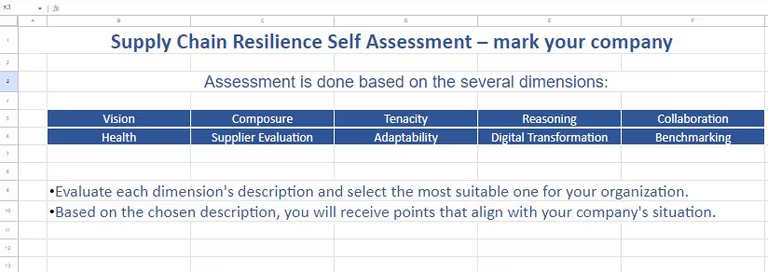
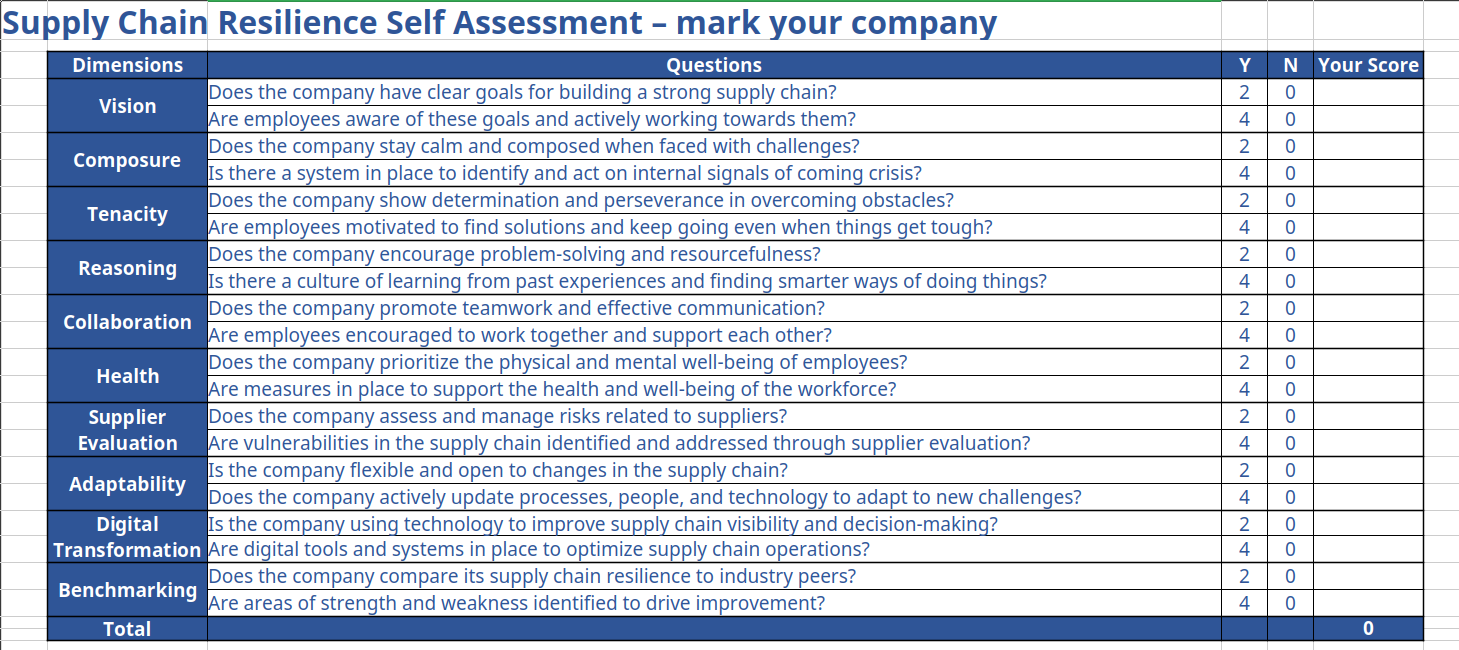
See what you'll be working with
A single, structured worksheet covering the full resilience baseline, clean enough to present, detailed enough to act on.

Designed for supply chain practitioners.
Not risk consultants.
Structured self-assessment format
Clear questions, logical flow, and automatic scoring. Complete your full resilience baseline in a single working session without external facilitation.
Multi-dimension coverage
Assess flexibility, redundancy, visibility, supplier health, recovery capability, and more, all the dimensions that determine real-world supply chain resilience.
Automatic scoring and output
Answer the questions and your scores calculate automatically. No manual tallying, no formula building, the output is ready as you complete each section.
Fully customisable
Tailor the assessment to your specific industry, supply chain structure, and risk profile. Rename dimensions, adjust weighting, and make it yours.
Presentation-ready output
Visualisations and scoring summaries that are clean enough to drop straight into a leadership deck or resilience programme presentation.
Repeatable and reusable
Run the assessment quarterly or annually to track how your resilience posture improves over time. One purchase, unlimited reuse.
From blank workbook to resilience baseline in four steps
Download and open
Open the Excel workbook and read the brief instruction sheet. You'll be ready to start in under five minutes.
Complete each dimension
Work through the structured questions for each resilience dimension. Answer honestly, the output is only as useful as your inputs.
Review your scores
Scores calculate automatically. Review your resilience baseline and identify which dimensions score lowest and need the most attention.
Build your action plan
Use the scored output to prioritise improvements, present findings to leadership, and track progress on your resilience journey.
Built for the people who have to
answer for supply chain risk to leadership
Establish a resilience baseline before the next disruption forces one
Know exactly where you're exposed. Present scored evidence, not gut feel.
Walk into the board with a credible resilience assessment, not assumptions
Structured scores across every resilience dimension, ready to present and defend.
Replace ad-hoc risk reviews with a repeatable, structured process
Run the same assessment quarterly and track whether resilience is improving or declining.
Run a rapid client resilience diagnostic on day one of an engagement
Load with client inputs, surface the biggest gaps, and present findings immediately.
Every supply chain resilience question people ask,
answered by your own assessment data
Practitioners and leadership teams ask these questions constantly. This self-assessment gives you the structured output to answer all of them, with your own scored data, not borrowed frameworks.
Supply chain resilience is the ability to anticipate, absorb, and recover from disruptions. It matters because unplanned shocks, supplier failures, demand spikes, logistics breakdowns, directly hit revenue and service levels.
Work through a structured self-assessment covering key resilience dimensions, flexibility, redundancy, visibility, and recovery. Score each area honestly and the gaps become immediately visible.
Flexibility, redundancy, visibility, supplier health, agility, and recovery capability. Strong resilience requires all dimensions, weakness in one can compromise the others during a real disruption.
A self-assessment is faster, cheaper, and gives you an honest internal baseline immediately. A formal audit adds independent validation, but the self-assessment is the right first step for most teams.
Focus first on the dimensions that scored lowest and carry the highest business impact. The assessment output maps directly to these priorities, start there, not with the easiest fixes.
At minimum annually, and after any major disruption or structural change. Quarterly reviews help teams track whether improvement actions are actually moving the needle on resilience scores.
Built by a practitioner who has studied
supply chain resilience from the inside

Before you buy
What exactly is included in the supply chain resilience self-assessment tool?
One Excel workbook with structured assessment questions across key resilience dimensions, automatic scoring, benchmark references, and clear instructions. Download and start immediately.
How long does the assessment take to complete?
Most practitioners complete the full assessment in one to two hours. You can also work through it dimension by dimension across multiple sessions.
Does this work for any industry or supply chain type?
Yes. The assessment is designed to be customised to your specific industry, supply chain structure, and risk profile. Fully editable, no locked fields.
I'm not a risk expert. Can I still use this assessment?
Yes. The tool is built for supply chain practitioners, not risk consultants. Clear instructions guide you through every step, no specialist knowledge required.
Can I reuse this assessment tool in the future?
Yes. One purchase gives you lifetime access. Run it quarterly, annually, or after any major disruption to track your resilience progress over time.
What format will I receive after purchase?
An instant download link to the Excel file (.xlsx), also sent by email. Works on Excel 2016 or later, Windows and Mac, and Microsoft 365.
Is there a full course available on supply chain resilience?
Yes. Vera Rozanova's full Supply Chain Resilience course is available on SCMDOJO. This assessment tool pairs directly with that curriculum as a practical companion.
Find out where your supply chain is actually exposed.
Download the SCMDOJO Supply Chain Resilience Self-Assessment Tool and get your scored resilience baseline, today.
Instant download · Excel (.xlsx) · Lifetime access · No subscription


