The Comprehensive Guide to Transportation Contracts Select the transporter, negotiate the terms, manage the contract, price the kilometre
Raw materials rarely appear magically at the factory doorstep. A network of transportation logistics brings them in, and procurement manages that network through carefully crafted contracts. This guide goes deeper than legalese: what a transportation contract is and how it is structured, how to select the right transporter, how to negotiate and finalize the agreement, and how to monitor it once it is live. It closes with a case study and an operating cost analysis per kilometre per metric tonne for a 10-tyre truck, the numbers a freight rate is built from.
Instant download · E-Book (PDF) · 22 pages · Lifetime access

What arrives at your factory door
arrived through a contract someone wrote.
From the paperwork behind the movement to the cost behind the rate
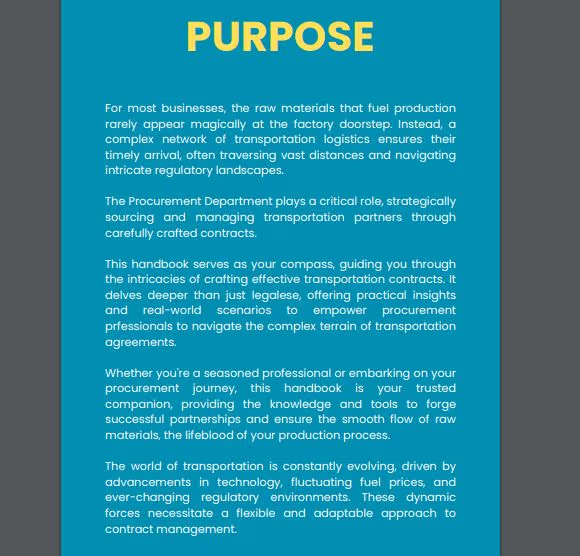
For most businesses, the raw materials that fuel production rarely appear magically at the factory doorstep. A complex network of transportation logistics ensures their timely arrival, often traversing vast distances and navigating intricate regulatory landscapes.
The procurement department plays the critical role in that network, strategically sourcing and managing transportation partners through carefully crafted contracts. This handbook is written as a compass for that work. It delves deeper than legalese, offering practical insights and real-world scenarios to empower procurement professionals navigating the terrain of transportation agreements.
The structure follows the lifecycle. Chapter one sets out what a transportation contract is and how it is built. Chapters two and three cover selecting the right transporter and then negotiating and finalizing the contract with them. Chapter four moves to contract management and monitoring, which is where most of the value is either protected or quietly lost.
The last two chapters are where the guide earns its place on the shelf. A case study traces those decisions through a real engagement, and chapter six works through an operating cost analysis per kilometre per metric tonne for a 10-tyre truck. That model is what turns a quoted freight rate from a number you accept into a number you can test.
Select the transporter
How to choose a partner who meets the requirement and fits the budget, rather than whoever quoted the lowest headline rate.
Negotiate and finalize
Preparing with data and benchmarks, structuring the discussion around value rather than price alone, and closing terms that hold both sides.
Manage after signature
Monitoring performance and compliance, handling disputes and corrective actions, and deciding between extension and re-bid.
Price the kilometre
The operating cost analysis per km per metric tonne for a 10-tyre truck, the cost structure any freight rate is assembled from.
Six chapters, twenty-two pages,
from the clause to the cost per kilometre
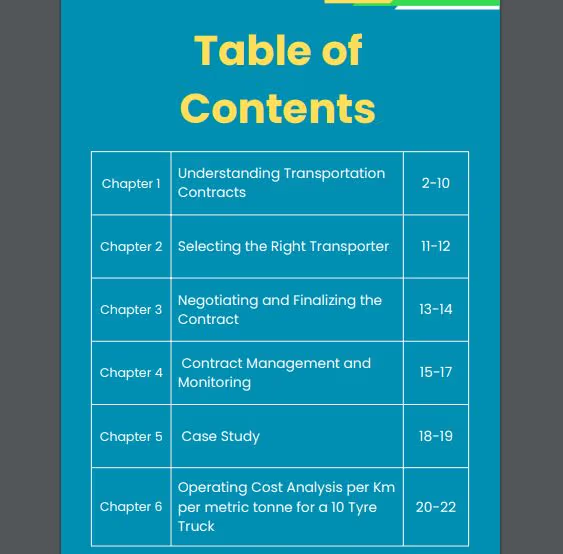
The chapter list and page ranges exactly as printed in the book's own contents table. Chapter one carries the foundations, two to four the lifecycle, five and six the evidence and the numbers.
Understanding Transportation Contracts (pages 2-10)
What a transportation contract is, how it is structured, and the definitions, responsibilities and liabilities its clauses carry.
Selecting the Right Transporter (pages 11-12)
The criteria for choosing the partner: capability against the requirement, and fit with the budget it has to work inside.
Negotiating and Finalizing the Contract (pages 13-14)
How the negotiation is prepared and run, and what has to be settled before the agreement is signed.
Contract Management and Monitoring (pages 15-17)
Performance, compliance and risk once the contract is live, and how a contract is kept from drifting after signature.
Case Study (pages 18-19)
The same decisions traced through a real transportation engagement, from selection through to management.
Operating Cost Analysis per Km per metric tonne for a 10 Tyre Truck (pages 20-22)
The cost model behind a freight rate, worked for a 10-tyre truck, so a quoted price can be tested rather than accepted.
The e-book as delivered, by Ravi Nishant
A Comprehensive Guide to Transportation Contracts. Six chapters and 22 pages, delivered as a single PDF.

A contract guide that carries
its own cost model.
Follows the contract lifecycle
Understanding, selection, negotiation, management and monitoring are separate chapters, in the order the work actually happens.
An exclusive operating cost analysis
Chapter six works the cost per kilometre per metric tonne for a 10-tyre truck, giving you the structure underneath any quoted rate.
Deeper than legalese
The stated purpose of the handbook: practical insight and real-world scenarios for procurement professionals, not a catalogue of clauses.
Legal and regulatory ground
Regulatory compliance across regions and transport modes, and the risk allocation, insurance and liability coverage a contract has to settle.
Built around negotiation
Preparing data and benchmarks, structuring the negotiation around value rather than price alone, and reaching outcomes that work for the carrier too.
Written for a moving market
Advancing technology, fluctuating fuel prices and changing regulation are exactly why the guide argues for a flexible, adaptable approach to contract management.
Six moves from understanding the contract
to testing the rate inside it
Understand the instrument before you draft one
Chapter one takes nine pages to what a transportation contract is, how it is structured and what its clauses, definitions and liabilities actually do.
Shortlist on fit, not on headline rate
Chapter two gives the criteria for selecting the transporter who meets your needs and fits your budget, which are two different filters.
Negotiate with the cost structure in front of you
Chapter three covers negotiating and finalizing the contract; chapter six gives the operating cost analysis that supplies the numbers for it.
Put performance terms in the contract
Define the KPIs and service-level agreements, and how carrier accountability and performance tracking will be evidenced once the contract runs.
Manage it after the signature
Chapter four covers contract management and monitoring: compliance and service quality, disputes and corrective actions, extension and re-bid.
Test your own deal against the case study
Chapter five walks a real engagement end to end, which is the quickest way to see where your current transportation contract is thin.
Written for the people who buy
the movement, not just the material
Contract transportation on evidence
Selection criteria, negotiation preparation and an operating cost model, so a freight quote can be analysed rather than compared.
Keep a live contract delivering
Performance monitoring, compliance, disputes and corrective actions, the part of transportation contracting that starts after signature.
Connect inbound flow to the agreement behind it
How the regulatory, insurance and liability terms written into a contract shape the flow of raw materials into the plant.
Improve efficiency where the cost hides
Built for anyone seeking to improve efficiency in transportation contracts, from a seasoned professional to someone running their first transportation sourcing.
The questions people ask before
signing a transportation contract
Procurement, logistics and supply chain professionals ask these about transportation contracting. Each maps to a chapter in the guide.
Chapter one covers the core elements: contract structures and essential clauses, the definitions, responsibilities and liabilities, and the key pricing models and cost structures the rate is built on.
Chapter two sets out the selection criteria. The guide treats meeting your needs and fitting your budget as two separate filters, which is why the lowest headline quote is not automatically the right partner.
Chapter three covers negotiating and finalizing the contract, supported by the guide's approach to preparing data and benchmarks, structuring the negotiation around value rather than price alone, and reaching a win-win with the carrier.
Chapter four covers contract management and monitoring: tracking compliance and service quality, managing disputes and corrective actions, and the extension versus re-bid decision.
Chapter six works through an operating cost analysis per kilometre per metric tonne for a 10-tyre truck. Fuel surcharges, accessorials and other variable-cost components are what that rate is assembled from.
Yes. Chapter five is a case study across pages 18 and 19, tracing the selection, negotiation and management decisions inside a real transportation engagement.
Seventeen years of sourcing and contracting
for power, fertiliser, PVC and cement plants

Before you buy
What exactly is included in this purchase?
The complete e-book, A Comprehensive Guide to Transportation Contracts, 22 pages across six chapters: understanding transportation contracts, selecting the right transporter, negotiating and finalizing the contract, contract management and monitoring, a case study, and the operating cost analysis per km per metric tonne for a 10-tyre truck.
What format is the e-book in?
PDF, delivered as a single lightweight file of about 1 MB. It reads on a laptop, tablet or phone, needs no special software, and the chapter structure makes the cost model easy to return to.
Does it include a cost model, or only contract theory?
Chapter six is a working operating cost analysis per kilometre per metric tonne for a 10-tyre truck, and chapter five is a case study. The contract chapters lead into both.
Who is this e-book written for?
Procurement managers and analysts, logistics professionals and supply chain specialists, and anyone whose job includes improving efficiency in transportation contracts.
Which transport modes does it cover?
The contracting and management guidance applies across modes, and the guide's scope includes rate-setting approaches for road, ocean, air and multimodal transport. The worked cost model in chapter six is a 10-tyre road truck.
How long is the e-book?
Twenty-two pages, six chapters, written to be read in one sitting and then used chapter by chapter when a contract is on the table.
What will I receive after purchase?
Instant access to the e-book from your account, plus a download link sent to your email address. Lifetime access, no subscription.
Stop accepting freight rates.
Get the SCMDOJO Comprehensive Guide to Transportation Contracts and put selection, negotiation, monitoring and a working cost-per-kilometre model in front of your next transportation agreement.
Instant download · E-Book (PDF) · 22 pages · Lifetime access · No subscription


