Take AI in procurement to the intermediatory level Where Integration, Negotiation and Governance Decide the Result
Volume 1 explained what AI does inside procurement. Volume 2 is about making it work: how to overcome the challenges AI creates, the steps to leverage it inside existing operations, what procurement looks like with and without it, and how to implement it ethically, legally and sustainably. Written by Marc Kloepfel after 25 years and more than 1,000 procurement optimization projects.
Instant download · PDF · 52 pages · Lifetime access

The first book answers what AI can do.
This one answers why implementations still fail.
Moving from capability to integration, governance and measurable return
Artificial intelligence in procurement is changing how organizations source, negotiate and manage suppliers. Volume 1 set out the fundamentals. Volume 2 builds on those insights with actionable strategies for professionals who have to integrate AI into systems that are already running, and defend the result.
It opens by going deeper into what AI in procurement means, then recalls the benefits and challenges before turning to the part most guidance skips: how to overcome the AI-related challenges in procurement, and the steps to effectively leverage AI inside your existing operations.
The middle of the book is comparative and practical. The core procurement functions transformed by AI are examined one by one, followed by a direct comparison of procurement with versus without AI, negotiations and how AI assists them, the scale at which integration makes sense, and the tools with use cases mapped to different procurement functions.
It closes on governance, which is where the risk actually sits. Legal, ethical and sustainability impacts of AI in procurement get a chapter, followed by how to implement AI ethically, legally and sustainably, so the roadmap ends in a function that can be audited as well as praised.
Integration over invention
Steps to leverage AI inside the systems you already run, rather than a greenfield architecture nobody can fund.
With AI versus without
An entire chapter comparing procurement with and without AI, so the case is made on evidence rather than on vendor claims.
AI at the negotiation table
How AI assists negotiations in procurement, the highest-value moment in the function and the least documented one.
Legal, ethical, sustainable
Two chapters on governance: the impacts of AI in procurement, and how to implement against all three requirements.
Fifty-two pages, from a deeper insight
to implementing AI ethically, legally and sustainably
Twelve chapters, exactly as listed in the book's own contents table. Chapters one to four move from insight to action, five to nine cover the functions and the tools, ten and eleven carry the governance, and twelve closes.
Introduction to AI in Procurement: A Deeper Insight (pages 4-5)
Building past the Volume 1 fundamentals into how AI enhances decision-making, automates processes and drives efficiency.
Recalling the Benefits and Challenges of AI in Procurement (pages 6-9)
The gains and the frictions restated, so the implementation advice that follows has something to answer to.
How to Overcome AI-Related Challenges in Procurement (pages 10-13)
Practical responses to the obstacles that stall AI adoption inside a procurement function.
Steps to Effectively Leverage AI in Your Procurement Operations (pages 14-17)
A sequenced approach to using AI within existing operations, aimed at measurable return rather than experimentation.
Core Functions of Procurement Transformed by AI (pages 18-22)
Where the technology changes the work: sourcing, supplier management, spend analysis and the rest of the function.
A Comparison of Procurement With vs. Without AI (pages 23-27)
The same function examined both ways, so the difference is stated in operational terms rather than as a promise.
Negotiations in Procurement and How AI Can Assist (pages 28-31)
Using AI to prepare, analyse and run negotiations, the part of procurement where insight converts fastest into value.
Scale of AI Integration in Procurement (pages 32-35)
How far integration should go, and which decisions remain with the buyer rather than the model.
AI Tools and Their Use Cases in Different Procurement Functions (pages 36-40)
The tools mapped to specific functions, with the use cases that justify each one.
Legal, Ethical, and Sustainability Impacts of AI in Procurement (pages 41-44)
The three constraints that decide whether an AI deployment is defensible, including the ESG dimension.
How to Implement AI in Procurement, Ethically, Legally, and Sustainably (pages 45-48)
Turning the governance chapter into an implementation approach that holds against all three requirements.
Summarizing Our Understanding of AI in Procurement (pages 49-52)
What future-ready procurement looks like, drawn together from the twelve chapters.
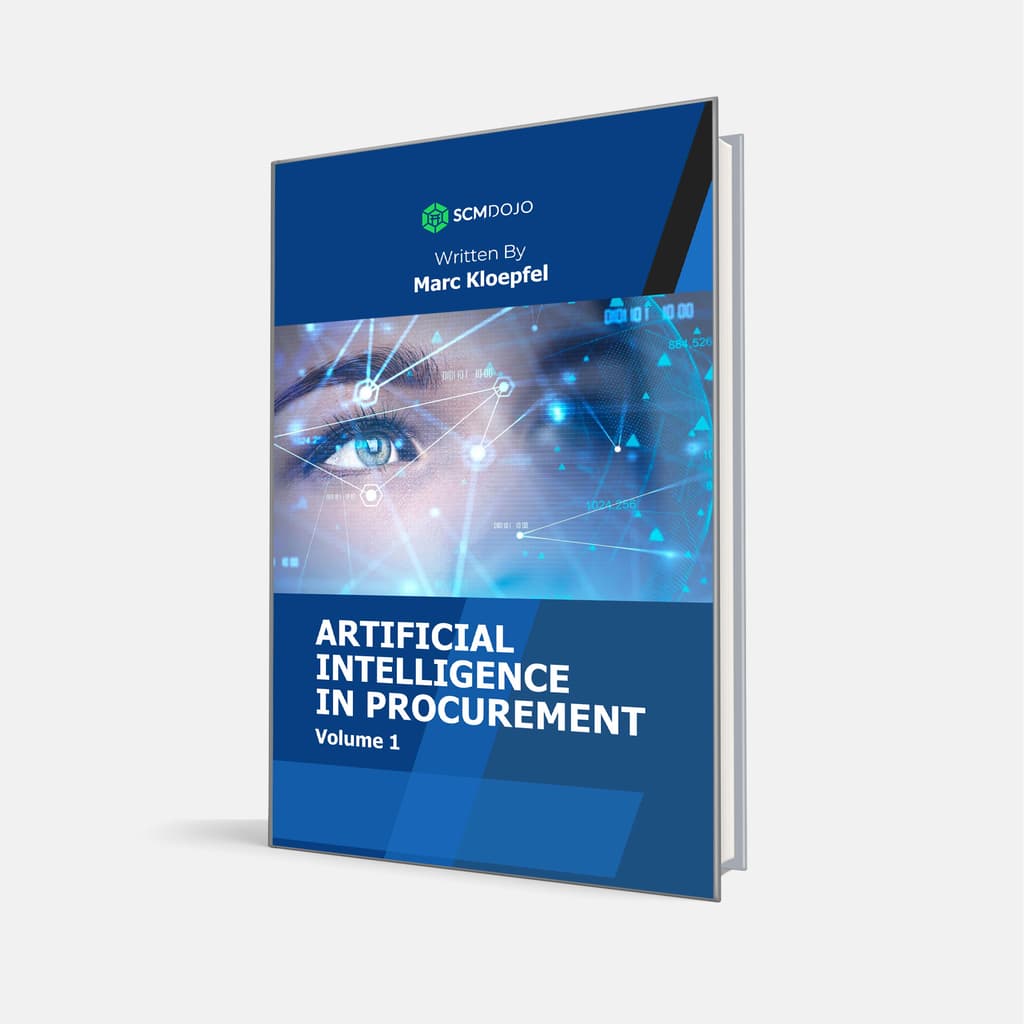
The e-book as delivered, by Marc Kloepfel
Artificial Intelligence in Procurement – Volume 2, intermediatory level. Twelve chapters and 52 pages, delivered as a single PDF.


The second half of the AI story:
integration, evidence and governance.
Continues from Volume 1
Assumes the fundamentals are settled and moves to overcoming challenges, leveraging AI in operations and scaling the integration.
An evidence chapter, not an opinion
Procurement with versus without AI compared directly across the core functions, so the business case can be argued from the book itself.
AI in negotiations
A dedicated chapter on how AI assists procurement negotiations, where preparation and data decide most of the outcome.
Scaled deliberately
The scale of AI integration is treated as a decision with a right answer per function, not a destination to reach as fast as possible.
Legal, ethical and sustainability impacts
Two full chapters on governance and on implementing AI ethically, legally and sustainably, including the ESG dimension of the function.
Tools mapped to functions
AI tools and their use cases organised by procurement function, so selection starts from the requirement rather than the product.
Six moves from insight
to a governed AI-enabled procurement function
Go deeper before you decide anything
Chapters one and two restate the benefits and challenges, so the plan is built on the current state of the function, not on a demo.
Clear the blockers first
Chapter three covers how to overcome AI-related challenges in procurement, which is where most programmes quietly stop.
Leverage AI inside existing operations
Chapter four gives the steps to apply AI to the systems and processes already running, rather than waiting for a new platform.
Compare the function both ways
Chapters five and six examine the core functions transformed by AI and compare procurement with versus without it, to test where the value is real.
Apply it to negotiations and pick the scale
Chapters seven and eight cover how AI assists negotiations and how far integration should go before it starts costing more than it returns.
Implement it under governance
Chapters ten and eleven cover the legal, ethical and sustainability impacts, and how to implement AI against all three requirements.
For the people who have to integrate AI
and then answer for how it was used
Turn AI into cost, agility and advantage
How AI drives cost optimization and competitive advantage, with the legal, ethical and sustainability constraints stated plainly.
Put AI into sourcing, negotiation and spend analysis
The steps to leverage AI in daily operations, and the tools with use cases mapped to each procurement function.
Build the skills the landscape actually needs
Supplier relationships, risk management and strategic sourcing as AI reshapes them, beyond the fundamentals covered in Volume 1.
Connect automation, supplier analytics and ESG
Where procurement automation meets supplier analytics and ESG initiatives, and what integration at scale requires.
The questions that come after
"yes, AI works in procurement"
Volume 1 answers what AI does. Volume 2 answers how to integrate it, how to prove it, and how to govern it once it is running.
Volume 1 covers the functions, AI types, tools and ChatGPT prompts. Volume 2 moves to implementation: overcoming AI-related challenges, the steps to leverage AI in existing operations, the scale of integration, and the legal, ethical and sustainability requirements.
Chapter three addresses the AI-related challenges directly, following chapter two, which recalls the benefits and the challenges so the solutions map onto named problems.
Chapter six compares the two side by side across the core functions covered in chapter five, which is where the business case is either supported or quietly dropped.
Yes. Chapter seven covers negotiations in procurement and how AI can assist them, from preparation and data analysis through to the options available at the table.
Chapter eight treats the scale of AI integration as its own decision, followed by chapter nine, which maps the tools and their use cases to specific procurement functions.
Chapter ten covers the legal, ethical and sustainability impacts, and chapter eleven sets out how to implement AI in procurement ethically, legally and sustainably.
A procurement consultant who has run
over a thousand optimization projects

Before you buy
What exactly is included in this purchase?
The complete e-book, Artificial Intelligence in Procurement – Volume 2, 52 pages across twelve chapters, from the deeper introduction and the challenges through the comparison with and without AI, negotiations, tool use cases and the legal, ethical and sustainability impacts.
What format is the e-book in?
PDF, delivered as a single lightweight downloadable file. It reads on a laptop, tablet or phone, and the chapter structure makes the implementation and governance material easy to return to.
Do I need to read Volume 1 first?
It helps but is not required. Chapter one of Volume 2 goes deeper into AI in procurement and chapter two recalls the benefits and challenges, so the foundations are restated before the implementation material begins.
Is this level suitable for a beginner?
The book is marked intermediatory level on its cover. Readers new to the topic will get most from it after Volume 1, or alongside a structured introduction such as the SCMDOJO procurement track.
Does it cover governance and compliance, not just tools?
Yes, and at length. Chapters ten and eleven cover the legal, ethical and sustainability impacts of AI in procurement and how to implement AI against all three requirements.
Will it help me build a business case for AI?
That is the purpose of chapters five and six, which cover the core functions transformed by AI and compare procurement with versus without it, giving the argument in operational terms rather than as a claim.
What will I receive after purchase?
Instant access to the e-book from your account, plus a download link sent to your email address. Lifetime access, no subscription.


Stop piloting AI in procurement and start governing it.
Get Artificial Intelligence in Procurement – Volume 2 and give your procurement, category and transformation teams the steps to integrate AI into existing operations, the evidence to compare the function with and without it, and the legal, ethical and sustainability framework to implement it properly.
Instant download · PDF · 52 pages · Lifetime access · No subscription


