Stop reading a supplier quote as one number Start Reading the Cost Structure Behind It
Unclear pricing, hidden fees and quotes that feel impossible to compare are the everyday problem in procurement. Decoding Supplier Quotes is the handbook for understanding, analysing and negotiating supplier quotations: how to break down the cost structure, identify the risks buried in a proposal, and negotiate from should-cost evidence rather than from the lowest figure on the page.
Instant download · E-Book (PDF) · 46 pages · Lifetime access

A quoted price is a conclusion.
The negotiation is about the working behind it.
From reviewing a price line to analysing a cost structure
Understanding supplier quotes goes far beyond reviewing a price line. It requires analysing cost structures, identifying hidden charges and validating the assumptions a supplier never wrote down. Two quotes for the same part can carry the same total and completely different economics underneath, and the buyer who compares only totals has no way of knowing which.
Decoding Supplier Quotes starts where the work actually starts: you have received a quotation from a vendor, now what. It sets out the significance of a quote and why it must be understood before negotiation, the drivers of price analysis, the key components of a price breakdown, and the definitions that get used loosely in this function, price analysis, cost breakdown and Total Cost of Ownership.
The middle of the book is the method. The elements of a supplier quote are decoded, the key components dissected, and a list of the potential indicators of hidden costs in a quote is drawn out. Six cost analysis methods follow: comparative market analysis, should-cost analysis, bottom-up estimating, parametric estimating, analysing historical prices by leveraging SAP functionalities, and the evolving market intelligence platforms now used for cost analysis.
It closes on the balance score card of a quote, the instrument that turns all of that analysis into a comparison you can defend in a negotiation and in a file. The result is a 360° view of true cost, not just the quoted one.
Dissect before you negotiate
Learn how to take a supplier quote apart before any negotiation, using comparative analysis, bottom-up costing and historical data.
Find the hidden costs
Spot the cost drivers that inflate total spend and the risks buried inside vendor proposals, while they are still cheap to fix.
Negotiate with evidence
Build leverage from accurate should-cost insight to secure better terms, pricing and value-added benefits, not just a lower number.
Make it repeatable
Streamline quote evaluation with cost analysis methods you can apply again, reducing uncertainty and raising decision confidence.
Forty-six pages, from the moment
the quotation lands to a score card you can defend
Five chapters, following the book's own contents table and page ranges. Chapter three carries the dissection and the hidden-cost indicators, chapter four the six analysis methods, chapter five the score card that makes quotes comparable.
You Received a Quotation from a Supplier, Now What? (pages 2-6)
The significance of a quote and the need to understand it prior to negotiation, the drivers of price analysis, the key components of a price breakdown, and the definitions of price analysis, cost breakdown and Total Cost of Ownership.
Decoding the Code Language of Quotation (pages 7-14)
The elements of the supplier's quote, laid out field by field, so the vocabulary a quotation is written in stops being a black box.
Understanding Supplier Quotes: Dissecting the Components (pages 15-35)
The longest chapter in the book, working through the key components of a supplier quote and how each one is built up.
Hidden Cost Indicators and Best Practices (pages 15-35)
A list of the potential indicators of hidden costs in a supplier quote, followed by the best practices for bringing transparency to the evaluation.
Cost Analysis Methods: Market, Should-Cost, Bottom-Up, Parametric (pages 36-42)
Comparative market analysis, should-cost analysis, bottom-up estimating and parametric estimating, the four methods that answer a quote on its own terms.
Historical Prices in SAP and Market Intelligence Platforms (pages 36-42)
Analysing historical prices by leveraging SAP functionalities, and how evolving market intelligence platforms are now used for cost analysis.
The Balance Score Card of a Quote (pages 43-46)
A score card that turns the analysis into a structured comparison, so quotes are evaluated on the same basis rather than on their totals.
The e-book as delivered, by Ravi Nishant
Decoding Supplier Quotes: A Procurement Guide to Cost Analysis. Five chapters and 46 pages, delivered as a single PDF.
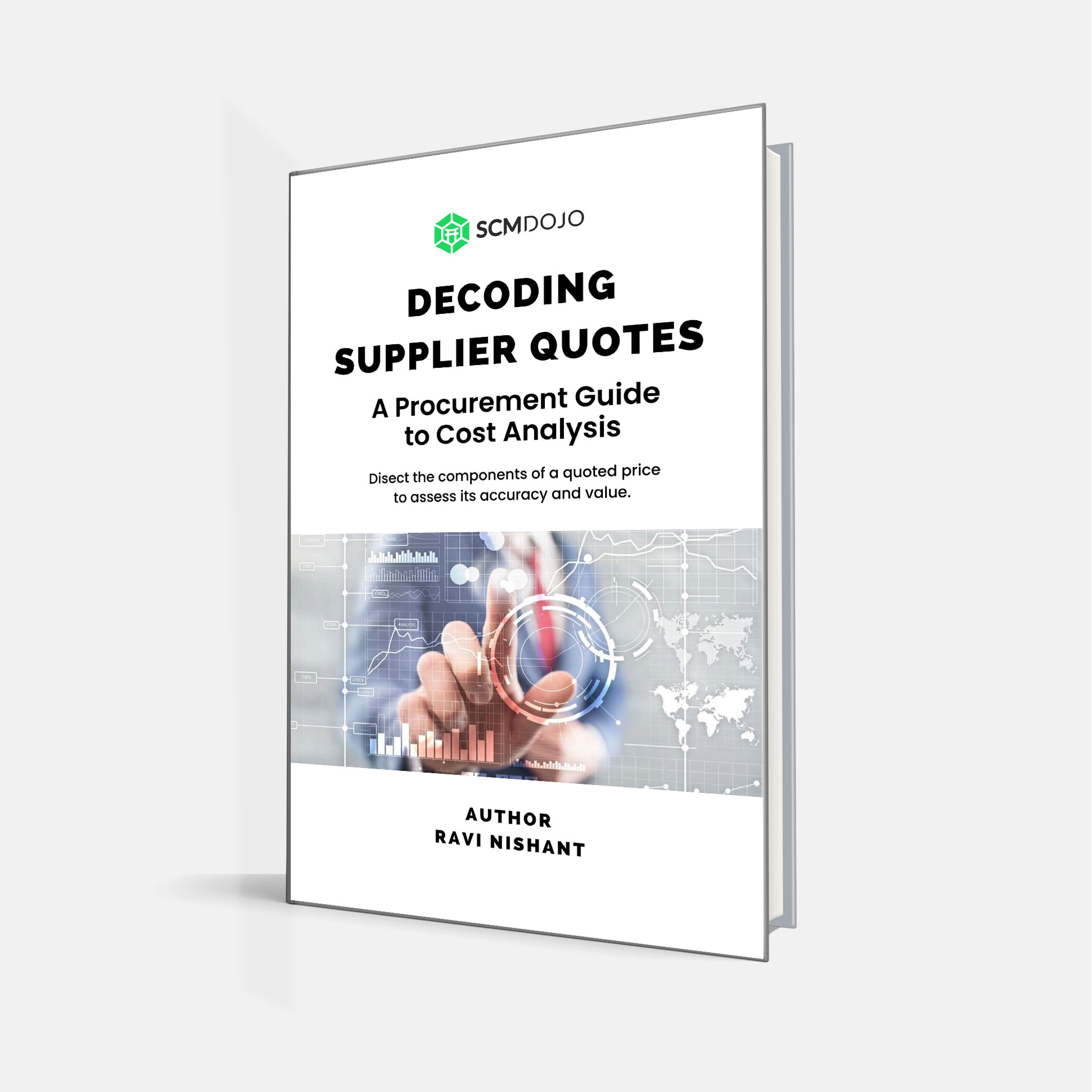

A quote is treated as a cost structure,
not as a number to accept or beat down.
The components of a price breakdown
Key components of a price breakdown are defined before any method is applied, so material, labour, overhead and margin are visible separately.
A named list of hidden-cost indicators
The quote is read against a list of the potential indicators of hidden costs, which is what turns a long chapter into something you can use on Monday.
Six cost analysis methods
Comparative market analysis, should-cost analysis, bottom-up estimating, parametric estimating, historical price analysis in SAP, and market intelligence platforms.
Written around the systems buyers use
Analysing historical prices by leveraging SAP functionalities is covered as its own method, alongside the evolving platforms now used for cost intelligence.
A balance score card for every quote
The closing chapter gives a score card so two differently structured quotes can be compared on the same basis. No more apples-to-oranges comparisons.
Practitioner-written and immediately usable
Written by a procurement and supply chain professional with 17+ years across power, fertiliser, PVC granules and cement, with actionable strategies and worked examples.
Six moves from a quotation on your desk
to a comparison you can defend
Set the quote up before you react to it
Chapter one covers the significance of a quote and the need to understand it prior to negotiation, plus the drivers of price analysis that decide where to spend effort.
Learn the code language
Chapter two decodes the elements of the supplier's quote, so every line, term and exclusion in the document in front of you has a known meaning.
Dissect the components
Chapter three works through the key components of the quote and how they are built up, which is where an unrealistic element becomes visible.
Hunt the hidden costs
Read the same quote against the list of potential indicators of hidden costs, then apply the best practices for gaining transparency before the conversation starts.
Run the method that fits the category
Chapter four gives six cost analysis methods, from comparative market and should-cost analysis to bottom-up and parametric estimating, SAP historical prices and market intelligence platforms.
Score it and compare
Chapter five applies the balance score card of the quote, so the shortlist is decided on the same basis across suppliers rather than on headline price.
For everyone whose decisions start
with a number somebody else wrote down
Enhance your strategic capability
Move from accepting or challenging totals to analysing cost structures, and take should-cost evidence into the negotiation instead of a target price.
Optimise supplier relationships while driving savings
Validate supplier assumptions and identify risks in proposals, so cost conversations strengthen the relationship rather than strain it.
Navigate supplier quotes with confidence
A repeatable way to read a quotation and maximise purchasing power without a procurement team or an analyst behind you.
Learn cost analysis as it is actually practised
Price analysis, cost breakdown, Total Cost of Ownership and the estimating methods used in procurement and supply chain management, defined and applied.
Reduce uncertainty in the decision
Streamline how quotes are evaluated and increase the confidence behind the choice, whichever function the buying decision belongs to.
The questions a quote raises
before anyone reaches the negotiation table
Each of these is addressed by a named chapter, in the order the book works through a quotation.
Chapter one defines both, along with Total Cost of Ownership. Price analysis compares the quoted price itself; cost breakdown goes underneath it to the components the supplier built the price from. The book treats the definitions as the starting point, because the terms get used interchangeably and the methods do not.
Chapter three carries a list of the potential indicators of hidden costs in a supplier quote, followed by the best practices for gaining transparency. Reading a quotation against an explicit list is what catches the charges that never appear as a line item.
Chapter four covers six: comparative market analysis, should-cost analysis, bottom-up estimating, parametric estimating, analysing historical prices by leveraging SAP functionalities, and market intelligence platforms. They answer different questions, and the book sets out which method fits the category and the data you have.
No. SAP appears as one of the six methods, for analysing historical prices by leveraging its functionalities. If your history lives elsewhere, comparative market analysis, should-cost, bottom-up and parametric estimating all stand on their own.
That is the purpose of chapter five, the balance score card of a quote. Once the components have been dissected and analysed, the score card evaluates each quote on the same basis, which is where the apples-to-oranges problem disappears.
The negotiation advantage is the reason the analysis comes first. Chapter one covers the need to understand a quote before negotiating, and accurate should-cost insight is what builds the leverage to secure better terms, pricing and value-added benefits.

Before you buy
What exactly is included in this purchase?
The complete e-book, Decoding Supplier Quotes: A Procurement Guide to Cost Analysis, 46 pages across five chapters, from the significance of a quote and the elements of a supplier quotation through the hidden-cost indicators, the six cost analysis methods and the balance score card of a quote.
What format is the e-book in?
PDF, delivered as a single downloadable file of about 3 MB. It reads on a laptop, tablet or phone, and prints cleanly for the chapter you need at the negotiation table.
Is this about negotiating, or about analysing the quote?
Both, in that order. The book is a cost analysis guide: it works on the quotation before the conversation, because the leverage in a supplier negotiation comes from understanding the cost structure rather than from asking for a lower price.
Will it help me compare quotes from different suppliers?
Yes. Dissecting the components, applying a cost analysis method and then scoring the quote on the balance score card in chapter five is exactly the sequence that makes differently structured quotations comparable.
Is it suitable if I am new to procurement?
It is written to be accessible to all backgrounds and experience levels. Chapter one starts with the definitions, price analysis, cost breakdown and Total Cost of Ownership, before any method is applied.
Does it cover tools and systems, not only theory?
It covers analysing historical prices by leveraging SAP functionalities and the evolving market intelligence platforms used for cost analysis, alongside the four classic estimating methods.
What will I receive after purchase?
Instant access to the e-book from your account, plus a download link sent to your email address. Lifetime access, no subscription.


Stop negotiating against the price line and start negotiating against the cost structure.
Get Decoding Supplier Quotes and give your procurement, sourcing and category teams the components of a price breakdown, the indicators of hidden costs, six cost analysis methods from should-cost to SAP historical price analysis, and a balance score card that finally makes supplier quotes comparable.
Instant download · PDF · 46 pages · Lifetime access · No subscription


