The Cycle Counting Procedure Guide Built the Way Warehouse Teams Actually Work
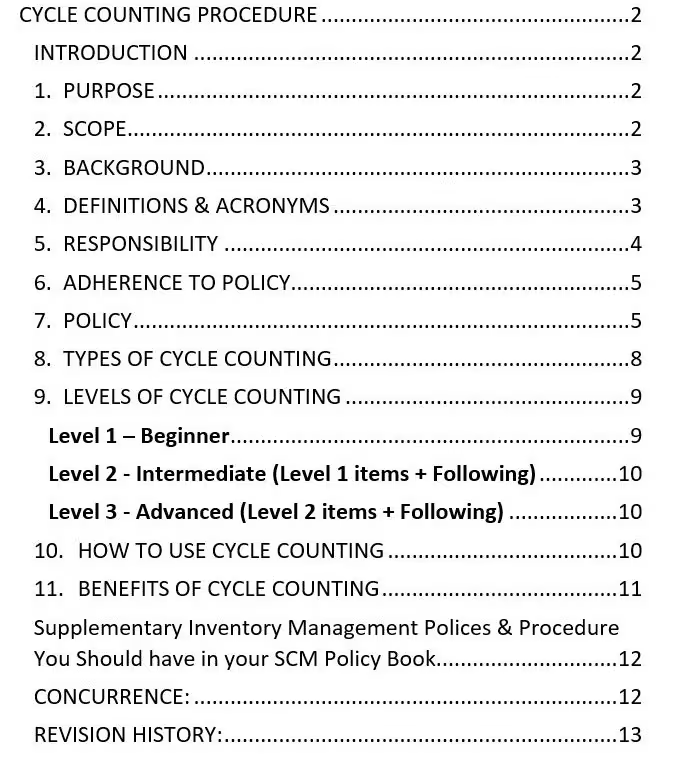
Stop halting operations for a full stocktake every quarter. This 13-page editable procedure guide gives you a structured, audit-ready cycle counting programme, with corrective action steps, item categorisation rules, and a customisable Word template your team can deploy from day one.
Instant download · Word (.docx) & PDF · Fully editable · Lifetime access

Your inventory records are sitting there.
The accuracy isn't.
From stock discrepancies to reliable records, without stopping operations
Every warehouse team deals with inventory discrepancies. Items go missing, quantities drift from the system, and stocktake season brings everything to a halt. The data exists, in your WMS, your ERP, your spreadsheets, but without a structured counting programme, errors compound quietly until they become a real problem.
A good cycle counting procedure replaces the disruptive annual stocktake with a rolling, risk-based approach. High-value and fast-moving items get counted more often. Discrepancies get root-caused and corrected before they cascade into production or customer service failures. Audit readiness becomes a default state, not a panic response.
This guide was built by a practitioner, for practitioners. It gives your team a ready-to-deploy procedure document, structured, editable, and grounded in how real warehouse operations actually run.
What are we counting?
Item categorisation rules define which SKUs get counted, how often, and with what level of scrutiny.
How often do we count?
Frequency schedules by item category keep your most critical stock verified on a rolling basis.
Why is there a discrepancy?
Root cause analysis steps surface the real reason behind count variances so they don't repeat.
Are we audit ready?
Continuously accurate records mean you walk into any audit with confidence, not a scramble.
Every element your inventory team needs, pre-written
Open the Word document, replace the placeholder company name, and adapt the categories to your site. The procedure structure, corrective action framework, and audit guidelines are already written for you.
Programme Objectives & Scope
Clear statement of purpose, scope across sites and business processes, and the governing principles of your cycle counting programme.
Item Categorisation Rules
Framework for classifying items by value, velocity, and risk, so high-priority stock gets counted more frequently than low-risk items.
Counting Frequency Schedule
Pre-defined frequency guidelines by item category. Set daily, weekly, or monthly cycles depending on item criticality and historical accuracy.
Acceptable Loss Criteria
Defined tolerance thresholds for variance. Know exactly when a discrepancy requires escalation versus when it falls within acceptable bounds.
Discrepancy Root Cause Analysis
Step-by-step process for identifying why count variances occurred and documenting the corrective action taken.
Corrective Action Reporting Structure
Ownership assignments and reporting templates so every corrective action has a named owner and a deadline, not just a note in the count sheet.
Audit Readiness Guidelines
Documentation requirements and record-keeping standards that keep your inventory audit-ready as a baseline, not just during audit season.
Customisation Instructions
Clear guidance on adapting the document to your organisation's structure, site names, item taxonomy, and internal terminology.
A procedure guide your team will actually follow
A well-structured cycle counting guide removes ambiguity, your team knows exactly what to count, when, and what to do when something doesn't match.
Designed for warehouse and inventory practitioners.
Not consultants.
Ready-to-edit Word format
The document opens in Microsoft Word. Replace the placeholder text with your company name, site details, and item categories. No specialist software required.
Risk-based item classification
Count your high-value and fast-moving items more often. The guide includes a classification framework so your counting schedule reflects actual inventory risk.
Root cause, not just recount
Most count sheets stop at the variance. This procedure goes further, structured root cause steps identify why the discrepancy happened and what prevents it next time.
No operational downtime
Cycle counting integrates into daily warehouse activity. No production halts, no overtime counting weekends, no shutting down to run a stocktake.
Audit-ready by design
The record-keeping structure and documentation standards in this guide mean your inventory records are defensible at any point, not just after a frantic pre-audit tidy-up.
Multi-site compatible
The procedure is written for deployment across multiple business sites. Customise site names, regional structures, and item categories to match your network.
From download to deployed procedure in four steps
Download & open
Open the Word document. Review the full structure before making any edits.
Customise to your site
Replace company name, site details, item categories, and tolerance thresholds with your own.
Brief your team
Walk warehouse staff through the counting schedule, variance thresholds, and corrective action process.
Run & improve
Start your counting cycles. Use the root cause and corrective action structure to improve accuracy over time.
Built for the people who have to
defend inventory accuracy to operations and finance
Replace ad-hoc counts with a repeatable programme
Stop counting the same items twice and missing others entirely. A structured schedule keeps your team consistent without extra overhead.
Keep records accurate without a full stocktake shutdown
Rolling counts mean you catch discrepancies early. No more year-end surprises when the auditors arrive.
Give production and distribution teams data they can trust
Accurate stock records mean better replenishment decisions and fewer production stoppages caused by phantom inventory.
Deploy a client inventory procedure in hours, not weeks
Hand a client a professional, branded procedure document on day one. Instant credibility, zero writing time.
Every cycle counting question practitioners ask,
answered by a structured procedure
These are the questions warehouse and inventory teams search for, or ask their managers, when trying to get cycle counting right. This guide gives you the procedural structure to answer all of them, inside your own operation.
A cycle counting procedure defines how items are selected, counted, and reconciled on a rotating schedule. It replaces disruptive full stocktakes with continuous, lower-risk inventory verification.
Classify your items by risk and value, set counting frequencies per category, define acceptable loss thresholds, and assign corrective action ownership. This guide walks you through each step.
By catching and root-causing discrepancies frequently, errors stop compounding. Accuracy improves steadily rather than resetting once a year after a full stocktake.
Cycle counting is less disruptive, more frequent, and catches issues earlier. Physical inventory is a one-off snapshot. Most operations benefit from cycle counting as the primary method.
High-value or problem-prone items typically need weekly or even daily counts. The guide provides a frequency framework based on item category and historical accuracy.
Scope, item classification rules, counting frequencies, acceptable loss criteria, discrepancy handling, corrective action ownership, and audit documentation standards. This guide covers all of them.
Built by a practitioner who has lived
the inventory accuracy problem firsthand

Before you buy
What file formats are included?
You receive both a Microsoft Word (.docx) and a PDF. The Word file is fully editable; the PDF is ready to share or print as-is.
Can I adapt this for my organisation's terminology and structure?
Yes. The document is fully unlocked. Replace company names, site references, item category labels, and tolerance values to match your operation.
Is this suitable for multiple warehouse sites?
Yes. The procedure is written for cross-site deployment. Adapt the site names and regional structures to match your network, then distribute a copy per location.
How is this different from a basic cycle count checklist?
A checklist tells you what to count. This procedure tells you how to classify items, set frequencies, handle variances, assign corrective actions, and maintain audit-ready records.
Does the guide cover corrective actions when counts don't match?
Yes. Root cause analysis steps and corrective action reporting templates are included, with guidance on assigning ownership and tracking resolution.
What version of Microsoft Word do I need?
Word 2016 or later (Windows and Mac). Compatible with Microsoft 365. The PDF version works on any device without any software requirement.
How do I receive the file after purchase?
Instant download link after checkout, plus a copy sent to your email. One-time purchase, lifetime access, no subscription.



Stop the stocktake chaos. Build a cycle counting programme that actually works.
Download the SCMDOJO Cycle Counting Procedure Guide and give your team a structured, editable, audit-ready inventory process, today.
Instant download · Word & PDF · Lifetime access · No subscription


