How to Integrate a Warehouse Management System A decision approved on the numbers, not the hunch, from evaluation to the business case
A Warehouse Management System improves operational efficiency, inventory accuracy and workflow standardization, but the hard part is not the software: it is deciding whether your operation needs one, which candidate to evaluate, whether it runs on-premise or as SaaS, and how to get the investment approved. This guide works through each of those in turn, then covers implementation across the three edges of technology, processes and people, and finishes with how to expand the value once it is live. Ten sections, delivered as PDF and editable Word, by José Ambe, CEO of Logística de México (LDM).
Instant download · PDF + Word · Lifetime access

The software is the easy part.
The decision around it is not.
From what a WMS actually does, to the business case that gets it funded
This practical guide explains what a Warehouse Management System is, the benefits of using one, and why integration is essential for modern supply chain operations. Effective integration ensures that digital tools, warehouse processes and people operate in sync, providing real-time visibility and improved warehouse control.
It starts with the question most operations skip. Integrating a WMS enhances control over warehouse activities and ensures accuracy across receiving, storage, picking, packing and shipping, which is what reduces errors, eliminates inefficiencies and accelerates order fulfilment. The guide asks you to establish that need for your own operation before any vendor conversation begins.
The middle of the book is the decision layer: how to evaluate candidate systems, including defining the WMS solutions to be evaluated and gathering internal and external references, then how to compare on-premise against SaaS on five dimensions: adaptation to new technology, personalization capabilities, software update, hardware upgrade and investment.
It then turns to the part that stalls most projects, the approval. A business case is built section by section with expected results, followed by implementation across three edges (technology, processes and people), how to expand the value afterwards through voice picking, courtyard administration, productivity management and business intelligence tools, and three named success stories.
What a WMS changes
Operational efficiency, inventory accuracy and workflow standardization, with control across receiving, storage, picking, packing and shipping.
On-premise vs SaaS
Five dimensions to settle the deployment model: new technology adaptation, personalization, software update, hardware upgrade and investment.
The business case
How to build the case for leadership with expected results, so the strategic and financial impact are both on the table.
Value after go-live
Voice picking, courtyard administration, productivity management and business intelligence tools, the sections that extend a live system.
Ten sections, in the order
the contents table prints them
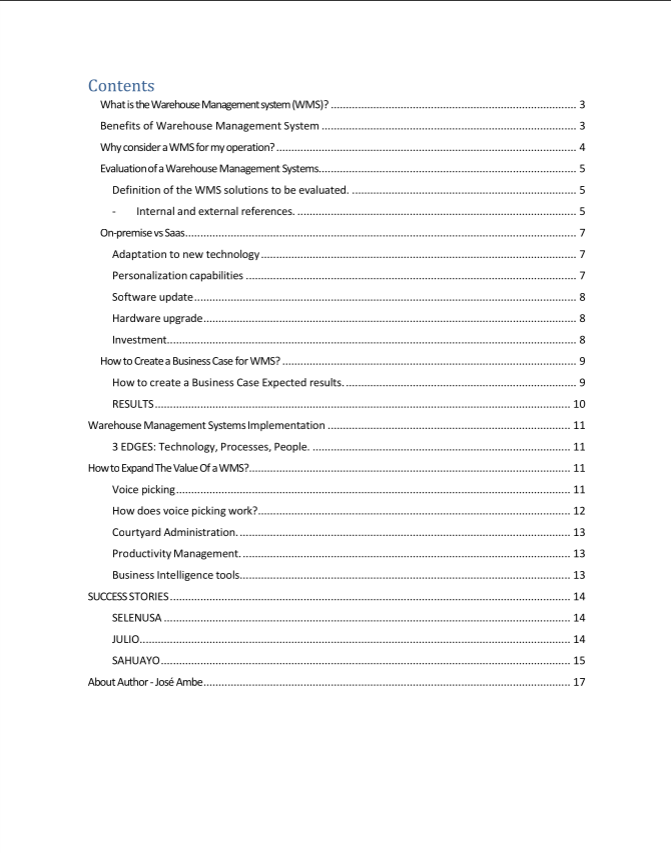
Titles and page numbers as listed in the guide's own contents table, which runs from the WMS definition on page 3 to the author page on page 17. Where a section has sub-topics, the span covers the pages they are printed on.
What is the Warehouse Management system (WMS)? (page 3)
The definition the rest of the guide is built on, and why integration matters for a modern operation.
Benefits of Warehouse Management System (page 3)
Operational efficiency, inventory accuracy and workflow standardization, stated before any product is discussed.
Why consider a WMS for my operation? (page 4)
Control across receiving, storage, picking, packing and shipping, and what a missing WMS costs you in errors and cycle time.
Evaluation of a Warehouse Management Systems (pages 5-6)
Defining the WMS solutions to be evaluated, then internal and external references, both printed on page 5.
On-premise vs Saas (pages 7-8)
Five comparison sections: adaptation to new technology, personalization capabilities, software update, hardware upgrade and investment.
How to Create a Business Case for WMS? (pages 9-10)
Creating the business case with expected results on page 9, and the results section on page 10.
Warehouse Management Systems Implementation (page 11)
Implementation framed as the 3 EDGES: technology, processes and people, aligned rather than run in sequence.
How to Expand The Value Of a WMS? (pages 11-13)
Voice picking and how it works, courtyard administration, productivity management and business intelligence tools.
SUCCESS STORIES (pages 14-16)
Three named implementations: SELENUSA and JULIO on page 14, SAHUAYO on page 15.
About Author - José Ambe (page 17)
The consulting background behind the method, from Logística de México.
The guide as delivered, by José Ambe
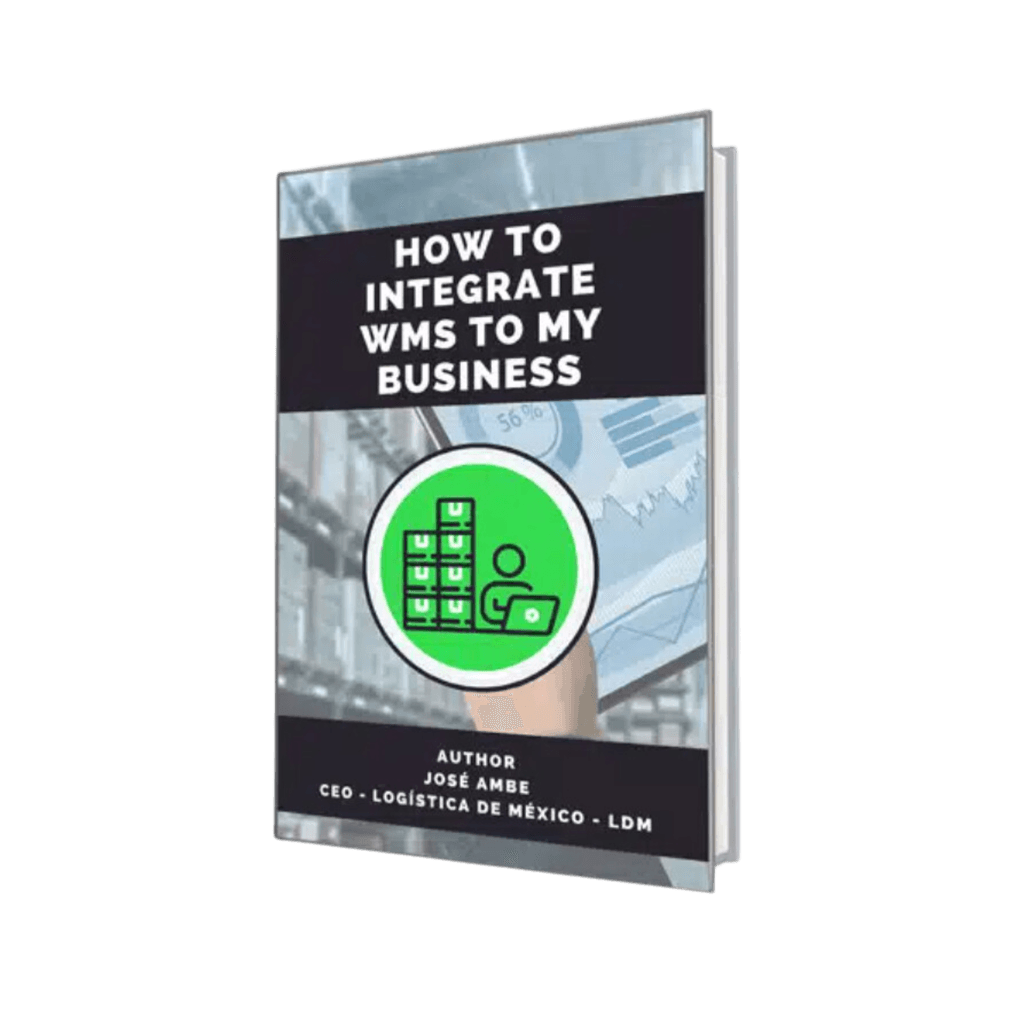
How to Integrate WMS To My Business. Ten sections, delivered as a PDF and an editable Word document.
A WMS guide that spends most of itself
on the decision, not the software.
An evaluation method, not a vendor list
The evaluation section starts by defining the WMS solutions to be evaluated, then gathering internal and external references, both on page 5.
On-premise vs SaaS on five axes
Adaptation to new technology, personalization capabilities, software update, hardware upgrade and investment, each with its own printed section.
A business case built for approval
Pages 9 and 10 cover creating the business case with expected results, so stakeholders see the strategic and the financial impact together.
Implementation on three edges
Technology (configuration, connectivity, testing and IT readiness), processes (workflows reengineered to WMS best practice) and people (training, communication and change adoption).
Value expansion after go-live
Hands-free voice picking and how it works, courtyard administration for inbound and outbound vehicle flows, productivity management and business intelligence tools.
Field results, in two file formats
Three named success stories, SELENUSA, JULIO and SAHUAYO, and the guide delivered as both a PDF and an editable Word document.
Six moves from a warehouse
question to an approved WMS
Establish what a WMS would change for you
Pages 3 and 4 cover the definition, the benefits, and why consider a WMS for my operation, before any system is named.
Screen the candidates deliberately
Pages 5 and 6: define the WMS solutions to be evaluated, then collect internal and external references on the ones still standing.
Settle on-premise or SaaS
Pages 7 and 8 compare the two models across five dimensions, ending with the investment question that decides it.
Write the business case
Pages 9 and 10 take you through creating the case with expected results, the part leadership actually reads.
Implement on all three edges
Page 11: technology, processes and people together, because configuration alone is what makes an implementation stall.
Expand the value, then read the proof
Pages 11 to 13 add voice picking, courtyard administration, productivity management and BI tools; pages 14 to 16 carry the SELENUSA, JULIO and SAHUAYO stories.
For the people who have to
justify a warehouse system
Decide whether your operation needs one
The guide opens on the question you actually have: why consider a WMS for my operation, across receiving, storage, picking, packing and shipping.
Evaluate without being sold to
A defined evaluation method: which solutions to assess, which internal and external references to gather, and how on-premise compares with SaaS.
Put the numbers in front of the decision
Pages 9 and 10 are the business case with expected results, written for the approval step that stalls most WMS projects.
Cover the three edges, then extend the system
Implementation across technology, processes and people, then voice picking, courtyard administration, productivity management and BI tools.
The questions people ask
before a WMS is approved
Asked by the managers, leads and sponsors who have to make the warehouse system decision. Each maps to a section in the guide.
Operational efficiency, inventory accuracy and workflow standardization. With integration done properly, digital tools, warehouse processes and people operate in sync, which is where the real-time visibility and warehouse control come from.
Section three, Why consider a WMS for my operation? on page 4, is built around control across receiving, storage, picking, packing and shipping, and the errors, inefficiencies and fulfilment speed that follow from it.
The guide's evaluation section starts from defining which WMS solutions to evaluate at all, then gathering internal and external references on pages 5 and 6, before any commercial conversation.
Pages 7 and 8 compare them on five printed dimensions: adaptation to new technology, personalization capabilities, software update, hardware upgrade and investment.
Section six, How to Create a Business Case for WMS?, runs from page 9 to page 10 and works through the case with expected results, so the strategic and financial impact are presented together.
The three edges on page 11: technology through configuration, connectivity, testing and IT readiness; processes reengineered to WMS best practice; and people through training, communication and change adoption.

Before you buy
What exactly is included in this purchase?
The complete guide in two files: a PDF and an editable Word document. Together they cover ten sections, from what a WMS is and its benefits, through evaluation, on-premise vs SaaS, the business case, implementation and expanding the value, to three success stories and the author page.
What formats does the guide come in?
A PDF of about 0.8 MB and the same guide as a Word document of about 0.7 MB, 1.5 MB in total. The PDF reads on laptop, tablet or phone with no software required; the Word file is the editable version of the same content.
Is this written for a particular WMS product?
No. The contents table shows where the effort goes: a section on defining the WMS solutions to be evaluated and gathering internal and external references, rather than a walkthrough of one named system.
Does it help with the approval, not just the technology?
Yes, that is the section most readers send to their leadership. Pages 9 and 10 cover how to create a business case for WMS, with expected results and the results section that follows them.
Who is this guide written for?
Warehouse and distribution centre managers deciding whether their operation needs a WMS, supply chain and logistics leads evaluating one, and the people who have to take the investment case to leadership.
How long is the guide?
Ten sections. The contents table runs from the WMS definition on page 3 to the author page on page 17, with the three success stories printed across pages 14 to 16.
What will I receive after purchase?
Instant access to both files from your account, plus a download link sent to your email address. Lifetime access, no subscription.


Stop defending the WMS decisionwith a hunch.
Get the SCMDOJO Warehouse Management System integration guide and put a method behind the decision: what a WMS changes for your operation, how to evaluate and compare on-premise against SaaS, a business case with expected results, and implementation across technology, processes and people.
Instant download · PDF + Word · 10 sections · Lifetime access · No subscription


