The Maritime Freight Sourcing and Procurement Guide Ocean rate bids that should not feel like a guessing game, from your requirements to the awarded tender
Requesting ocean rate bids can often feel like a guessing game, which makes the maritime freight tendering process tedious and time-consuming for shippers. This guide replaces the guesswork with a structured approach: know your own requirements first, then the cargo types and the container types they need, then the commercial side of the market including conference shipping and shipping alliances, and finally tender execution as eight numbered steps from the baseline to awarding the business. Written by Matías Guarello Wilhelmy, who applied these practices as an Export and Import Manager and in high-stakes global freight tender negotiations.
Instant download · Guide (PDF) · 8 chapters · Lifetime access

A freight tender is only as good
as the data you take into it.
From your own requirements, through cargo and equipment, to the awarded business
Maritime freight sourcing and procurement is a best-practices guide for the shipper side of ocean freight. It provides a structured approach for assessing your organisation's ocean freight needs and understanding what to consider throughout the sourcing process, whether you manage global shipping lanes, negotiate with carriers, or run annual tenders.
The starting point is the part most tenders skip. Because most supply chain and logistics professionals have to run these tenders annually, being prepared with the correct data and a well-defined sourcing methodology is what determines the cost, service and operational outcome. Every business has unique freight flows and service expectations, so a one-size-fits-all approach to maritime freight sourcing does not work.
The middle of the book is the market itself. Types of cargoes covers IMO goods, perishable or reefer goods, frozen food goods and liquid goods; type of containers covers standard, high-cube, refrigerated, flat-rack, open-top and tank containers. Commercials and conference shipping then explain the structures behind the rate, including shipping alliances.
The last substantive chapter is the method: tender execution as eight numbered steps, from creating the baseline and the shipment profiles, through the questionnaire, the rate card(s) and the RFQ, to a short(er) list, the impact analysis, and the approvals that award the business.
Know your requirements
Assess your own organisation first: cargo characteristics, lane patterns and commercial requirements, before the market is asked to bid.
Match cargo to equipment
Four cargo types and six container types, so IMO, reefer, frozen and liquid flows are quoted on equipment that can actually carry them.
Read the commercial side
Commercials, conference shipping and shipping alliances: the structures that shape the rate a carrier puts in front of you.
Run the tender
Eight numbered steps: baseline, shipment profiles, questionnaire, rate card(s), RFQ, short(er) list, impact analysis, approvals and award.
Eight chapters, in the order
the contents table prints them
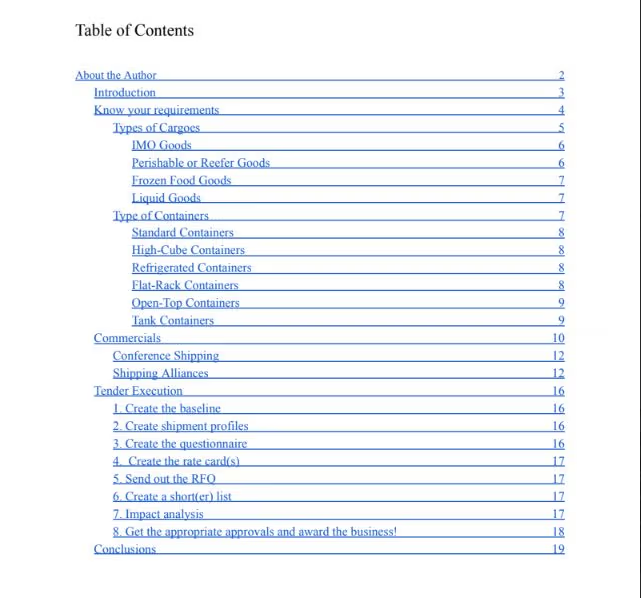
Titles and page numbers as listed in the guide's own contents table, which runs from About the Author on page 2 to Conclusions on page 19. Where a chapter has sub-topics, the span covers the pages they are printed on.
Introduction (page 3)
Why ocean rate bids turn into a guessing game, and what a defined sourcing method changes for the shipper.
Know your requirements (page 4)
The first structural step: assessing your organisation's own ocean freight needs before talking to the market.
Types of Cargoes (pages 5-7)
IMO goods, perishable or reefer goods, frozen food goods and liquid goods — the cargo characteristics that decide who can carry them.
Type of Containers (pages 7-9)
Standard, high-cube, refrigerated, flat-rack, open-top and tank containers, across the six sections the contents table lists.
Commercials (pages 10-11)
The commercial terms underneath an ocean freight rate, sitting between the equipment and the market structures.
Conference Shipping (pages 12-15)
The longest background chapter, and it carries shipping alliances inside it: how carriers organise capacity and pricing.
Tender Execution (pages 16-18)
The method chapter, as eight numbered steps: baseline, shipment profiles, questionnaire, rate card(s), RFQ, short(er) list, impact analysis, approvals and award.
Conclusions (page 19)
What to carry out of the guide and into the next annual tender cycle.
The guide as delivered, by Matías Guarello Wilhelmy
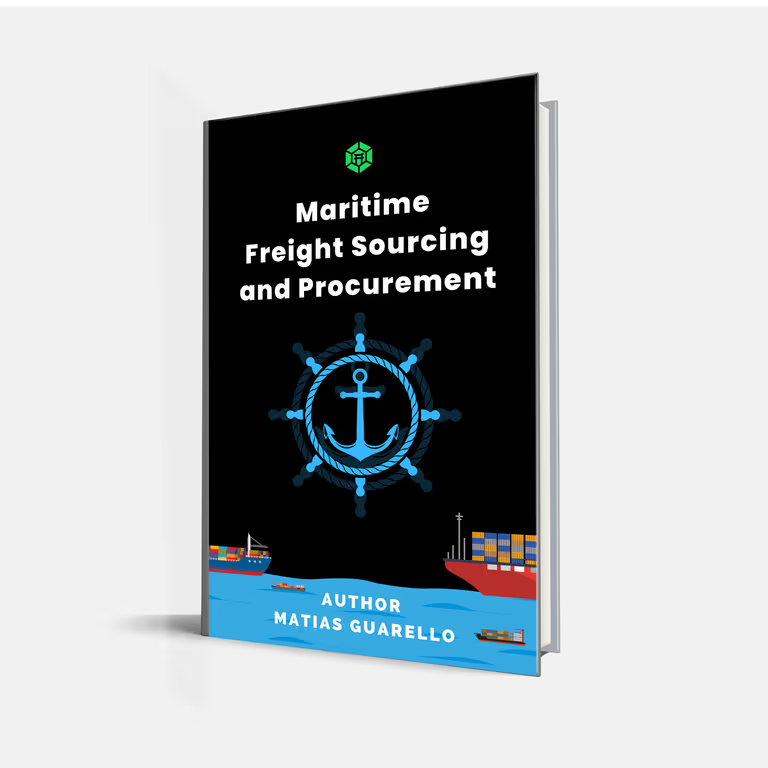
Maritime Freight Sourcing and Procurement. Eight chapters, delivered as a single PDF of about 240 KB.
A sourcing guide that puts the
tender last, not first.
A structured sourcing approach
A step-by-step way to assess your organisation's ocean freight needs and understand what to consider throughout the sourcing process.
Cargo and equipment covered together
IMO, perishable or reefer, frozen food and liquid goods, then standard, high-cube, refrigerated, flat-rack, open-top and tank containers.
How the market is organised
A chapter on commercials and a chapter on conference shipping, which carries shipping alliances inside it: the structures behind the rate you are quoted.
An eight-step tender method
Tender execution is set out as eight numbered steps, from creating the baseline to getting the appropriate approvals and awarding the business.
Written for an annual cycle
Most supply chain and logistics professionals run these tenders annually, so the guide is organised as a repeatable process rather than a one-off answer.
From the negotiating table
The author applied these concepts during his career as an Export and Import Manager, and in high-stakes global freight tender negotiations.
Six moves from your own
freight data to an awarded tender
Assess your own freight before the market
Chapter two, Know your requirements on page 4, is the starting point: your freight flows and service expectations, not a generic rate request.
Classify what you actually ship
Chapter three, Types of Cargoes, pages 5 to 7, separates IMO goods, perishable or reefer goods, frozen food goods and liquid goods.
Put the right equipment on each flow
Chapter four, Type of Containers, pages 7 to 9, covers standard, high-cube, refrigerated, flat-rack, open-top and tank containers.
Understand the commercial structure
Chapters five and six: Commercials from page 10, then Conference Shipping from page 12, including shipping alliances.
Build the tender pack
Steps one to four of chapter seven: create the baseline, create shipment profiles, create the questionnaire and create the rate card(s).
Run the event and award it
Steps five to eight: send out the RFQ, create a short(er) list, run the impact analysis, then get the appropriate approvals and award the business.
For the shipper side of
an ocean freight tender
Get the requirement right before the rate
A structured approach for assessing your organisation's ocean freight needs and understanding what to consider throughout the sourcing process.
Walk in with the market mapped
Commercials, conference shipping and shipping alliances: the structures that decide what a carrier is able to quote you.
Run the event as a repeatable process
Eight numbered steps from the baseline and the shipment profiles through the RFQ and impact analysis to the approvals that award the business.
Cargo characteristics first
IMO, reefer, frozen and liquid flows, and the six container types that carry them, covered before any commercial conversation starts.
The questions shippers ask
before an ocean freight tender
Asked by the people who manage lanes, negotiate with carriers and run the annual tender. Each maps to a chapter in the guide.
Because every business has unique freight flows and service expectations. Chapter two, Know your requirements on page 4, is the guide insisting you assess your own organisation before the market is asked to bid.
Chapter three, Types of Cargoes, pages 5 to 7, covers IMO goods, perishable or reefer goods, frozen food goods and liquid goods as separate cases rather than one generic shipment.
Six of them, each with its own section in chapter four: standard, high-cube, refrigerated, flat-rack, open-top and tank containers, printed across pages 7 to 9.
Chapter six, Conference Shipping, runs from page 12 and carries shipping alliances inside it. It sits between the commercial terms and the tender method, which is where the guide puts the market structure.
Chapter seven, Tender Execution, pages 16 to 18, as eight numbered steps: create the baseline, create shipment profiles, create the questionnaire, create the rate card(s), send out the RFQ, create a short(er) list, run the impact analysis, then get the appropriate approvals and award the business.
Chapter five, Commercials, from page 10, is the guide's answer, and it is placed deliberately before the market structures in chapter six and the tender itself in chapter seven.

Before you buy
What exactly is included in this purchase?
The complete Maritime Freight Sourcing and Procurement guide as a single PDF: know your requirements, types of cargoes, type of containers, commercials, conference shipping including shipping alliances, tender execution in eight steps, conclusions, plus an introduction and the About the Author page.
What format is the guide in?
PDF, delivered as one file of about 240 KB. It reads on a laptop, tablet or phone and needs no special software, so the tender chapter can go to whoever runs the event and the cargo chapters to whoever specifies the lanes.
Is this about ocean freight specifically?
Yes. It is a maritime freight sourcing and procurement guide: cargo types, container types, commercials, conference shipping and shipping alliances, and the tender that puts them all into a rate.
Does it come with a rate card or RFQ template?
No separate files. The tender execution chapter walks through the artefacts you build yourself for your own lanes: the baseline, the shipment profiles, the questionnaire and the rate card(s).
Who is this guide written for?
Shippers who manage global shipping lanes, negotiate with carriers, or run annual freight tenders, and the export and import managers who sit between the cargo and the carrier.
How long is the guide?
Eight chapters. The contents table runs from About the Author on page 2 to Conclusions on page 19, with the eight tender execution steps printed across pages 16 to 18.
What will I receive after purchase?
Instant access to the guide from your account, plus a download link sent to your email address. Lifetime access, no subscription.

Stop treating ocean rate bidsas a guessing game.
Get the SCMDOJO Maritime Freight Sourcing and Procurement guide and put a method behind your next tender: your own requirements first, the cargo and equipment matched, the market structure understood, and the eight steps run in order through to the award.
Instant download · Guide (PDF) · 8 chapters · Lifetime access · No subscription


