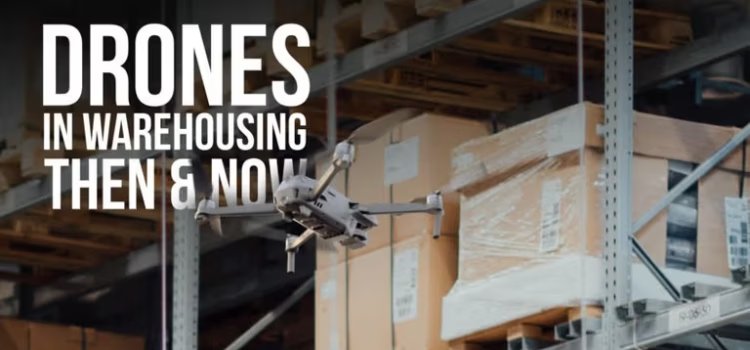
Did You Hear about Drones in Warehousing?
It has now been over a decade since academic researchers, technology startups and even some large companies first started experimenting with drones for indoor applications – particularly in the supply chain industry for use-cases such as locating and counting inventory in warehouses or container trucks in yards, and of course last-mile package delivery. The latter came into public attention around 2015-16 when Walmart & Amazon talked about their in-house drone programs, and their strategic intent to expand drone operations from proof-of-concept projects into worldwide deployments.
Best Warehouse Assessment & Improvement Tool
Much water has flown under the bridge since – with far less traction than the tens of thousands (or even millions!) of drones that were projected to be flying outdoors, making deliveries. Unfortunately, this has resulted in some ‘doom and gloom’ articles that seek to extrapolate the failure of some high-profile drone startups into generic pessimism about the technology and its future. Reality is, of course, far more nuanced – public safety, wind turbine inspection, construction, agriculture and vaccine/medicine delivery are examples where autonomous drones have gained commercial traction.
Similarly, there is one segment of the supply chain industry that is starting to see true business value by deploying drones. Surprisingly, it is the indoor use-cases for UAVs that are gaining commercial traction – not the outdoor ones, as many expected. Regulation no doubt plays an important role in this adoption lifecycle, but so do hardware advances, automation software, operational considerations, and go-to-market strategies.
As these facilities become more automated, integrating digital tools across the entire logistics footprint becomes increasingly important. For instance, a Dock and yard management system can help organizations improve visibility into truck movements, dock scheduling, and yard activities, ensuring smoother coordination between internal warehouse processes and external transportation operations.
Recognizing the opportunity for drones in warehousing, numerous companies have sought to pursue it – not only Silicon Valley startups and university spinoffs, but even those who were offering RFID, WMS or other solutions to the supply chain industry. Many have announced ongoing/successful proof-of-concept projects globally – working in partnership with one or more customers, who tend to be early adopters of warehouse automation in their respective industries.
3 Key Factors Drive the Success of Autonomous Drones in Warehousing
3 key factors drive the success of autonomous drones in Warehousing for inventory management in warehouses, distribution centers, fulfillment centers, air cargo facilities and even retail stores such as warehouse clubs. These are:
- The reliability, stability, scalability and affordability of drone hardware,
- The ability of software to enable fully autonomous indoor navigation and automatic scanning of barcodes, QR codes, alphanumeric labels, RFID tags, etc., and
- The operational, commercial and strategic fit between inventory drone solutions and the ground realities of warehouse inventory management.
Many commercial attempts at offering drone solutions for cycle counting inventory in large warehouses faltered due to the first factor. Given the technical challenges in flying drones in GPS-denied environments, vendors sought to build custom drones with a comprehensive (read: complex and expensive) mix of sensors to help navigate indoors. This, however, resulted in lack of stability, reliability, and scalability not to mention ever-expanding R&D and testing budgets. The earliest adopters of drones in warehouses found that such solutions not only needed significant manual intervention but also were unviable commercially.
The lack of a sharp focus on the day-to-day challenges of inventory stakeholders, combined with the lack of stable navigation and reliable scanning, resulted in incomplete or abandoned PoC deployments. Worse, this made some of the early adopters in the warehousing and logistics industry skeptical of all unmanned aerial vehicle (UAV) technology. Even RFID, a once-promising technology, which at one point did seem relevant for aerial inventory counts, remains to be adopted at scale across the warehouse industry.
Fortunately, warehouse automation is seeing a steady adoption – thanks to the broader adoption of autonomous mobile robots (AMRs) and AI-driven fulfillment use-cases, driven by the increasing velocity of the global supply chain due to e-commerce and a tight labor market. This is accompanied by a resurgence of drone-based inventory counts – the difference being that the latest solutions have addressed the first success factor i.e. they leverage off-the-shelf, cost-effective, reliable hardware that can be quickly scaled to large fleets of autonomous drones.
This has, in part, been driven by the rapid innovations in intelligent automation software i.e. software that enables multiple drones to fly autonomously, hover accurately and land precisely. Computer vision, AI/ML, high-quality video, cloud connectivity, robotics, auto-pilots, and numerous other technical capabilities underpin such world-class software, increasingly deployed using SaaS models.
Yet, there remain few public announcements of large-scale production deployments of autonomous drones in warehouses, DCs, and stores. This is where the third success factor comes in – matching the UAV technology with not only a use case like counting inventory stored in warehouse racks but diving much deeper into operational matters such as:
- Storage methods: How pallets, cartons, and cases are stored on racks.
- Counting frequency: Cycle counting cadences driven by business strategy (e.g., 3PLs vs. BCOs).
- Space optimization: How storage space is maximized using narrow aisles and tall racks.
- Racking configurations: The trade-offs of one-deep versus multi-deep storage setups.
- Label variability: Accommodating a wide variety of barcode sizes, colors, fonts, alignments, and physical conditions.
- Inventory turnover: Adapting to turnover rates based on the facility type (e.g., high-velocity air cargo vs. durable goods).
- Operational windows: The hours available for uninterrupted inventory counts (e.g., 24/7 distribution centers vs. retail stores).
- Drone autonomy: The necessary degree of hardware and software autonomy for tasks like flight, charging, scanning, and mission execution.
and many more.
This operational focus, when aligned with the overall strategic intent of warehouse automation, is what will finally drive and determine the success of drones in warehousing. A leading indicator of enterprise-wide drone deployments in warehouses is the migration of drone program leadership from R&D/innovation teams and digital transformation executives to the GMs of warehouse and VPs of operations & continuous improvement.
Yet another sign of technology maturity will be the involvement of ecosystem players such as supply chain consultants, large IT/ITES companies, WMS vendors, and drone-focused system integrators, in drone deployments.
Like any new technology, drones for industrial applications went through their initial hype cycle between 2013-2018. Today, they have firmly emerged as commercially viable, certainly for indoor (and perhaps soon enough for outdoor) applications in the supply chain industry.

Drones (Cutting-Edge Technology)

References for Drones in Warehousing blog:
● https://www2.isye.gatech.edu/~spyros/courses/IE6202/Fall-2002/Bartholdi-Hackman.pdf
● https://hal-enac.archives-ouvertes.fr/hal-00939230/file/424.pdf
● https://www.sciencedirect.com/science/article/pii/S1474667015349430
●https://www.researchgate.net/publication/325500802_Feasibility_of_Warehouse_Drone_Adoption_and_Implementation
● https://www.businessinsider.in/Walmart-is-developing-a-drone/articleshow/52560301.cms
● https://www.theverge.com/2015/6/3/8719659/amazon-prime-air-drone-delivery-profit-free-shipping-small-items
●http://www.cs.cornell.edu/~asaxena/MAV/saxena_MAV_perspectivecues_stairs.pdf
● https://flytware.com/blog/digital-warehouse-transformation/
● https://www.logisticsbureau.com/spotlight-on-the-10-most-common-pallet-racking-systems/
● https://www.gartner.com/en/documents/3947400/hype-cycle-for-drones-and-mobile-robots-2019
FAQs
Why are indoor warehouse drones gaining more commercial traction than outdoor delivery drones?
While outdoor retail delivery drones faced complex regulatory hurdles, public safety concerns, and unpredictable environmental conditions, indoor environments are highly controlled. In warehouses, distribution centers, and yards, autonomous drones provide immediate, measurable business value by automating tedious tasks like tracking, scanning, and locating inventory without the need for strict outdoor airspace approvals.
What are the three key factors driving the success of autonomous drones in warehousing?
The commercial viability of modern warehouse drones relies on three foundational pillars:
- Hardware Maturity: The shift toward cost-effective, highly reliable, and scalable off-the-shelf drone hardware rather than over-engineered, expensive custom models.
- Intelligent Software Integration: Advanced AI, computer vision, and machine learning software that enables automated, precise indoor navigation in GPS-denied environments alongside automatic barcode, QR code, and RFID scanning.
- Operational Alignment: A deep strategic fit between unmanned aerial vehicle (UAV) technology and the ground realities of day-to-day warehouse operations.
Why did early attempts at deploying inventory drones in warehouses fail? Early drone initiatives often faltered because vendors focused on building overly complex, expensive custom hardware with excessive sensor payloads to navigate indoor spaces without GPS. This lack of hardware stability and affordability, combined with insufficient focus on the practical operational constraints of inventory managers, led to high R&D costs and abandoned proof-of-concept projects.
What operational realities must a warehouse consider before deploying a drone program?
Successful drone integration requires matching the technology to a facility’s specific operational environment, including:
- Storage and Racking Configurations: Adapting to how pallets or cases are stacked, whether in deep or narrow aisles, and managing vertical rack height.
- Label Variability: Ensuring the drone’s computer vision can read a wide array of barcode fonts, colors, alignments, and physical conditions.
- Operational Windows and Turnover: Planning flight schedules around high-velocity inventory turnover rates and facility operating hours (e.g., 24/7 fulfillment centers vs. standard retail spaces).
- Autonomy Levels: Determining the necessary hardware and software capability for automated charging, mission planning, and data synchronization.
What indicates that warehouse drone technology has moved past the initial industry hype?
The strongest indicator of technology maturity is organizational leadership migration. Instead of being managed strictly by digital innovation or R&D teams, warehouse drone programs are increasingly led by General Managers of Warehouses and VPs of Operations & Continuous Improvement. Furthermore, the active involvement of ecosystem players like WMS vendors, supply chain consultants, and system integrators confirms that indoor UAVs are now a commercially viable reality.
About the Author- Dr Muddassir Ahmed
Dr. Muddassir Ahmed is a globally recognized supply chain expert, thought leader, and keynote speaker. As the Founder & CEO of SCMDOJO, he has built one of the world’s leading platforms dedicated to empowering supply chain professionals with cutting-edge knowledge, practical tools, and access to expert insights. With over 19 years of leadership experience spanning the UK, Europe, the Middle East, and Southeast Asia, Dr. Ahmed has held key roles at Bridgestone, Doncasters Group, Eaton, and Volvo Cars, managing multi-million-dollar supply chain operations.
His expertise spans all facets of supply chain management, with a particular focus on leveraging technology and innovation to optimize processes and build resilient supply chains.
Recognized among the Top 10 Supply Chain Influencers in the World by Supply Chain Digital, Dr. Ahmed has been instrumental in shaping industry best practices through his extensive research, vlogs, and thought leadership. Holding a PhD in Management Science from Lancaster University Management School, he is also a certified Six Sigma Black Belt.
His platform, SCMDOJO, serves a vibrant community with over 51,000 monthly visitors. Moreover, he has 72,000 newsletter subscribers, and a social media following exceeding 105,000 supply chain professionals
A sought-after keynote speaker and thought leader, sharing his insights on industry trends, best practices, and the future of supply chain management. Dr. Ahmed delivers high-impact talks on supply chain excellence, digital transformation, and strategic leadership. His mission is clear: to help supply chains thrive
You can follow him on LinkedIn, Facebook, Twitter