Open Source ERP or Purpose-Built ERP for Manufacturers?
Margin compression, demand volatility, labor shortages, customer compliance obligations, traceability expectations, and a steady drumbeat of AI promises: that’s the backdrop against which manufacturers now choose enterprise software. Picking a platform is an operational design decision, not just a purchase order for accounting tools.
Open-source platforms promise lower initial costs and broad configuration options, while purpose-built manufacturing systems promise faster implementation and less operational friction. Choose the wrong approach, and it shows up in delivery reliability, quality escapes, inventory accuracy, and your project budget.

Why This ERP Debate Matters More in 2026
Enterprise Software Is Expanding Deeper Into the Shop Floor
ERP vendors are moving well beyond finance and simple order entry. Modern platforms are expanding aggressively into manufacturing execution, quality management, purchasing, warehouse traceability, and supply chain collaboration tools.
Recent software updates across the industry feature embedded in-process inspections, license plate numbering (LPN), AP automation, OCR document handling, and AI-assisted batch rescheduling to capture plant knowledge before experienced workers retire. Enterprise software now overlaps heavily with warehouse control and procurement intelligence, requiring supply chain leaders to evaluate platforms through a much wider operational lens.
AI Has Raised the Stakes, But Data Quality Still Decides the Value
Poor data doesn’t get fixed by automation; it gets magnified. Industry observers repeatedly point out that ERP data quality issues hold back AI readiness across the manufacturing sector.
Automation projects succeed or fail at the system level because that is where demand, materials, production, cost, and quality intersect. A noticeable gap remains between polished vendor demos and the daily grind of the plant floor. No algorithm will paper over weak routing logic, shaky inventory accuracy, or fragmented quality records.
Open Source ERP and Purpose-Built ERP Solve Different Problems
What Open-Source / Modular ERP Means in Manufacturing
Open-source options are typically broad business platforms with modular architectures and lower initial entry costs. Operational flexibility comes from community apps, partner extensions, and custom development rather than rigid, predefined workflows. Ecosystems like Odoo fit this description, serving companies across many industries at varying levels of operational complexity.
What Purpose-Built Manufacturing ERP Means
These platforms are designed specifically for manufacturing from the start not general accounting software bolted onto a factory floor afterward. Material Requirements Planning (MRP), complex routings, traceability, embedded quality controls, WIP visibility, and finite scheduling come natively. Implementation teams spend less time stitching disparate modules together because the software assumes a shop floor exists from day one.
The Real Difference Is Operating Model Fit
Open-source systems tend to fit organizations with strong internal technical teams and an appetite to build custom workflows. Purpose-built systems tend to fit teams that prioritize manufacturing depth, implementation predictability, and a lighter long-term IT burden.
ERP Selection Fit
| Open-Source / Modular ERP | Purpose-Built ERP |
| • High internal IT capability
• Simple/Standard processes • Appetite for custom code |
• Operational depth priority
• Complex BOMs & Routings • Low tolerance for custom software maintenance |
Gauge your internal technical maturity honestly before committing to a platform that requires heavy programming to run effectively.
💡 Recommended SCM DOJO Guide: Enterprise software architecture directly shapes working capital and inventory health. Read our deep-dive on Proven Inventory Reduction Strategies to see how planning accuracy prevents excess stock build-up across complex supply chains.
Side-by-Side Comparison: Open Source vs. Purpose-Built ERP
| Evaluation Area | Open Source / Modular ERP | Purpose-Built Manufacturing ERP
|
| Core Design | Broad business platform with configurable modules | Manufacturing-first platform designed around plant workflows |
| Entry Cost | Lower initial software/licensing sticker price | Higher headline subscription or licensing cost |
| MRP Depth | Varies widely by edition, module, and customization | Strong out of the box for complex manufacturing |
| Multi-Level BOMs & Routings | Supported, but deep complexity requires configuration | Native and production-oriented |
| Finite Scheduling | Often limited without third-party add-ons | Built natively into planning logic |
| QMS & Quality | Often a separate app or custom module | Combined with operations and lot/serial genealogy |
| Traceability | Depends heavily on initial design and setup | Built for lot/serial tracking and compliance audits |
| Implementation Effort | Lower for simple processes; high for complex plants | More predictable if manufacturing fit is strong |
| Internal IT Dependency | High over time as custom code accumulates | Lower, as vendor maintains core manufacturing features |
| Best Fit | Simpler operations + strong internal IT team | Growing complexity + desire for fast deployment |

The 6 Questions That Should Drive Your ERP Decision
A tidy feature checklist rarely tells the whole story. Good operational questions force software vendors to demonstrate real capability instead of showing a polished executive dashboard.
1. How deep is your MRP requirement?
Can the system handle material offsets, shortages, pegging logic, and purchasing signals reliably without buckling under load? Missing components halt production lines and strain supplier relationships fast. Confirm that raw material lead times map correctly to production schedules so you avoid costly stockouts.
2. How complex are your BOMs and routings?
Multi-level BOMs, co-products, revisions, alternate components, engineering changes, subcontract steps, and rework paths ramp up system demands quickly. Planners need accurate BOMs to calculate costs, order parts, and issue work instructions without patching things by spreadsheet. Check how the software handles engineering change orders (ECOs) so the floor always builds the correct product revision.
3. Do you need finite scheduling or just order prioritization?
Plenty of companies say they need advanced scheduling when what they really want is a simple dispatch list for machine operators. Others genuinely need machine-, labor-, and material-constrained planning to hit strict customer deadlines and dodge financial penalties. Knowing whether your shop floor needs finite capacity constraints or simple priority sequencing narrows your shortlist quickly.
⏱️ Essential Reading: Constrained scheduling and accurate MRP logic directly govern plant throughput. Read SCM DOJO’s comprehensive guide on Lead Time: Definition, Calculation, and How to Reduce It to see how floor scheduling impacts on-time delivery.
4. How embedded must quality and traceability be?
Ask whether quality lives as a side module or as a required gate during receiving, in-process checks, and nonconformance tracking. A recent Pulse of Quality survey found 71% of organizations plan to increase quality investment, driven by tight compliance rules and labor shortages. Bake these controls into the core workflow so operators cannot skip inspections during a hectic shift.
5. What implementation risk can your business absorb?
Every deployment carries risk, but a manufacturing facility pays a steep price if production stalls mid-transition. Benchmark data shows that only 49% of ERP implementation projects are completed on time, while 64% experience budget overruns, primarily due to scope expansion and underestimated staffing. A system with predefined manufacturing workflows lowers the odds of major delays.
6. Who will own the system after go-live?
Industry data indicates that 73% of discrete manufacturing ERP projects fail to meet their primary objectives, frequently because long-term operational ownership was thin. Complex custom configurations demand constant upkeep, especially when third-party extensions break during upgrades. If your facility lacks a dedicated development team, a heavily customized architecture can quickly turn into an operational liability.
Total Cost of Ownership: Looking Beyond the Sticker Price
Licensing typically accounts for only 20% to 30% of the total five-year cost of an ERP system. The remaining 70% to 80% is tied up in implementation, customization, testing, internal labor, and ongoing maintenance.
Key Takeaway: Open-source platforms may offer lower upfront license fees, but heavy custom development can quickly erode those savings. Purpose-built manufacturing platforms often justify their higher headline software cost through faster implementation, lower IT overhead, and reduced operational friction.
📊 Related SCM DOJO Article: Evaluating software TCO goes far beyond headline software license fees. Read Financial Supply Chain Management Explained to understand how software architecture decisions influence long-term capital efficiency and operating cash flow.
Where a Manufacturing-Native ERP Changes the Equation
Single-System Architecture vs. Custom Integrations
Some manufacturing-native platforms combine enterprise planning, shop-floor execution, warehouse control, and quality management inside a single environment. This reduces reliance on outside developers and avoids version conflicts during upgrades. A unified database tracks materials from purchasing to final dispatch without requiring a fragile web of custom API connections.
For teams actively weighing modular platforms against manufacturing-native alternatives, reviewing a direct operational comparison like OnRamp vs Odoo provides a practical example of how implementation burden, planning depth, quality tracking, and long-term support model can diverge.
What to Look for in a Native Platform
- Built-in MRP & Capacity Planning: Native handling of complex constraints without third-party add-ons.
- Integrated Quality & Traceability: Direct links between receiving, shop-floor operations, and lot genealogy.
- Unified Data Model: Finance, inventory, and production sitting in one database to eliminate month-end spreadsheet reconciliations.
A Practical Shortlist Strategy for Supply Chain Leaders
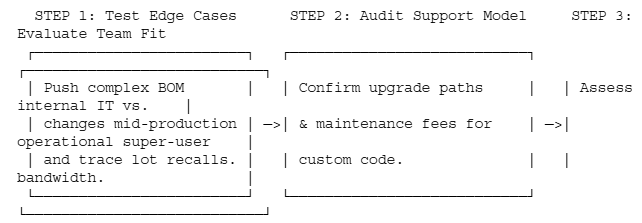
- Run evaluations using real production scenarios: Don’t accept standard sales demos on clean sample data. Push a revision-controlled multi-level BOM change mid-production, simulate a critical component shortage, or trigger a supplier quality hold to see how the system reschedules work.
- Test the post-go-live support model early: Ask vendors who maintain custom logic after go-live what breaks during updates and how scheduling exceptions are handled when operators deviate from the master plan.
- Align software with your team’s capability: Platforms requiring extensive coding demand a strong, dedicated IT department. Purpose-built systems rely more on operational super-users. Pick the model that fits your actual workforce structure.

Final Thoughts: Choose the ERP Your Plant Can Run Sustainably
The best manufacturing software isn’t the one with the longest feature list or the lowest upfront price tag. It is the platform that supports your BOM complexity, planning discipline, quality requirements, and traceability obligations without turning your team into a permanent software development team.
Choosing a platform that respects your shop-floor reality will save far more money over time than any aggressively negotiated software discount.
Manufacturing ERP FAQs
What is the main difference between an open-source/modular ERP and a purpose-built manufacturing ERP?
An open-source or modular ERP (like Odoo) is a broad business platform that uses add-on modules and custom code to handle shop-floor tasks. A purpose-built manufacturing ERP (like OnRamp or SYSPRO) is designed specifically for manufacturing from day one, with tools like multi-level BOMs, Material Requirements Planning (MRP), finite scheduling, and quality controls built natively into the core software.
Why are open-source ERP systems often cheaper up front but more expensive long-term?
Open-source ERPs typically have very low upfront software licensing fees. However, because deep manufacturing processes (like complex routings, lot traceability, or finite capacity planning) require custom code and third-party extensions, long-term costs add up through developer fees, custom integration maintenance, and broken code during version updates.
What are the key signs that my plant needs a purpose-built manufacturing ERP?
You likely need a purpose-built ERP if your plant manages:
- Multi-level Bill of Materials (BOMs) and frequent Engineering Change Orders (ECOs).
- Strict quality control, compliance standards, or end-to-end lot/serial traceability.
- Machine-, labor-, and tooling-constrained production scheduling.
- A lean internal IT team that cannot spend time writing or maintaining custom code.
What is the difference between simple order prioritization and finite scheduling?
Simple order prioritization creates a basic dispatch list showing operators which jobs to work on next. Finite capacity scheduling is a dynamic calculation that plans production based on real-world constraints such as machine availability, specialized operator shifts, raw material lead times, and available tooling preventing shop-floor bottlenecks and establishing accurate delivery dates.
How much of an ERP’s total cost comes from the software license itself?
Software licenses typically account for only 20% to 30% of an ERP’s total five-year cost of ownership. The remaining 70% to 80% is tied up in implementation consulting, data migration, custom development, staff training, ongoing maintenance, and internal labor.