Dig deeper, pay less: Activity Based Costing in Procurement Uncover the hidden costs your spend data already contains
Traditional costing tells you what you paid. Activity Based Costing tells you what the process cost to run: which procurement activities consume money, where the hidden and indirect costs sit, and what a purchase decision actually costs. This guide applies the ABC methodology directly to procurement operations, from the introduction and the activity drivers through implementation inside your process, to using the output for strategic decisions. Seventeen pages, five chapters, by Ravi Nishant.
Instant download · E-Book (PDF) · 17 pages · Lifetime access

Your spend report knows what you paid.
It does not know what it cost to get it.
From the price on the invoice to the activities that generate it
Cost drivers are hard to see when the number on the invoice is the only number anyone looks at. Activity Based Costing changes the unit of analysis: instead of asking what a purchase cost, it asks which activities had to happen to make that purchase, and what each of them costs to run.
That shift is what exposes the hidden and indirect costs a procurement process carries, and what makes a saving measurable at activity level rather than estimated at category level. The stated purpose of this guide is clear visibility into every cost driver in your procurement process, so decisions are made on reliable cost data instead of on the price line alone.
It is procurement-specific by design. Chapter one introduces ABC, chapter two covers procurement activities and their drivers, and chapter three, the longest in the book, works through implementing ABC inside the procurement process itself rather than in a costing model that never sees a purchase order.
The final chapters turn the output into decisions and direction: chapter four uses ABC for strategic procurement decisions, chapter five concludes and looks at the future of ABC in procurement. Frameworks, examples and practical techniques carry the method, so it can be applied from day one.
Reveal hidden costs
Identify cost drivers across the supply chain, and the hidden or indirect costs a traditional cost view leaves out.
Streamline the process
Transparent cost structures show which procurement steps are worth the effort they cost, and where resources should go.
Decide on true cost
Spend decisions aligned with organizational priorities, grounded in activity-level cost visibility rather than quoted price.
One shared cost view
Procurement, finance and operations reading the same numbers, which is what turns a cost debate into a data-driven discussion.
Five chapters, seventeen pages,
from the method to the decision
The chapter list and page ranges exactly as printed in the book's own contents table. Chapter one and two build the model, three implements it, four and five use it.
Introduction to Activity-Based Costing (ABC) (pages 1-2)
What ABC is and how it differs from the costing view a procurement team normally works from.
Understanding Procurement Activities and Drivers (pages 3-5)
The activities a procurement process runs and the cost drivers behind them, the layer where hidden costs become visible.
Implementing ABC in Procurement Process (pages 6-12)
The longest chapter in the book: standing ABC up inside the procurement process, with the frameworks and examples to do it.
Utilizing ABC for Strategic Procurement Decisions (pages 13-15)
Using the cost visibility to make decisions: aligning spend with organizational priorities and allocating resources deliberately.
Conclusion and Future of ABC in Procurement (pages 16-17)
What has been established, and where activity-based costing inside procurement is heading next.
The e-book as delivered, by Ravi Nishant
Master Activity Based Costing (ABC) in Procurement. Five chapters and 17 pages, delivered as a single PDF.
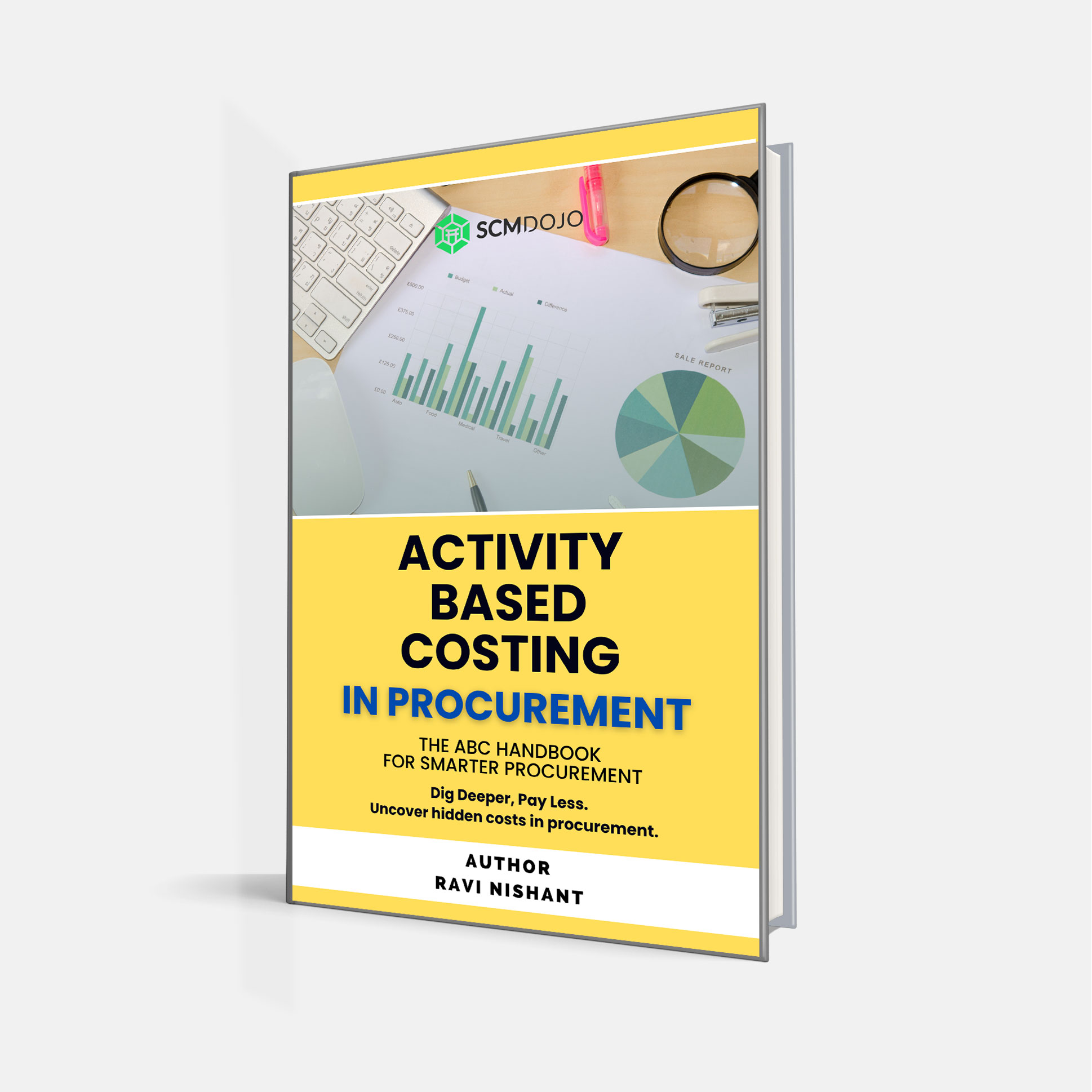

A costing method applied
to procurement, not to a factory.
Procurement-specific, not generic
The full ABC methodology applied directly to procurement operations, rather than a general costing explanation adapted afterwards.
Step-by-step implementation
Chapter three spends seven pages on implementing ABC in the procurement process, with frameworks and examples that show how it is done.
Activity-level financial insight
Savings are located at the activity that causes the cost, which is the only level at which an accurate number can actually be acted on.
Real-world examples
How ABC is used in supply chain organizations to improve savings, accuracy and operational performance, drawn from practical experience.
Cross-functional by construction
Creates a shared view of costs across procurement, finance and operations, so priorities are argued from the same data set.
Usable from day one
Seventeen pages written so the techniques can be applied immediately to uncover savings and improve decision quality.
Five moves from the method
to procurement decisions built on it
Understand what ABC measures
Chapter one (pages 1-2) introduces Activity Based Costing and how it differs from the costing view you already report from.
Name your activities and their drivers
Chapter two (pages 3-5) covers procurement activities and drivers, the layer where hidden and indirect costs stop being invisible.
Implement it inside your process
Chapter three (pages 6-12) is the longest in the book: standing ABC up in the procurement process itself, step by step.
Turn the output into decisions
Chapter four (pages 13-15) uses ABC for strategic procurement decisions, aligning spend with organizational priorities.
Give the team one shared cost view
Use the activity-level numbers as the common reference between procurement, finance and operations, so the conversation is about trade-offs rather than about whose figures are right.
Built for the people accountable
for procurement cost, not only for price
Find the savings the price list hides
Cost drivers across the process, so the reduction plan targets the activities that generate the cost rather than the supplier with the lowest quote.
Give the numbers a structure
Reliable cost data and a transparent cost structure to build analysis on, instead of reconciling totals that cannot be decomposed.
Negotiate from true cost
Activity-level insight into what a category costs to run, which is a stronger position than an opinion about the quoted price.
Extend visibility past the purchase order
How cost drivers operate across the supply chain, and how to allocate resources strategically for greater operational impact.
The questions people ask before
applying ABC to procurement
Procurement managers, analysts, sourcing professionals and supply chain specialists ask these about activity-based costing. Each maps to a chapter in the guide.
A costing approach that assigns cost to the activities a procurement process performs, rather than only to the goods bought. Chapter one introduces the method and chapter two applies it to procurement activities and their drivers.
By identifying the cost drivers across the supply chain and making indirect and hidden costs visible at activity level, where they can be eliminated. That accurate, activity-level view is what turns a savings estimate into a savings plan.
Chapter three, the longest in the book at seven pages, covers implementation step by step, with the frameworks and examples that show how ABC is stood up inside procurement operations.
Chapter four covers using ABC for strategic procurement decisions: building strategy on true cost visibility, aligning spend decisions with organizational priorities, and allocating resources where they have operational impact.
Yes. A shared view of costs across procurement, finance and operations is one of the stated benefits, which is what enables data-driven discussion and alignment on priorities instead of competing numbers.
It is written around practical tools and techniques: frameworks, worked examples and how ABC is used in real supply chain organizations to improve savings, accuracy and operational performance.
Seventeen years of sourcing and contracting
for power, fertiliser, PVC and cement plants

Before you buy
What exactly is included in this purchase?
The complete e-book, Master Activity Based Costing (ABC) in Procurement, 17 pages across five chapters: the introduction to ABC, procurement activities and drivers, implementing ABC in the procurement process, using ABC for strategic procurement decisions, and the conclusion and future of ABC in procurement.
What format is the e-book in?
PDF, delivered as a single lightweight file of about 1.4 MB. It reads on a laptop, tablet or phone, needs no special software, and the chapter structure makes the implementation chapter easy to return to while you work.
Do I need a finance or accounting background?
No. Chapter one introduces Activity Based Costing before any of it is applied, and the method is then worked through in procurement terms: activities, cost drivers and the process you already run.
How is ABC different from traditional costing?
Traditional costing reports what was paid. ABC assigns cost to the activities that had to happen to make the purchase, which is what exposes the hidden and indirect costs and lets a saving be measured at activity level.
Who is this e-book written for?
Procurement managers, procurement analysts, sourcing professionals and supply chain specialists who want to optimize procurement efficiency and master cost control.
How long is the e-book?
Seventeen pages, five chapters, written to be read in one sitting and then applied to your own cost data.
What will I receive after purchase?
Instant access to the e-book from your account, plus a download link sent to your email address. Lifetime access, no subscription.


Stop counting what you paid.
Get the SCMDOJO guide to Activity Based Costing in Procurement and put a cost structure behind every activity your team performs, from the first purchase requisition to the renewal decision.
Instant download · E-Book (PDF) · 17 pages · Lifetime access · No subscription


