What three decades of supply chain research tells us about absorptive capacity, learning alignment, knowledge integration and Supplier Innovation in Supply Chain and what it means for procurement leaders today.
The $64 Billion Question No One Is Asking in Procurement
Every CPO wants innovative suppliers. It appears in every category strategy. It features in every supplier scorecard. And yet, study after study, including three peer-reviewed papers I have been analysing this week shows that most manufacturers and procurement organisations capture only a fraction of the innovation value their suppliers are actually capable of delivering.
Why? The short answer: we are selecting for the wrong things, structuring the relationship in the wrong way, and almost never building the internal capabilities needed to absorb what suppliers know.
This piece synthesises three landmark academic papers into a practical framework for supply chain and procurement leaders. If you want your supply base to be a genuine source of competitive advantage, not just a cost variable, this is the thinking you need.
Quick Summary of Article Supplier innovation benefits manufacturers in two ways: directly (embedded components improve product performance) and indirectly (knowledge transfers improve internal capabilities). However, the indirect pathway only activates when the buying firm has adequate absorptive capacity, aligned learning styles with its suppliers, and strong internal knowledge integration capabilities specifically proficiency in supplier management and cross-functional decision-making. Without these conditions, supplier innovativeness remains latent value on the table. |
Part 1: The Two Pathways of Supplier Innovation Value
Let us start with the foundational model from Azadegan, Dooley, Carter and Carter (2008), published in the Journal of Supply Chain Management. Their conceptual insight is deceptively simple but strategically profound.
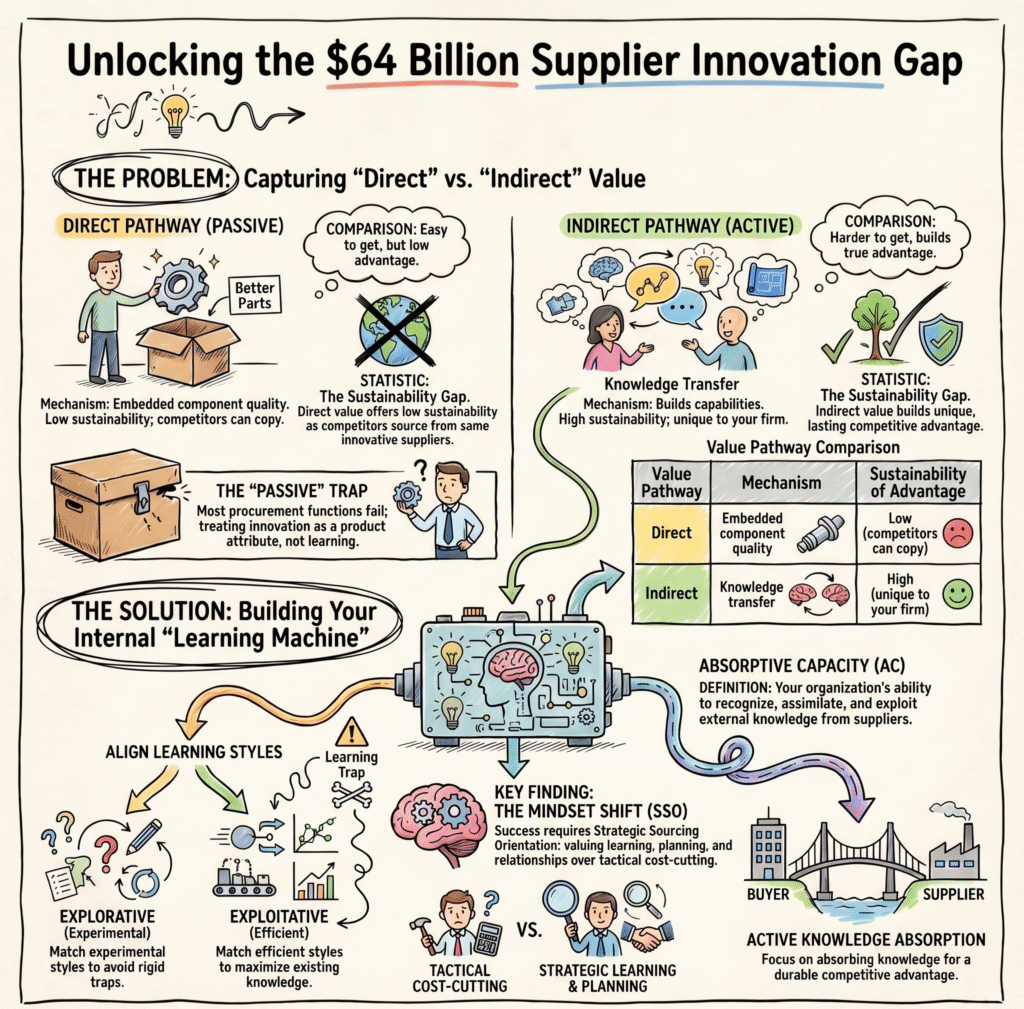
Direct vs. Indirect Effects
When you source a component from an innovative supplier, you get two types of value:
• Direct value – the component itself is better. If a supplier innovates in materials science, your product benefits because the part is embedded in it. You do not need to do anything clever to capture this.
• Indirect value – the supplier’s knowledge transfers to you through organisational learning. If your people interact with that supplier’s engineers, attend their process reviews, or participate in joint development, your internal capabilities improve. You get smarter, faster, more capable.
The direct pathway is passive. The indirect pathway requires deliberate action. And it is the indirect pathway that creates durable competitive advantage.
Here is where most procurement functions fall short: they are exceptionally good at capturing direct value (selecting better components) but almost entirely passive about capturing indirect value (absorbing the supplier’s knowledge). They treat supplier innovation as a product attribute rather than a learning opportunity.
Value Pathway | Mechanism | Procurement Action Required | Sustainability of Advantage |
Direct | Embedded component quality | Good supplier selection | Low — competitors can source the same supplier |
Indirect | Interorganisational knowledge transfer | High — requires absorptive capacity & relationship design | High — your capabilities are unique and non-imitable |
Table 1: Direct vs. Indirect Supplier Innovation Value Pathways (adapted from Azadegan et al., 2008)
Part 2: Why Your Organisation Cannot Learn From Innovative Suppliers (Yet)
The Absorptive Capacity Problem
Cohen and Levinthal’s concept of absorptive capacity (AC) the ability to recognise, assimilate, and exploit external knowledge is central here. Azadegan et al. (2008) argue convincingly that AC is the primary moderator of the supplier innovativeness → performance link.
In plain language: a highly innovative supplier is worth very little to you if your organisation cannot understand what they know, integrate it into your processes, or apply it to new problems.
AC is built on four underlying mechanisms:
- Related prior knowledge – organisational memory, experience, and collective insight that allows you to interpret new information in context
- Communication climate – a culture that rewards external dialogue, risk-taking, and cross-functional knowledge sharing
- Communication network – structural connections (both internal and external) that route information to the right people
- Scanning mechanisms – systematic tools (market tracking, benchmarking) that identify and capture relevant external knowledge early
The Procter & Gamble example from the research is instructive: P&G deployed 70 technology entrepreneurs who did nothing but identify, organise, and connect external product innovations to internal needs. That is absorptive capacity institutionalised. Most procurement organisations have none of this.
|
Part 3: Learning Style Alignment — The Most Overlooked Variable in Supplier Selection
Exploration vs. Exploitation: March’s Framework Applied to SCM
The second major insight from Azadegan et al. draws on James March’s (1991) exploration/exploitation framework, arguably the most influential concept in organisational learning theory, and applies it to buyer-supplier dyads.
- Explorative organisations seek new possibilities through experimentation, radical thinking, and risk-taking. Their R&D intensity is high; their tolerance for uncertainty is high. Sun Microsystems is the canonical example.
- Exploitative organisations focus on improving existing processes through incremental gains, efficiency, quality, and delivery reliability. Dell’s historical operating model is the textbook case.
The research proposes a nuanced, counterintuitive set of recommendations depending on what you are actually outsourcing:
When Outsourcing Tangible Resources (Manufacturing, Assembly, Components)
Here, the risk is learning traps, excessive similarity in learning style creates rigidities. The prescription: seek complementary learning styles.
- Explorative manufacturer + Exploitative supplier = High performance (Sun + Benchmark Electronics)
- Exploitative manufacturer + Explorative supplier = High performance (Dell + Mitac)
- Like-with-like (explorative + explorative or exploitative + exploitative) = Risk of rigidity and underperformance
When Outsourcing Intangible Resources (Design, R&D, Intellectual Services)
Here, the risk is erosion of exploration complex intangible work requires sustained investment in new thinking, which tends to atrophy over time. The prescription: always prefer an explorative supplier.
- Both explorative and exploitative manufacturers benefit from explorative suppliers in knowledge-intensive outsourcing
- Dell + EMC (storage system design) and Sun + Imation (tape cartridge development) are both examples of exploitative and explorative manufacturers pairing with explorative suppliers to unlock intangible value.
Outsourcing Type | Manufacturer Type | Optimal Supplier Type | Risk if Mismatched | Industry Example |
Tangible (Mfg/Assembly) | Explorative | Exploitative | Learning trap – both over-experiment, no discipline | Sun + Benchmark Electronics ✓ |
Tangible (Mfg/Assembly) | Exploitative | Explorative | Success trap -both optimise, no novelty | Dell + Mitac ✓ |
Intangible (Design/R&D) | Explorative | Explorative | Erosion of exploration without buffer | Sun + Imation ✓ |
Intangible (Design/R&D) | Exploitative | Explorative | Need explorative supplier to compensate for gap | Dell + EMC ✓ |
Table 2: Learning Style Alignment Matrix (adapted from Azadegan et al., 2008)
The practical implication is significant: learning style should be an explicit supplier selection criterion – particularly for strategic and bottleneck categories in your Kraljic matrix. You are not just buying capability; you are buying a learning relationship.
Part 4: Strategic Sourcing Orientation — The Managerial Mindset That Makes It All Work
What Eltantawy, Giunipero & Handfield (2014) Add to the Picture
The second paper published in the International Journal of Physical Distribution & Logistics Management shifts focus from the supplier relationship to the mindset of the sourcing manager. The authors identify and empirically validate a higher-order construct they call Strategic Sourcing Orientation (SSO).
SSO is defined as a management philosophy that recognises the importance of identifying and meeting the needs and goals of strategic sourcing. It is built on four first-order dimensions:
SSO Dimension | Definition | Procurement Implication | Path Coefficient to SSO |
Learning Orientation | The degree to which the sourcing unit values learning as core to long-term improvement | Invest in capability development; treat category knowledge as a strategic asset | 0.71 |
Performance Orientation | The degree to which sourcing demonstrates and proves its competence and value-add to the firm | Build robust value demonstration frameworks; link sourcing KPIs to firm P&L | 0.80 |
Planning Orientation | The degree to which strategic planning tools and analytical skills guide sourcing decisions | Move from reactive procurement to scenario-based category strategy | 0.98 |
Relational-Process Orientation | The degree to which sourcing systematically manages and structures supplier relationships | Invest in SRM programmes; track relationship health, not just price | 0.94 |
Table 3: Strategic Sourcing Orientation (SSO) Dimensions and Path Coefficients (Eltantawy et al., 2014)
The structural equation model from this study tells a clear performance story:
- SSO → SS Reputation (path coefficient: 0.89, R² = 79%)
- SS Reputation → Supplier Management (path coefficient: 0.95, R² = 91%)
- Supplier Management → Profitability Performance (path coefficient: 0.71, R² = 51%)
In plain language: sourcing teams with the right mindset are perceived as strategic contributors, which gives them access to better resources, which improves how they manage suppliers, which improves firm profitability. The effect is strong and the research is rigorous.
The Hard Truth A Deloitte Consulting study cited in this research found that 44% of firms did not realise expected sourcing cost savings. The authors argue this is largely a mindset failure — not a process or technology failure. Most sourcing professionals are still operating from a tactical, goods-dominant logic when they need to be operating from a value co-creation, service-dominant logic. |
Part 5: Knowledge Integration — Turning Supplier Innovation into Firm Performance
Bengtsson, Lakemond & Dabhilkar (2013) — The Internal Capabilities Imperative
The third paper, from the International Journal of Technology Management, provides the empirical verification that internal capabilities are the mechanism through which supplier innovativeness translates to firm performance. Based on a survey of 681 firms across Europe and North America, the findings are unambiguous.
What the Data Shows
- Innovative suppliers (unique assets + network relationships) have a statistically significant direct effect on innovation performance time-to-market and level of innovation (H1 supported, β = 0.225, p<0.001)
- Proficiency in supplier management NPD involvement, supplier evaluation, supplier development has a direct and leveraging effect on innovation performance (H2a and H3a supported)
- Cross-functional decision-making on supplier integration becomes significant as a moderating variable under high technological uncertainty (H3b supported only in high-uncertainty conditions)
- When technological uncertainty is high, all effects strengthen substantially the adjusted R² jumps from 8.0% to 17.9% (Table 4 in the paper)
Hypothesis | Variable | All Firms (β) | Low Uncertainty (β) | High Uncertainty (β) | Significance |
H1 | Supplier Innovativeness → Innovation Performance | 0.225 | 0.145 | 0.322 | p<0.001 |
H2a | Supplier Mgmt Proficiency → Innovation Performance | 0.148 | 0.032 | 0.222 | p<0.01 |
H2b | Cross-Functional Decisions → Innovation Performance | 0.001 | -0.018 | 0.040 | n.s. |
H3a (interaction) | Supplier Innov. × Supplier Mgmt Proficiency | 0.135 | 0.088 | 0.146 | p<0.05 |
H3b (interaction) | Supplier Innov. × Cross-Functional Decisions | 0.086 | 0.033 | 0.152 | p<0.05 (high unc. only) |
Table 4: Regression Results — Innovation Performance as Dependent Variable (adapted from Bengtsson et al., 2013)
Two Counterintuitive Findings Worth Noting
The Bengtsson et al. study also surfaced two results that deserve attention from practitioners:
- Higher purchasing share (as % of sales) negatively correlates with innovation performance under high uncertainty. The interpretation: heavy outsourcing, without maintained internal technical competence, hollows out your ability to integrate external knowledge. You cannot absorb what you no longer understand.
- Longer supplier relationships negatively correlate with innovation performance under high uncertainty. Stability brings comfort, but comfort reduces knowledge diversity. For categories requiring radical innovation, you need the creative friction of new supplier relationships not the comfort of long-established ones.
Part 6: Seven Actions for Procurement Leaders
Theory is useful. Application is the point. Here is what this research compels you to do differently:
# | Action | Research Basis | Priority |
1 | Add ‘learning style’ to your supplier selection criteria. Specifically: is this supplier explorative or exploitative? Does that complement or supplement your own organisation’s dominant mode? | Azadegan et al. (2008) | High |
2 | Audit your absorptive capacity across 4 dimensions: prior knowledge depth, communication climate, internal network connectivity, and scanning mechanisms. Identify the weakest link. | Azadegan et al. (2008) | High |
3 | Build dedicated knowledge capture routines into every major supplier interaction — site visits, RFPs, QBRs, joint NPD sessions. Treat these as learning events, not just transactional touchpoints. | Bengtsson et al. (2013) | High |
4 | Assess your SSO across all four dimensions (learning, performance, planning, relational-process). Use the validated framework from Eltantawy et al. to identify where your team’s mindset is weakest. | Eltantawy et al. (2014) | Medium |
5 | For high-uncertainty categories: form cross-functional supplier management teams (Procurement + R&D + Operations). Cross-functionality only becomes critical under technological uncertainty — that is exactly where it matters most. | Bengtsson et al. (2013) | High |
6 | Resist the temptation to lock in long relationships for innovation-critical categories. Intentionally rotate or expand your supply base to maintain knowledge diversity and avoid innovation stagnation. | Bengtsson et al. (2013) | Medium |
7 | Maintain internal technical competence even as you outsource. Heavy outsourcing without parallel investment in internal capability creates knowledge hollowing — you lose the ability to understand, integrate, or leverage what your suppliers know. | Bengtsson et al. (2013); Azadegan et al. (2008) | High |
Table 5: Seven Practical Actions for Procurement Leaders
What This Means for Where Procurement Learning Needs to Go
I founded SCMDOJO on a specific conviction: the supply chain and procurement profession is being systematically underdeveloped relative to its strategic importance. The research I have reviewed here reinforces that conviction sharply.
The capability gap this research identifies is not about knowing more supplier management processes. It is about building the organisational infrastructure for learning absorptive capacity, cross-functional collaboration, scanning mechanisms, relational orientation and operating from a fundamentally different managerial mindset (SSO).
The firms that will win in the next decade of supply chain competition are not the ones who find the most innovative suppliers. They are the ones who build the internal machinery to capture, integrate, and apply what those suppliers know.
That is a learning and capability development challenge at its core. And it is one our community of 300,000+ supply chain professionals at SCMDOJO is uniquely positioned to address.
Frequently Asked Questions (People Also Ask)
Q: What is supplier innovativeness in supply chain management?
Supplier innovativeness refers to the capability of a supplier to create innovations in products, processes, markets, or business models that can enhance the performance of their buying firm. It is distinct from the buyer’s own innovation capability and is particularly valuable when the buying firm has adequate absorptive capacity to capture and apply the supplier’s knowledge.
Q: How does absorptive capacity affect supplier relationships?
Absorptive capacity (AC) determines how much value a buying firm can extract from an innovative supplier. Firms with high AC built through related prior knowledge, open communication cultures, strong networks, and scanning mechanisms are better able to identify, understand, and apply supplier knowledge. Without AC, even the most innovative supplier delivers only direct component-level benefits, and the more valuable indirect learning effects are lost.
Q: What is strategic sourcing orientation (SSO)?
Strategic Sourcing Orientation is a management philosophy encompassing four dimensions: learning orientation, performance orientation, planning orientation, and relational-process orientation. Research by Eltantawy, Giunipero and Handfield (2014) shows SSO acts as the foundational mindset that elevates procurement’s internal reputation, improves supplier management practices, and ultimately drives profitability performance.
Q: Should I choose an explorative or exploitative supplier?
It depends on what you are outsourcing. When outsourcing tangible resources (manufacturing, assembly), choose a supplier whose learning style complements yours if you are explorative, choose exploitative, and vice versa. When outsourcing intangible resources (design, R&D, intellectual services), always prefer an explorative supplier regardless of your own organisation’s dominant learning mode.
Q: How does technological uncertainty affect supplier collaboration?
Under high technological uncertainty, the value of internal knowledge integration capabilities specifically supplier management proficiency and cross-functional decision-making is amplified. Firms with these capabilities benefit significantly more from innovative suppliers when dealing with complex, uncertain categories. Under low uncertainty, these effects are weaker and less critical to performance outcomes.
Conclusion
Three decades of supply chain research, synthesised here, converge on a single uncomfortable truth: most firms are leaving most of the value from their innovative suppliers on the table.
The fix is neither exotic nor expensive. It requires building absorptive capacity systematically, selecting suppliers based on learning style alignment rather than price alone, developing internal knowledge integration capabilities, and instilling a strategic sourcing mindset that treats supplier relationships as value co-creation partnerships.
The supply chain organisations that take this seriously in the next three to five years will build competitive advantages that their peers will spend decades trying to replicate. The ones that do not will remain in the cycle of cost negotiation, viewing their supply base as a cost lever rather than an innovation engine.
The research is clear. The choice is ours.
References
Bengtsson, L., Lakemond, N. and Dabhilkar, M. (2013) ‘Exploiting supplier innovativeness through knowledge integration’, International Journal of Technology Management, Vol. 61, Nos. 3/4, pp. 237–253.
Cohen, W.M. and Levinthal, D.A. (1994) ‘Fortune favors the prepared firm’, Management Science, Vol. 40, No. 2, pp. 227–251.
Eltantawy, R., Giunipero, L. and Handfield, R. (2014) ‘Strategic sourcing management’s mindset: strategic sourcing orientation and its implications’, International Journal of Physical Distribution & Logistics Management, Vol. 44, No. 10, pp. 768–795.
March, J.G. (1991) ‘Exploration and exploitation in organizational learning’, Organization Science, Vol. 2, No. 1, pp. 71–88.
Zahra, S.A. and George, G. (2002) ‘Absorptive capacity: a review, reconceptualization, and extension’, Academy of Management Review, Vol. 32, No. 3, pp. 185–203.
About the Author- Dr. Muddassir Ahmed
Dr. Muddassir Ahmed is a globally recognized supply chain expert, thought leader, and keynote speaker. As the Founder & CEO of SCMDOJO, he has built one of the world’s leading platforms dedicated to empowering supply chain professionals with cutting-edge knowledge, practical tools, and access to expert insights. With over 19 years of leadership experience spanning the UK, Europe, the Middle East, and Southeast Asia, Dr. Ahmed has held key roles at Bridgestone, Doncasters Group, Eaton, and Volvo Cars, managing multi-million-dollar supply chain operations.
His expertise spans all facets of supply chain management, with a particular focus on leveraging technology and innovation to optimize processes and build resilient supply chains.
Recognized among the Top 10 Supply Chain Influencers in the World by Supply Chain Digital, Dr. Ahmed has been instrumental in shaping industry best practices through his extensive research, vlogs, and thought leadership. Holding a PhD in Management Science from Lancaster University Management School, he is also a certified Six Sigma Black Belt.
His platform, SCMDOJO, serves a vibrant community with over 51,000 monthly visitors. Moreover, he has 72,000 newsletter subscribers, and a social media following exceeding 105,000 supply chain professionals
A sought-after keynote speaker and thought leader, sharing his insights on industry trends, best practices, and the future of supply chain management. Dr. Ahmed delivers high-impact talks on supply chain excellence, digital transformation, and strategic leadership. His mission is clear: to help supply chains thrive
You can follow him on LinkedIn, Facebook, Twitter