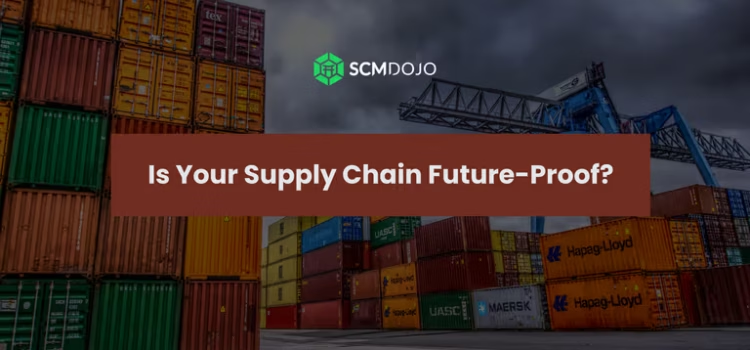
The last few years have been brutal for supply chain management. Remember when $5.2 billion worth of cargo was stuck in West Coast ports in 2023, thanks to labor contract talks dragging on and other bureaucratic snafus. (1) The result? Big delays and traffic jams at important supply chain and transportation centers across the country.
That’s the thing about supply chains as we know them today. One week, everything seems fine. Then, the next week, something happens at a key supply point somewhere and knocks your operations off balance.
And it’s not just you alone. Research cited by IT Supply Chain revealed that up to 90% of businesses suffer from supply chain disruptions. (2) These are not just numbers. These are wake-up calls.
To develop a stronger, disruption-ready organization, the Mastering Supply Chain Resilience course from SCMDOJO provides proven tools to boost agility and preparedness.

But what can you do about it? In fact, is your supply chain management strategy ready for the next unexpected event? Or are you just hoping that 2026 will be better than 2023?
Whether you’re a manufacturer, distributor, retailer, or fleet owner, it’s important that you take steps to ensure that your supply chain is resilient enough to handle whatever is thrown at it.
How to Future-Proof Your Supply Chain
Future-proofing is a word that gets thrown around a lot, but for businesses that rely on the supply chain, it’s not just a buzzword. It means having a competitive advantage and surviving in the midst of unpredictability.
So, how do you future-proof your supply chain? Let’s explore three effective strategies.
For businesses looking to build a long-term, future-ready roadmap, SCMDOJO’s How to Create a Supply Chain Strategy course offers step-by-step guidance for designing a competitive, resilient supply chain.

Embrace Digital Transformation
It all starts here. Incidentally, digital transformation is another word that gets thrown around a lot, but when it comes to the supply chain, this can be the backbone of your entire future-ready operation.
The goal of digital transformation isn’t to have the shiny new software or the most advanced equipment. It’s for you to have the ability to see, understand, and act faster than you could before. So, what exactly does digital transformation entail for your supply chain strategy?
For a structured, practical guide on digital transformation, SCMDOJO’s Supply Chain Digitalization Course helps you understand digitization, automation, and the technologies needed to build a modern, future-proof supply chain.

1. AI and Predictive Analytics
Artificial intelligence is a key component of any digital transformation project.
AI can analyze massive datasets historic sales, weather forecasts, geopolitical news, and social media trends in real-time. It spots patterns a human team would never see, giving you actionable insights to predict, to a large extent, what the coming weeks and months will look like.
But that’s not all. What about your processes? AI can help with that, too. In fact, experts believe that GenAI can speed up the supply chain documentation process by up to 60 percent. That means you can get more done in less time.
2. IoT for Real-Time Visibility
Investing in the Internet of Things (IoT) gives you real-time visibility into every key aspect of your logistics operation. Put an IoT sensor in a shipping container, and you’ll know exactly where it is at every point in time. That’s in addition to vital metrics like temperature, humidity, and more.
Mind you, the advantage goes beyond simply knowing where your shipment is. Companies using real-time tracking can run their supply chain and deliveries more smoothly.
Think about it: If you always know where your shipment is and what’s happening to it, you can fix problems early and make smart decisions about routes and schedules. This kind of proactiveness can save you a lot of money in the long run.
If you want to deepen your understanding of real-time tracking, control towers, and transparency, SCMDOJO’s Supply Chain Visibility Fundamentals course is an excellent next step.

3. Automation for Speed and Accuracy
When you’re doing your digital transformation to future-proof your supply chain, don’t forget automation. And no, this is not just about robots lifting things in the warehouse or conveyor belts that never get tired.
It’s also about the behind-the-scenes business processes. Things like automatic inventory updates, real-time stock alerts, invoice processing, order verification, and all those details that usually eat up time.
The goal here is to reduce human error to the barest minimum while keeping everything accurate and moving smoothly.
Invest in Workforce Development
Here’s the thing about technology. It’s only as effective as the people running it. This means that it may not be enough to invest in digital transformation; you also have to empower your team with the skills to manage your new tech. Here’s how:
1. Provide Digital Supply Chain Skills
You can’t just roll out new AI tools and expect everyone to automatically know how to use them. You have to train them for it.
This means training your analysts to use your new AI tools, teaching your warehouse managers to interpret IoT dashboards, and helping your back-office team grasp the fine details of business process automation. In other words, build digital supply chain skills across the board.
2. Upskill and Cross-Train Your Team
Now, let’s say everyone knows their tools. That’s great. But what happens when one key person is off for a week? Should everything come to a standstill? This is where upskilling and cross-training come in.
It’s not enough to just teach people what they need to function in their roles. Why not take things a step further? Hand-pick fast learners and let them learn how to use the tools for other areas of your operation. This way, your team can quickly pivot when there’s a need to, or shift roles when there’s a workload spike.
But beyond that, any form of professional or career development is good for employee retention. In fact, according to the 2025 LinkedIn Workplace Learning Report, 88 percent of businesses now see career development as their number one retention strategy. (3)
So, it’s a win-win for you. You have people who can keep your operations running, and they’d likely be with you for the long haul.
3. Invest in Leadership Programs
So, what about leadership? The supply chain landscape has changed, and it’s important that leaders understand the new landscape and have the skills to succeed in it.
This is exactly why more and more executives are attending DBA schools online to help them develop that strategic, big-picture thinking required to truly design a future-proof operation. It’s an investment you should consider for yourself and the leaders of your organization.
Even better, it’s 100% online learning, and as Marymount University describes it, programs like these are pretty flexible. They allow you to balance your career and commitments. There’s virtually no downside to your business.
Diversify Your Supply Sources
Relying too heavily on one supplier, or one region, can leave your business dangerously exposed. What if that supplier runs out of stock? Or there’s a political problem in the region you buy from? Building a future-proof supply chain means diversifying your supply sources so that such unexpected events don’t leave you scrambling.
To strengthen your ability to anticipate disruptions and build robust contingency plans, the Risk Management and Business Continuity Tactics in Supply Chain course by SCMDOJO provides practical frameworks you can apply immediately.

What are your options?
1. Friendshoring
The idea here is simple: shift your sourcing to politically stable and allied partners. It may not be as cheap as you’d want, but you’re less likely to face trade restrictions or problems with political instability.
A very good example of this is Apple shifting part of its production from China to India and Vietnam. This move will heavily minimize the impact on Apple’s products of US tariffs on Chinese goods. (4)
According to a recent Trade in Transition survey, 34% of businesses are now embracing friendshoring as a way to avoid geopolitical risks.
2. Create Parallel Supply Chains
This one is pretty much self-explanatory don’t have just one supply chain for the same products or inventory. That’s a recipe for disaster. Instead, always have a Plan A and a Plan B. If Plan A stumbles, quickly pivot to Plan B.
Think of it like this: if your main source is Asia, your parallel source might be in the Americas (nearshoring) or Europe.
It’s not just about having a backup supplier on paper only. They should be handling at least 20% of your volume all the time. This way, you keep the relationship warm, so that when a crisis hits, you don’t have to waste six months vetting a new vendor. According to the same Trade in Transition survey, 32% of businesses engage in dual sourcing or have parallel supply chains.
3. Expand Into Neutral Markets
Sometimes, the answer to future-proofing your supply chain is in leaving the traditional hubs and expanding your search into neutral, stable markets.
Places like the UAE, India, Brazil, and a few other countries in Southeast Asia have become increasingly attractive to many American businesses. The beauty of this strategy is that these countries have growing infrastructure and a lower risk of getting caught in crossfire between larger powers.
Wrapping Up
So, is your supply chain future-proof?
If you’re still relying on spreadsheets, single suppliers, and gut instinct, probably not. But the good news is that you can start fixing that today.
Here’s the thing: you must not check all the boxes all at once. Pick one area. Maybe it’s adding IoT sensors to your most critical shipments. Maybe it’s diversifying your supplier base or finally taking that online course to help build you into a better strategic thinker.
And while you’re at it, spend some time actively looking for gaps in your process before they become expensive problems. This is where “What If Scenarios” come in.
Sit with your team maybe monthly, maybe quarterly, and ask, “What would we do if X happens?” Walk through the responses. Document them. Those conversations often surface simple fixes you can implement immediately.
It may also be a good idea to lean more towards sustainable supply chain practices. Reuse materials, reduce waste, or refurbish products. Circular economy strategies like these not only help you cut costs, but they also make your operation more resilient to sudden shortages.
The point is: start building resilience now, before the next crisis hits. Because it will hit. The question is, will you be ready or scrambling?