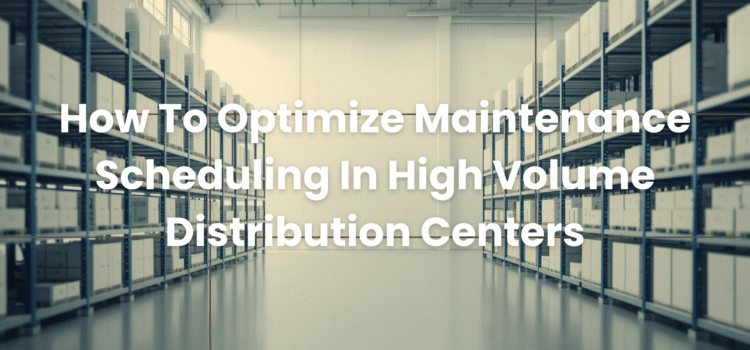
The high volume distribution centers have been operating under the continuous pressure to keep up the speed, accuracy, and uptime. Malfunctions or untimely maintenance of equipment may interrupt the work processes, cause delays in deliveries, and raise the cost of operations. It is necessary to optimize the time of maintenance to assure that systems do not fail and productivity is not disturbed. This entails a deliberate strike between proactive measures and operational needs, backed by effective procedures and instruments.

Understanding Operational Demands
Effective maintenance scheduling is based on a clear understanding of the operational demands. The distribution centers are usually characterized by peaks and declines in workloads due to seasonal factors, promotions and changing customer expectations. Maintenance operations should conform to such trends in order to prevent disrupting peak throughput times. This includes historical analysis, determining the periods of high and low activity and scheduling maintenance activities.
The interdependence of systems in a facility also needs to be noted. Conveyor systems, sorting machines, and automated storage systems are usually interconnected, in that a breakdown in any of the systems can affect the whole process. These dependencies should be considered in maintenance scheduling, which should prioritize critical assets and coordinate the downtime of other related systems. This strategy helps minimize the possibility of chain-reaction interrupts and makes the functioning smoother.
Establishing Preventive Maintenance Plans
Preventive maintenance is also central in maximizing the scheduling in high volume settings. Through frequent checkups and maintenance activities, organizations are in a position to detect possible problems before they turn out to be huge failures. This is a proactive solution that reduces unplanned downtime and assists in ensuring the performance is on par across all equipment.
To come up with an efficient preventive maintenance plan, one has to have detailed information about the individual asset, such as its manufacturer recommendations, usage history, and performance history. Scheduling should be designed by the maintenance teams using these factors and not general intervals. This will make maintenance work timely and efficient and will avoid unnecessary work and focus on actual risks.
Leveraging Data for Decision Making
Maintenance scheduling is more accurate and effective with the use of data-driven decision making. Contemporary distribution centers produce huge amounts of operational data which can be utilized to determine trends, forecast failure and maximize maintenance intervals. Knowing this information, organizations can get beyond reactive strategies and implement more strategic practices.
Predictive maintenance strategies can also be supported by advanced analytics and involve maintenance being done based on the level of actual equipment condition instead of scheduled maintenance. This saves time and prolongs the asset life. By incorporating the insights of data into scheduling activities, the maintenance teams will be able to prioritize the tasks and distribute resources more efficiently and where they are most required.
Coordinating Maintenance with Operations
Close interactions between the maintenance and operations teams should be done to reduce disruption. The maintenance operations must be planned with operational staff so that they do not disrupt the important work-flows. This needs open communication and a common knowledge on priorities among departments.
The impact can be significantly reduced by scheduling the maintenance during the scheduled downtime or when there is low traffic. However, this strategy must be flexible to address unexpected changes in demand. With this tight coordination, organizations can easily change schedules where there is need and simultaneously ensure that essential maintenance activities are completed in time.

Utilizing Digital Tools for Scheduling
The internet applications have significant roles in supporting the maintenance planning in the large volume distribution facilities. Work order management software and others offer a centralized solution to plan, monitor and execute maintenance activities. These tools can contribute to making the organization more transparent, enabling teams to track their progress and effectively resolve problems.
Also, maintenance management software can be used to automate the scheduling process and provide alerts of future work and provide real time information on the equipment status. This will assist in minimizing the workload on the administration and assist in making sure that no important duties are omitted. These technologies help organizations to improve coordination, accuracy and streamline the maintenance process.
Prioritizing Critical Assets
Equipment in a distribution center does not have the same level of importance. Effective maintenance scheduling is dependent on identifying and prioritizing critical assets. Such assets are the ones that make the biggest difference in operations, like primary conveyor lines or automated sorting.
It is important to concentrate the maintenance on the assets that are critical, so that the resources are distributed in a way that will produce the greatest effect. This practice mitigates the risk of significant disruptions and promotes stability in overall operations. Meanwhile, less important equipment must not be neglected either, so that some minor problems would not be allowed to mount up over time.
Managing Workforce Efficiency
One of the most important aspects of maintaining efficiency in scheduling workforce is optimization. The presence of qualified technicians to carry out maintenance work at the appropriate time should not delay the processes. This necessitates a thorough design of shifts, workloads, and skill assignments to make sure that all the work is done properly.
The workforce can also be made more flexible through training and cross-skilling. In case technicians are able to work with various equipment types, it becomes more convenient to adjust schedules and react to any unforeseen problems. This flexibility facilitates greater efficiency of resource use and aids in facilitating uniform performance within the facility.
Balancing Reactive and Planned Maintenance
Preventive and predictive maintenance are critical but reactive maintenance cannot be eradicated. There will still be equipment failures and organizations have to be ready to act quickly. It is important to strike a balance between reactive and planned maintenance to ensure continuity of operations.
An optimized scheduling plan has a plan of contingency in case of unforeseen breakdowns. This can be in terms of scheduling time slots to repair on an emergency basis or having a buffer in the availability of technicians. Planning the unexpected helps organizations minimize the effects of reactive maintenance on the overall schedules and ensures that organizations are a lot more reliable.
Improving Communication and Reporting
Effective maintenance scheduling requires proper communication and reporting. Accurate and up to date information should be made available to all stakeholders such as the maintenance teams, operations staff and the management. This makes sure that the whole team is on track and they are able to make wise decisions.
Constant communication on maintenance operations offers good information about performance and improvement opportunities. Organizations can use metrics like the duration of downtime, rate of task completion and equipment dependability to determine the efficiency of their scheduling strategies. Constantly measuring these indicators, teams can see ways to optimize their operations and get improved results.
Adapting to Changing Conditions
High volume distribution centers are dynamic in nature and their conditions may vary quickly. The scheduling of maintenance should be adaptable to accommodate such changes without compromising on efficiency. This demands a spirit of reviewing and revising plans as new information is availed.
One of the major facets of this process is the concept of continuous improvement. The organizations are supposed to review their maintenance strategies periodically, including the feedback obtained in the groups, and the performance statistics. Being flexible and receptive to change to distribution centers will help them keep the best scheduling practices despite the changing operational requirements.
Strengthening Spare Parts Availability and Inventory Control
One factor that has not been considered in maintenance scheduling in high volume distribution centers is the availability of spare parts. Well being maintenance work can be postponed in case the necessary components are unavailable when they are in demand. Planning of spare parts directly into maintenance schedules can be of great help in ensuring that technicians are able to finish their tasks in a non-disruptive manner, which saves them on time, and they do not waste much time waiting to repair equipment.
Equipment criticality and equipment failure history should be matched with effective inventory control systems. Parts with high failure rate and frequently used should be kept in sufficient quantities and other less important parts can be handled using reorder levels. The connection between inventory systems and maintenance management systems enhances visibility and enables teams to predict demand to ensure that maintenance processes are conducted with ease and are well synchronized with the operation timetables.

Conclusion
The process of optimization of maintenance planning in large volume distribution centers is complex and involves planning, data analysis, and coordination. Organizations can devise schedules that help achieve reliability and productivity by knowing what to operate on, what is important, and capitalizing on digital tools. These efforts are further improved by effective communication and a concern toward continuous improvement.
The role of efficient maintenance scheduling will only grow as distribution centers keep on evolving. By investing in strong strategies and being innovative, organizations will be in a better position to deal with the challenges of high volume operations. Maintenance can also be made a strategic asset and not a disruption with proper planning and implementation.