

🎯 Get Early Access to SENSEI - Your AI Supply Chain Consultant! Apply Now

Specifically, this course targets supply chain and logistics professionals, procurement leaders, and human resources personnel tasked with managing or overhauling company travel expenses. Suitable Roles: • Entry-Level: Procurement Assistant, Travel Coordinator, Purchasing Coordinator. • Mid-Level: Travel Manager, Sourcing Analyst, Category Manager, Procurement Specialist. • Senior-Level: Director of Corporate Services, Head of Procurement, Strategic Sourcing Manager. • Executive-Level: Chief Procurement Officer (CPO), VP of Sourcing, Director of Operations. • Specialized Titles: Corporate Travel Manager, Indirect Procurement Manager, Vendor Relationship Manager.
27 Apr

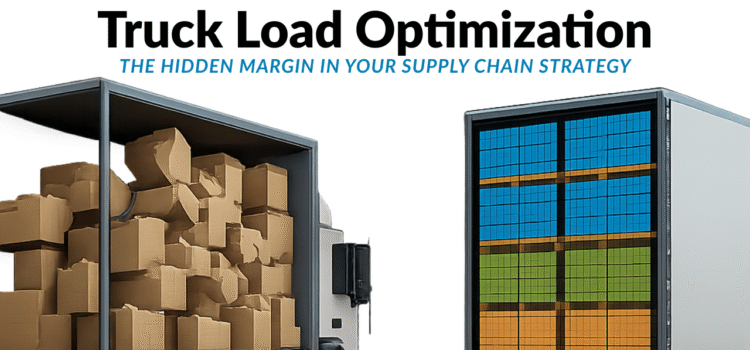
Truck Load Optimization: The Hidden Margin in Your Supply Chain Strategy

In the volatile landscape of global logistics, organizations often exhaust their energy negotiating for a 2% reduction in carrier base rates while ignoring a massive 20% “hidden tax” sitting right inside their trailers. This tax is the result of inefficient truck load optimization.

If you are paying for a full truckload but only utilizing 60% of its weight or volume capacity, your “negotiated” rate is a mathematical illusion. This guide explores how to bridge the gap between negotiated rates and effective costs by mastering the science of freight loading.

Introduction: The Invisible Cost of "Empty Space"

Most supply chain leaders view freight as a procurement challenge—a battle of negotiations with carriers. However, the true cost of transportation is determined on the warehouse floor, not in the boardroom. Truck load optimization is the process of maximizing the weight and volume of a shipment to ensure that every euro, dollar, or pound spent on a freight rate translates into the maximum possible units delivered.

As global sustainability goals (ESG) tighten and fuel prices fluctuate, the ability to “carry more with less” has moved from a tactical benefit to a strategic necessity.

Part 1: Answering the Truck Load Optimization Dilemma

A user recently asked: “What about Freight loading optimisation? How are we ensuring that we are carrying the tonnage based on the freight rates? Freight loading depends on the packaging and type of materials.”

This question touches the very heart of logistics inefficiency. To ensure you are carrying the tonnage you are paying for, you must understand that freight rates are not static prices—they are variables determined by density.

The Core Problem: You’re Paying for Air

Freight pricing is fundamentally shaped by three factors that operate independently of your negotiated base rate:

  1. Density: Weight per cubic meter.
  2. Stowability: How efficiently the product fits into the available space.
  3. Handling Complexity: The ease of loading/unloading.

When these three factors misalign with your packaging and load configuration, you are essentially paying for “ghost freight.” A 20-foot container that is 95% full by weight but only 60% full by volume means you have left cubic capacity on the table. Conversely, a truck full of lightweight pillows is 100% full by volume but carries almost no tonnage, leading to a high cost-per-kilogram.

Part 2: The Mathematics of Freight Rates

To optimize, you must first understand the “hidden math” carriers use to price your shipments.

Freight Class & Density Pricing

In Less Than Truckload (LTL) and parcel networks, your freight class is a direct reflection of your density. If your packaging increases the “cube” (volume) without increasing the weight, your density drops, your freight class rises, and your rate jumps—sometimes by 20–40%.

Case Study: The Density Difference

  • Product A: 500kg in a 2.5 cubic meter box = 200 kg/m³ density.
  • Product B: 500kg in a 1.8 cubic meter box = 278 kg/m³ density.
    Despite having identical weights, Product B ships at a lower freight class and costs 15–25% less.

The Tonnage-Rate Mismatch

If you negotiate a “per-tonne” rate, that rate is only meaningful if you maximize the vehicle’s capacity. Consider these industry statistics:

  • The average UK truck carries only 45.7% of its total possible load capacity.
  • The road freight sector lading factor averages 57%—meaning one-third of payload capacity sits unused.
  • Articulated vehicles under 33 tonnes often run at only 43% lading factor.

The Reality Check: If your negotiated rate is €0.50/kg but you only fill 50% of the truck’s weight capacity, your effective cost is €1.00/kg.

Part 3: The Packaging-Freight Interdependency

The user’s intuition was correct: freight loading optimization begins with packaging design, not carrier selection.

Packaging Cube Impact

When you right-size your carton dimensions, you trigger a chain reaction of savings:

  1. Reduced Wasted Space: Leads to higher density and lower freight classes.
  2. Optimized TiHi (Tier x Height): More cartons per pallet and better vehicle utilization.
  3. Zero Overhang: Aligning cartons to pallet standards prevents “dead space” and reduces damage claims.

Real-World Example: The Motorcycle Pivot

A manufacturer originally shipped motorcycles fully assembled. By shifting to a “disassembled parts” packaging strategy, they:

  • Increased density by 40%.
  • Eliminated awkward shapes that prevented stacking.
  • Reduced overall cube by 35%.

Achieved a 20% freight cost reduction without ever renegotiating their carrier rate.

Part 4: 5 Operational Control Points for Solution-Ready Teams

To ensure your tonnage aligns with your rates, implement these five practical control points.

1. Load Configuration Strategy

Stop relying on manual guesses. Use sophisticated truck load optimization software that considers:

  • Product weight and cubic dimensions.
  • Load-bearing strength (what can be stacked on top of what).
  • Center of gravity (placing heavier items on the bottom).
  • Result: A 15–25% improvement in cube utilization.

2. Packaging Specification Mandates

Marketing departments often design packaging for shelf appeal, ignoring shipping dimensions. Supply chain leaders must mandate that packaging:

  • Fits perfectly to standard pallet dimensions.
  • Uses cubic shapes rather than cylinders or irregular polygons.

The Able Plastics Example: By optimizing TiHi configuration (shifting from 48 to 52 cartons per pallet), a firm reduced their requirement by one full truck per shipment cycle—an 8.3% immediate saving.

3. Freight Class Audits

Carriers often “overclass” freight intentionally to pad margins. Conduct a detailed review:

  • Verify actual product dimensions and density.
  • Challenge misclassifications with data.

Impact: Misclassifications typically add 8–15% to freight spend unnoticed.

4. Mode-Product Alignment

Not every product belongs on a truck. Match transportation mode to your value density:

  • High Value/Low Weight: Air/Parcel (Focus on speed).
  • Medium Value/Medium Density: Road/Rail (Focus on load optimization).
  • Low Value/High Weight: Ocean/Rail (Focus on maximizing tonnage).

5. Carrier Accountability & Incoterms

Your choice of Incoterms determines who controls the margin. If you ship DDP (Delivered Duty Paid), you control the packaging and loading giving you the maximum opportunity to optimize.

In negotiations, specify:

  • Minimum load factor expectations (e.g., 85% weight utilization).
  • Surcharge transparency.

Part 5: Internalizing Best Practices

To master these concepts, professionals should look toward continuous education. Integrating the Logistics Management Track at SCMDOJO is a critical step in understanding the software that drives these optimizations. Furthermore, the Definitive Guide to Warehousing eBook provides deep insights into how warehouse flow directly impacts dock-to-truck efficiency.

Supporting Data Tables

Metric Shift: From Legacy to Modern Tracking

Stop Tracking (Legacy)

Start Tracking (Modern)

Why?

Cost per Kilogram (Base)

Effective Cost per Unit Sold

Captures the true impact of loading efficiency.

Negotiated Rate %

Vehicle Utilization Rate (Weight/Cube)

A low rate on an empty truck is a loss.

Cost per Shipment

Density Achieved vs. Target

Monitors if packaging is inflating costs.

Total Freight Spend

Accessorial Spend as % of Base

High accessorials indicate poor operational control.

Key Takeaways Section

  • Density is Destiny: Your freight cost is determined by your packaging dimensions more than your carrier negotiations.
  • The Lading Factor: Most trucks are half-empty. Filling that space is the fastest way to increase margin without selling more products. Hence, truck load optimization is a must have initiative.
  • TiHi Optimization: Small changes in how cartons sit on a pallet (the Able Plastics example) can eliminate entire truckloads from your annual budget.
  • Incoterms Matter: Choose Incoterms that allow you to control the loading and packaging specifications (DDP/Ex-Works).
  • Software is Required: Humans cannot calculate 3D load optimization as well as specialized algorithms. Invest in tech to unlock the “Hidden Margin.”

SCMDOJO RECOMMENDATION: Ready to transform your logistics from a cost center into a competitive advantage? Start with a Warehouse Self-Assessment to see how your floor flow affects your loading speed, and enroll in our Logistics Management courses today.

About the Author- Dr. Muddassir Ahmed​

Dr. Muddassir Ahmed is a globally recognized supply chain expert, thought leader, and keynote speaker. As the Founder & CEO ofDr. Muddassir Ahmed SCMDOJO, he has built one of the world’s leading platforms dedicated to empowering supply chain professionals with cutting-edge knowledge, practical tools, and access to expert insights. With over 19 years of leadership experience spanning the UK, Europe, the Middle East, and Southeast Asia, Dr. Ahmed has held key roles at Bridgestone, Doncasters Group, Eaton, and Volvo Cars, managing multi-million-dollar supply chain operations.

His expertise spans all facets of supply chain management, with a particular focus on leveraging technology and innovation to optimize processes and build resilient supply chains.

Recognized among the Top 10 Supply Chain Influencers in the World by Supply Chain Digital, Dr. Ahmed has been instrumental in shaping industry best practices through his extensive research, vlogs, and thought leadership. Holding a PhD in Management Science from Lancaster University Management School, he is also a certified Six Sigma Black Belt.

His platform, SCMDOJO, serves a vibrant community with over 51,000 monthly visitors. Moreover, he has 72,000 newsletter subscribers, and a social media following exceeding 105,000 supply chain professionals

A sought-after keynote speaker and thought leader, sharing his insights on industry trends, best practices, and the future of supply chain management. Dr. Ahmed delivers high-impact talks on supply chain excellence, digital transformation, and strategic leadership. His mission is clear: to help supply chains thrive

You can follow him on LinkedInFacebookTwitterTikTok or Instagram

Related Posts