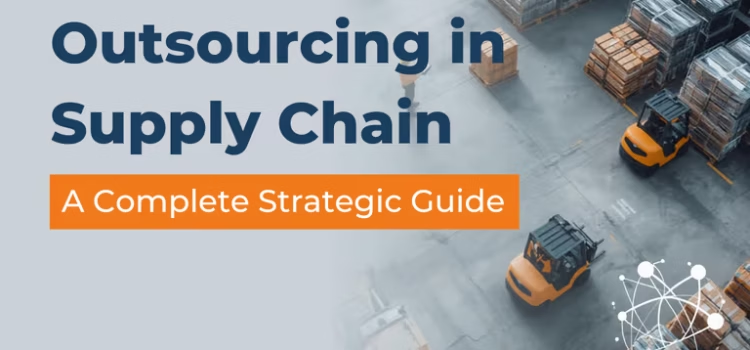
In today’s dynamic global marketplace, businesses constantly seek ways to optimize operations, reduce costs, and enhance efficiency. Outsourcing in supply chain management has emerged as a critical strategy to achieve these objectives, allowing organizations to focus on their core competencies while leveraging external expertise.
What is Outsourcing in Supply Chain Management?
Outsourcing, often used interchangeably with “contracting out,” is defined as the process of engaging external suppliers to provide goods and services that were previously handled internally. This involves a substitution of internal capacity and production with that of a third-party provider. While it’s not truly outsourcing if an activity was never performed in-house, the term is widely applied to contracting for services across the supply chain.
Key Drivers and Benefits of Outsourcing
Companies increasingly outsource selected activities and processes as competition intensifies. The primary benefits include:
- Cost Reduction: Outsourcing in the supply chain can lead to significant operating and capital cost reductions by leveraging external specialists who often achieve economies of scale.
- Service Level Improvement: Third-party providers, with their specialized focus, can often deliver higher service levels.
- Core Competence Prioritization: By offloading non-core activities, companies can dedicate internal resources and focus on what they do best.
- Risk Reduction: Outsourcing transfers risks, such as demand uncertainty, to providers who may be better equipped to manage them through risk pooling across multiple clients.
- Access to Expertise and Technology: External firms bring specialized knowledge, cutting-edge technology (e.g., eProcurement, advanced telephony), and skilled professionals that an internal team might lack.
- Enhanced Efficiency: Specialists can often process orders more efficiently and provide strategic support like spend analysis or facilitating design collaboration.
Examples of Outsourcing in Supply Chain Management
Many Fortune 1000 companies outsource multiple business processes, with several key areas in supply chain management:
- Supplier Relationship Management (SRM): Outsourced SRM can handle transactional purchasing, supplier sourcing, contract negotiation, two-way communication, and compliance management. It can also offer strategic support for spend analysis and design collaboration.
- Manufacturing: Production can be outsourced to organizations with advantages in labor costs, proximity to raw materials, or specialized expertise in efficient, high-quality production.
- Logistics and Logistics Management: This commonly involves using Third-Party Logistics (3PL) and Fourth-Party Logistics (4PL) providers for operations like warehousing, freight payment, transportation, information systems, inventory management, and customer order fulfillment.
- Customer Relationship Management (CRM): Outsourced CRM can include call centers, advanced telephony services, database management, and online service agents.
- Information Systems: Offshore development of custom technology applications and Software as a Service (SaaS) can significantly reduce labor costs and limit investment in quickly obsolete systems.
- Inventory Management: Studies suggest outsourcing inventory management can lower costs while maintaining high quality levels, especially for organizations with omnichannel distribution networks.
- Planning & Demand Management (Supply Chain as a Service – SCaaS): Companies can outsource these critical but resource-intensive functions to expert solution providers, addressing issues like time/resource consumption in data management and lack of technical knowledge.
- Transactional Operations: Routine tasks such as creating purchase orders, supporting transactional PR, and managing vendor data can be effectively outsourced.
- Strategic Functions: Even strategic areas like developing supply chain strategies or category strategies can be outsourced to consulting agencies or experts.
“This raises the question, can you Outsource the Procurement Function – Possible?”
Watch this episode of The Supply Chain Show ™, where Dr Muddassir Ahmed discussed with Maryna Trepova (Managing Partner at IPSM) how Outsourcing of the Procurement helps companies focus on their core processes, large strategic projects, optimization, and automation while getting rid of operational and tactical, non-value-added tasks for procurement and initiators
Challenges and Considerations
Despite the clear advantages, outsourcing presents its own set of challenges:
- Resistance to Change: Adapting to new technologies or outsourcing critical business domains can be complex due to the inherent difficulty of embracing unfamiliar processes and disrupting established norms.
- Apprehension with Technology: There can be apprehension about relying on third-party tech platforms for critical business responsibilities.
- Perceived Internal Expertise: Companies sometimes believe they can handle all functions internally more effectively, overlooking the specialized proficiency of external experts.
- Data Protection: A significant concern for supply chain leaders is protecting sensitive data when it’s shared with external parties who do not work directly for the company.
- Strategic Alignment: Ensuring the outsourcing partner’s goals align with the company’s long-term strategic objectives is crucial for success.
As supply chains become more complex and global, outsourcing, particularly through models like Supply Chain as a Service (SCaaS), continues to evolve. Companies are increasingly seeking external partners to enhance resilience, improve efficiency, and maintain competitiveness in an unpredictable world.
Steps of Sourcing in Procurement & Supply Chain
The sourcing process in procurement and supply chain is a multi-step strategic activity that extends beyond simple tendering or bidding. It is designed to identify, evaluate, and select suppliers to meet an organization’s needs effectively and build strong supplier relationships for cost-effectiveness.
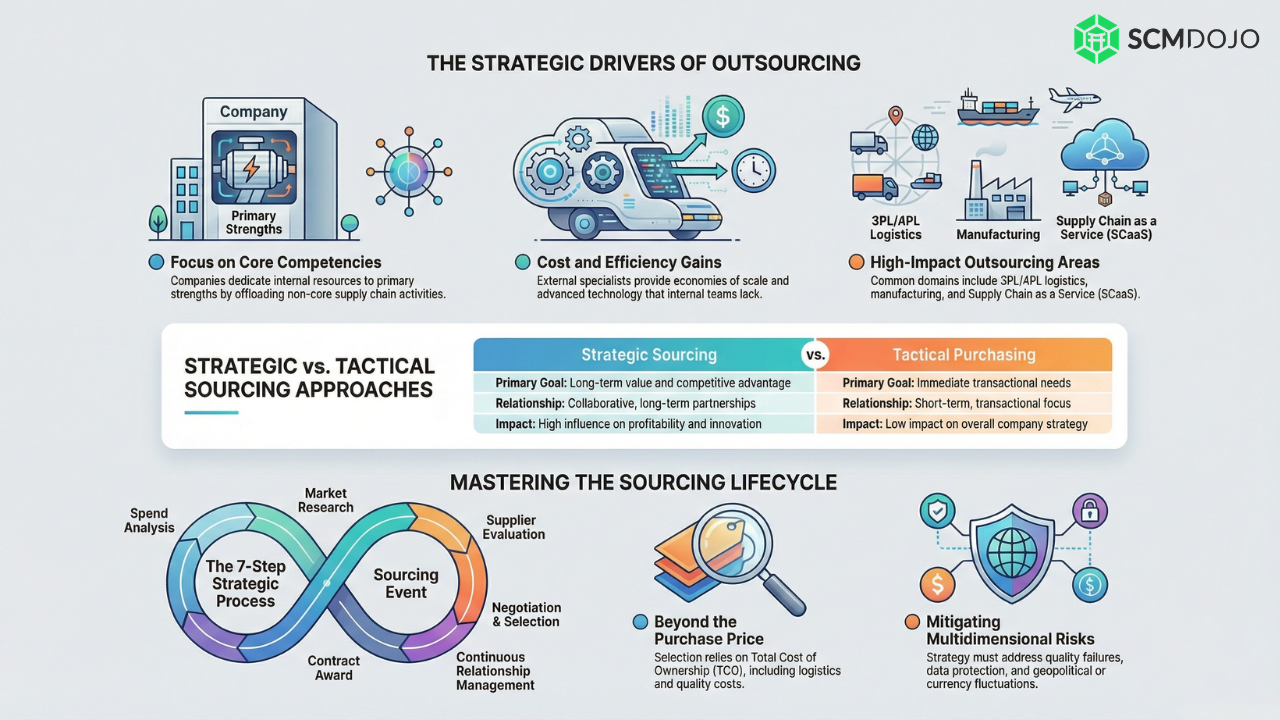
Here are the key steps involved in the sourcing process:
1. Understand Business Needs
This initial and crucial step involves a deep understanding of what the business truly requires. It’s about knowing what to search for, where to search, and what specific needs procurement activities must fulfil. This understanding forms the basis for specifications and tendering documents, and it requires verification with internal stakeholders.
If you’re looking to go deeper into structured sourcing, supplier evaluation, RFQs, negotiations, and contract award strategies, explore: The Fundamentals of Sourcing Process course walks you step-by-step through real-world sourcing execution, from business needs identification to supplier performance management.

2. Develop Sourcing Strategy
Once business needs are understood, a strategy must be developed. This involves making critical decisions such as whether to make, buy, or outsource the required goods or services. This stage also entails defining all necessary requirements to be communicated to potential suppliers. Key considerations include:
- The number of suppliers for a particular product or service, along with supplier segmentation.
- Geographical locations of potential suppliers.
- Criteria for partner selection, such as financial stability, lead times, quality, communication level, customer service, return processes, order volume, payment policy, delivery methods, production process development, supplier flexibility, knowledge and experience, distribution process development, environmental impact, and organizational culture. Strategic alignment with overall business goals, such as cost-leadership or innovation, is paramount.
3. Source Suppliers
With the strategy in place, the next step is to actively search for and identify potential suppliers. This involves market research, collaboration, and various activities to discover suitable partners capable of meeting the defined requirements.
4. Issue Documents (RFQ, RFP, Invitation to Tender)
After preparing all necessary documentation, requests for quotation (RFQs), requests for proposal (RFPs), or invitations to tender are issued to potential suppliers. This phase requires meticulous preparation of documents, including codes of conduct, contracts, formulas, drawings, and any other information that enables suppliers to propose the best value.
5. Tendering, Bidding, and Negotiation
This stage involves the formal process where suppliers submit their proposals (bids or tenders) in response to the issued documents. Following the submission, negotiations with selected suppliers take place to refine terms, conditions, and pricing, aiming for optimal value and alignment with strategic objectives.
6. Award the Contract
Upon successful negotiation and evaluation of proposals, the final strategic decision is made to award the contract to the chosen supplier(s). A formal contract is then signed, establishing the agreement between the organization and the supplier(s).
7. Contract Management and Supplier Relationship Management (SRM)
This is a continuous and vital stage that begins once the contract is awarded and operational activities (like ordering and delivery) commence. It involves actively managing the contract, evaluating supplier performance against agreed key performance indicators (KPIs), providing feedback, and fostering long-term relationships. This ongoing management ensures contractual obligations are met, issues are addressed, and opportunities for continuous improvement and value creation are identified.
Effective outsourcing depends on structured Supplier Relationship Management practices. Professionals seeking to build governance frameworks, performance review systems, and long-term supplier collaboration strategies may consider the Supplier Relationship Management course, which provides practical tools for managing supplier partnerships and mitigating operational risk.

How Does Strategic Sourcing Differ from Tactical Purchasing?
Strategic sourcing and tactical purchasing represent two distinct approaches within procurement, differing fundamentally in their scope, objectives, impact, and complexity. While both are essential for an organization’s supply chain, strategic sourcing is aligned with the company’s long-term vision, whereas tactical purchasing focuses on immediate transactional needs.
Strategic Sourcing
Strategic sourcing is a comprehensive approach coordinated with the overall company strategy, encompassing both supplier and market strategies. Its primary aim is to counter international cost pressure and ensure a company’s survival in an increasingly globalized market. It seeks to create distinctive value and achieve a competitive advantage by focusing on:
- Impact on Profitability & Value Creation: Strong impact on profitability and significant value creation.
- Complexity & Risk: Involves high complexity of sourcing due to geopolitical risks, a small number of competitors, high sourcing risk, and regulatory/legal restrictions.
- Supplier Relationships: Emphasizes long-term relationships, supplier management, and fostering strong partnerships to secure innovation and integrate supplier capabilities.
- Objectives: Focuses on long-term savings, cost reductions, innovation, and aligning sourcing decisions with strategic goals like lowest overall cost, perfect delivery lead time, or exacting quality for critical parts.
- Activities: Includes procurement risk analysis, stakeholder management, periodic reassessment of supply plans, automation of RFQ, RFP, e-auctioning, and contract management processes.
- Material Focus: Targets key, critical materials or services that differentiate the product and provide an
You can further read the article STRATEGIC SOURCING VS. PURCHASING – 7 KEY DIFFERENCES to learn more.
Key Steps in Developing a Strategic Sourcing Strategy?
Developing a strategic sourcing strategy involves a comprehensive, cyclical process aimed at aligning procurement decisions with overall business goals, focusing on Total Cost of Ownership (TCO) and long-term partnerships. The key steps typically include:
1. Getting a Picture of a Current State of Affairs (Spend Analysis)
This initial internal step involves specifying the spend overview for the product or service to be procured. It focuses on understanding who the internal users are and establishing historical data, total spend across categories, and internal requirements.
2. Strategy Formation
This crucial step involves defining all requirements for suppliers. It includes determining the number of suppliers for a particular product/service, geographical locations, and criteria for potential partners. These criteria can encompass financial stability, lead times, quality, communication level, customer service, return process, order volume, payment policy, delivery methods, supplier production process development, flexibility, knowledge, experience, distribution process development, environmental impact, and organizational culture. The strategy must align with overall business goals, such as cost-leadership or innovation.
3. Procurement Requirements & Market Analysis
This step involves assessing procurement needs (direct, indirect, capital expenditures) and conducting a thorough supply market analysis. This includes identifying key suppliers, market trends, assessing supplier risk, pricing volatility, global supply chains, and evaluating alternative sourcing strategies. A PESTEL analysis can be used for external market influences, and the findings are often summarized in a SWOT analysis.
4. Developing a Strategic Procurement Approach
This involves choosing the right procurement model (centralized, decentralized, or hybrid) and establishing a structured Supplier Relationship Management (SRM) strategy. Key aspects include defining supplier evaluation criteria (pricing, quality, ESG compliance, technological capabilities) and segmenting suppliers (strategic, leverage, bottleneck, routine), often using frameworks like the Kraljic Matrix.
5. Risk, Compliance & Cost Optimization
A procurement strategy must integrate measures to identify and mitigate risks. This step also emphasizes focusing on TCO, which calculates as Initial Cost + Expenses – Remaining Value, to look beyond just the purchase price.
6. Negotiation
This stage involves forming a dedicated team, including a negotiator and an expert in the product/service being purchased. Strategic sourcing software, such as Bid Ops, can automate negotiation processes and provide AI-driven intelligent first offers, as well as opportunity analysis and recommendations.
7. Implementation and Integration
Once negotiations are complete, it’s vital to communicate to the chosen suppliers that they are strategic partners, not merely transactional vendors. For important products, cooperation should be tight, involving suppliers in strategic discussions to ensure they understand business expectations. An implementation plan is developed, managed, and deployed to support sourcing decisions and supplier changes.
8. Benchmarking
Strategic sourcing is a cyclical process. After contracts are signed, continuous governance is essential. This involves establishing an effective way to measure supplier performance over time. This enables quick communication of discrepancies to vendors, allowing them to address issues with minimal business impact, ideally leading to a reduction in problems over time.
Criteria for Supplier Selection?
When selecting suppliers, organizations employ a comprehensive range of criteria, weighting them according to strategic priorities. After initial screening, a shortlist of ‘order qualifiers’ is generated, with the final selection often based on the best overall weighted value. It’s crucial to look beyond just the lowest price, considering a holistic view of the supplier’s capabilities and fit with the organization’s needs.
Key supplier selection criteria typically fall into several categories:
1. Cost and Financial Considerations
- Total Cost of Ownership (TCO): This is more than just purchase price. It encompasses transportation, duty costs, and crucially, inventory carrying costs associated with longer lead times. For example, a supplier with a lower initial price but significantly longer lead times may result in higher overall costs due to increased inventory holding. It also includes costs of goods sold and cost-reduction capabilities.
- Financial Strength and Stability: Assessing a supplier’s assets, liabilities, and profitability ensures their long-term viability and ability to meet obligations.
- Financing Criteria: Important for evaluating the overall financial impact of a supplier relationship.
2. Quality and Technical Capabilities
- Quality Philosophy and Control: The supplier’s approach to quality, including consistent conformance to specifications and product reliability.
- Technical and Design Capability: The ability to meet technical specifications, innovate, and contribute to product design.
- Technology Capability: The supplier’s technological sophistication and ability to adapt to changes.
- Production Facilities and Capacity: Ensuring the supplier has the necessary infrastructure and capacity to meet demand.
- Capability for Incremental Improvements: The potential for the supplier to continuously enhance their offerings and processes.
3. Delivery and Flexibility
- Delivery Lead Time: The time required to deliver products, including prompt response to requests.
- Consistent Meeting of Delivery Deadlines: Reliability in adhering to agreed-upon schedules.
- Flexibility: The ability to rapidly change production volumes and set up for new products at short notice, as well as general delivery and volume flexibility.
4. Relationship and Service
- After-Sales Support: The quality and availability of support post-purchase.
- Communication Openness: Transparency and effectiveness in communication channels.
- Likelihood of Long-Term Relationship and Closeness of Past Relationship: Indicators of a stable and collaborative partnership.
- Supplier Representative’s Competence: The skill and professionalism of the supplier’s contact persons.
- Willingness to Resolve Conflict: A crucial aspect for maintaining healthy, long-term relationships.
5. Organizational and Strategic Alignment
- Strategic Supply Plans and Alignment: How well the supplier’s capabilities align with the organization’s overarching supply chain strategy.
- Company’s Reputation for Integrity: Ethical conduct and trustworthiness.
- Global Presence: Relevant for organizations with global supply chain needs.
- Willingness to Make Needed Investments: Demonstrates commitment to the partnership and continuous improvement.
- Ability to Anticipate and Meet Technology Changes: Critical for maintaining competitive advantage.
- Organization and Management: The overall effectiveness and structure of the supplier’s operations.
6. Sustainable and Ethical Practices
- Environmental Aspects: Environmental costs, green design, environmental management systems, pollution control, green R&D, resource consumption, eco-design requirements, ozone-depleting chemicals, waste management (e.g., WEEE), recycling, and green supply chain management.
- Social Aspects: Interests and rights of employees, rights of stakeholders, work safety and labor health, information disclosure, and respect for policy.
7. External and Regulatory Factors
- Geographical Location: Proximity can impact lead times and logistics costs.
- Country, Regional, and International Regulations and Standards: Compliance with legal and industry requirements.
- Exchange Rate Implications: Important for international sourcing to manage financial risks.
Organizations will typically prioritize and weigh these criteria differently based on the specific product or service being sourced, market conditions, and their strategic objectives.
What are the Risks of Outsourcing in Supply Chain Management
Outsourcing in supply chain management, while offering potential benefits, introduces a range of significant risks that organizations must carefully manage. These risks can be broadly categorized as follows:
I. Quality and Performance Risks
- Poor Quality: The outsourced party may fail to meet desired quality standards.
- Failure to Perform or Deliver on Time: Dependability issues from the outsourced supplier can disrupt the supply chain.
- Underperformance of Outsourced Firms: Specifically, underperformance of outsourced delivery firms can negatively impact operations.
- Unresponsive Supply Chain: If there are sudden changes, an outsourced supply chain might lack the flexibility and responsiveness to adapt quickly.
- Loss of Productivity: Disruptions due to outsourcing can lead to a direct loss of productivity.
- Increased Cost of Working and Less Service: Poor performance can result in higher operational costs and reduced service levels.
II. Operational and Control Risks
- Lack of Control: High dependency on external firms can result in a loss of direct control over processes and outcomes.
- Increased Complexity: Assessing and developing potential suppliers, especially in offshore scenarios, becomes more complex.
- Supplier Risk: This includes the risk of a supplier going bankrupt or failing to deliver the correct quantity of product on time. Warning signs include late payments to their own suppliers, decreasing quality, unusual early shipments, longer lead times, declining investments in R&D/equipment, and executive turnover.
- Resource Risk: A lack of key personnel within the outsourced operations can lead to inefficiencies.
- Poor Information Sharing: Inadequate information exchange within the supply chain is a significant operational risk.
III. Financial and Relationship Management Risks
- Additional Cost Burden of Managing Relationships: The costs associated with managing outsourced relationships, including service level agreements, must be factored into the total cost analysis.
- Cash Flow Risk: The potential for financial loss due to inability to access cash in a timely manner or fund operational obligations.
- Opportunity Cost Risk: The risk that funds are not used in the most beneficial way for future earnings and operations.
- Process Efficiency/Effectiveness Risk: Inefficient, ineffective, or poorly designed outsourced operations can threaten business objectives.
IV. Reputational and Compliance Risks
- Reputation Damage: Poor quality, intellectual property theft, corruption/fraud, or failure to maintain organizational policies (e.g., worker protection, environmental sustainability) by an outsourced partner can significantly damage an organization’s reputation.
- Failure to Maintain Organizational Policy: Outsourced partners may not adhere to the organization’s policies, leading to compliance issues.
- Malfeasance Risks: These include supply chain theft, fraud, corruption, bribery, abduction, and counterfeiting.
- Litigation Risks: Exposure to lawsuits such as product liability or breach of contract.
V. Geopolitical and Cultural Risks (Offshoring Specific)
- Intellectual Property Theft: This risk is heightened when outsourcing, especially in offshore locations.
- Language and Culture Differences: Offshoring increases complexities due to varying languages and cultural norms.
- Country-Specific Processes, Legal, Tax, and Regulatory Differences: Navigating diverse legal and regulatory frameworks in different countries adds complexity and risk.
- Less Mature Organizational Levels and Technology: Suppliers in countries with lower labor costs may have less mature organizational structures, less emphasis on quality initiatives, or underdeveloped information technology.
- Onerous Government Regulations and Bureaucracy: Some countries may have regulations that slow cycle times or permitting, requiring local expertise to navigate.
- Policy and Culture Risks: Global supply chains operate in countries with different business cultures, laws, and trade policies, and are exposed to political and economic instability.
- Environmental Risk: Natural disasters, extreme weather, and other environmental factors can disproportionately affect global supply chains.
- Currency Exchange Risk: Fluctuations in currency values can impact the cost of inventory or equipment purchased in different currencies.
VI. Information and Technology Risks
- Cybersecurity Threats: Data breaches, ransomware attacks, and supply chain software vulnerabilities pose risks when sensitive information is shared with outsourced partners.
- Failure of Technology Systems: Risks include the failure of technology systems or electrical grids, disrupting operations.
VII. Strategic Risks
- Loss of Core Competencies: Mistakes in identifying core versus non-core activities can lead organizations to outsource functions that are crucial to their competitive advantage. Once lost, this competence is difficult to rebuild.
- Resistance to Change: Internal resistance to adopting new technologies or processes introduced by outsourcing in supply chain management can hinder successful implementation.
- Demand Risk: Unpredictable demand, influenced by economic states and other variables, poses a risk if the outsourced supply chain cannot adapt.
Summary,
This blog, Outsourcing in Supply Chain Management, discusses the strategic implementation of outsourcing and sourcing within modern supply chain management to bolster efficiency and competitiveness. It defines outsourcing in supply chain management as the transition of internal functions to external specialists, highlighting benefits such as cost reduction, risk mitigation, and access to superior technology.
The blog outlines a structured sourcing process, moving from the initial identification of business needs to the long-term management of supplier relationships. Furthermore, it distinguishes strategic sourcing from routine purchasing by emphasizing value creation and alignment with high-level corporate goals.
We concluded the blog by identifying critical supplier selection criteria, ranging from financial stability to ethical standards. Finally, it addresses the inherent risks of these practices, including potential quality failures, loss of control, and complex geopolitical challenges.
If you want to build a high-performing supply chain strategy or explore outsourcing opportunities, connect with SCMDOJO experts or explore our training and consulting programs.
About the Author- Dr. Muddassir Ahmed
Dr. Muddassir Ahmed is a globally recognized supply chain expert, thought leader, and keynote speaker. As the Founder & CEO of SCMDOJO, he has built one of the world’s leading platforms dedicated to empowering supply chain professionals with cutting-edge knowledge, practical tools, and access to expert insights. With over 19 years of leadership experience spanning the UK, Europe, the Middle East, and Southeast Asia, Dr. Ahmed has held key roles at Bridgestone, Doncasters Group, Eaton, and Volvo Cars, managing multi-million-dollar supply chain operations.
His expertise spans all facets of supply chain management, with a particular focus on leveraging technology and innovation to optimize processes and build resilient supply chains.
Recognized among the Top 10 Supply Chain Influencers in the World by Supply Chain Digital, Dr. Ahmed has been instrumental in shaping industry best practices through his extensive research, vlogs, and thought leadership. Holding a PhD in Management Science from Lancaster University Management School, he is also a certified Six Sigma Black Belt.
His platform, SCMDOJO, serves a vibrant community with over 51,000 monthly visitors. Moreover, he has 72,000 newsletter subscribers, and a social media following exceeding 105,000 supply chain professionals
A sought-after keynote speaker and thought leader, sharing his insights on industry trends, best practices, and the future of supply chain management. Dr. Ahmed delivers high-impact talks on supply chain excellence, digital transformation, and strategic leadership. His mission is clear: to help supply chains thrive
You can follow him on LinkedIn, Facebook, Twitter