
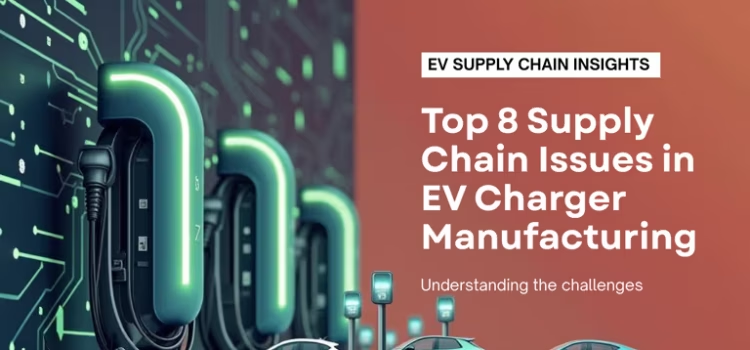
The electric vehicle revolution is accelerating, but its success hinges on a critical piece of infrastructure: the charging station. For manufacturers of these chargers, meeting soaring demand is a monumental task, heavily complicated by a fragile and complex global supply chain. Among the biggest hurdles are the supply chain issues in the EV charger industry, which continue to challenge scalability and timely deployment.
From raw materials to your driveway, numerous bottlenecks can delay deployments, increase costs, and frustrate everyone from manufacturers to new EV owners. In this article, we’ll break down the top 8 supply chain issues in the EV charger manufacturing industry today.
1. Semiconductor Chip Shortages
Problem: Modern EV chargers, especially DC fast chargers, are sophisticated computers. They require a wide array of semiconductors (chips) for power management, user interface, connectivity, and security. The global shortage of these components continues to be a primary constraint.
Impact: Production lines stall, leading to massive order backlogs. This directly delays national and corporate EV infrastructure projects, creating a significant bottleneck for EV adoption itself.
Solution: Diversify the supplier base beyond traditional sources. Develop closer, strategic partnerships with chip foundries to secure better allocation. Redesign circuits where possible to use more readily available chips without compromising performance (a process known as “respecification”).
2. Raw Material Price Volatility & Availability
Problem: Chargers are built from metals like copper (for wiring), steel (for enclosures), and aluminium (for heat sinks). They also require rare earth elements for internal components. The prices and availability of these commodities are highly volatile, influenced by global demand, geopolitics, and trade policies.
Impact: Wildly fluctuating material costs make it difficult to price products accurately and maintain profit margins. Shortages can bring manufacturing to a halt with little warning.
Solution: Implement long-term supply contracts with miners and metal suppliers to lock in prices and ensure supply. Increase investment in recycling programs to source secondary raw materials. Explore design alternatives that use more abundant materials.
3. Logistics and Shipping Delays
Problem: Getting components from global suppliers and finished chargers to customers is a logistical nightmare. Port congestions, container shortages, fluctuating freight costs, and unpredictable shipping times are the new norm.
Impact: Increased lead times, higher operational costs, and missed project deadlines. Delays in receiving a single component can hold up the entire assembly process (the “bullwhip effect”).
Solution: Diversify shipping routes and ports of entry. Utilize regional and local manufacturing where feasible to shorten supply chains (nearshoring). Increase inventory buffer stock for critical components to cushion against delays, even though this increases carrying costs.
4. Geopolitical Instability and Trade Policies
Problem: The EV supply chain is deeply globalized. Tariffs, trade wars, sanctions, and political instability in key supplier countries (e.g., for chips or minerals) can instantly disrupt the flow of essential materials.
Impact: Sudden price hikes, import/export bans, and the need to quickly find new suppliers, which is a time-consuming and costly process.
Solution: Build a more geographically diversified supplier map to avoid over-reliance on any single region. Advocate for stable, pro-trade government policies. Invest in political risk assessment to anticipate and mitigate potential disruptions.
5. Skilled Labour Shortages
Problem: This issue spans the entire chain. There’s a shortage of skilled workers for manufacturing, installation, and maintenance. A lack of truck drivers exacerbates shipping delays.
Impact: Even with all the parts available, a company cannot build, ship, or install chargers at scale without a skilled workforce. This slows down the entire rollout and increases labour costs.
Solution: Partner with technical schools and community colleges to develop training pipelines for manufacturing and installer technicians. Invest in robust internal training and certification programs. Offer competitive wages and benefits to attract and retain talent.
6. Complex Sourcing of Power Electronics
Problem: The core of a fast charger is its power module, which converts AC grid power to DC for the vehicle’s battery. Sourcing these high-capacity, reliable components from a limited pool of specialized global suppliers is extremely challenging.
Impact: This creates a single point of failure. Disruption at one power electronics supplier can halt production for multiple charger manufacturers simultaneously.
Solution: Dual- or multi-sourcing for critical power components. Foster joint ventures or strategic alliances with key suppliers to ensure priority access. Invest in in-house R&D to develop proprietary power conversion technology.
7. Quality Control and Supplier Reliability
Problem: Rushing to secure components from new, untested suppliers to meet demand can lead to quality compromises. A batch of faulty components may only be discovered during assembly or, worse, after the charger is deployed in the field.
Impact: Costly recalls, warranty claims, and reputational damage. Field failures undermine consumer and business confidence in the entire EV ecosystem.
Solution: Implement rigorous supplier qualification and auditing processes. Establish clear quality metrics and enforce them with contracts. Use advanced inspection technologies at receiving docks to catch defects early.
8. Certification and Standardization Delays
Problem: EV chargers must undergo stringent safety and compliance certifications (e.g., UL, CE) in different regions. The process is slow and can become a bottleneck if a single component is changed and requires re-certification.
Impact: Finished products can sit idle, unable to be sold or deployed, waiting for certification paperwork. This ties up capital and delays revenue.
Solution: Engage with certification bodies early in the design process. Standardize component platforms across product lines to minimize re-certification needs. Advocate for harmonization of international standards to simplify global expansion.
Conclusion: Building a More Resilient Chain
The path to electrification is not just about building more chargers; it’s about building a smarter, more resilient supply chain to support their production. Manufacturers who invest in diversification, deep supplier relationships, strategic inventory management, and localizing production will be the ones who power the future of transportation, reliably and efficiently. Overcoming the supply chain issues in the EV charger industry is critical to ensuring the EV revolution doesn’t stall before it even truly begins.
Want to turn today’s supply chain challenges into tomorrow’s competitive advantage?
The SCMDOJO course Risk Management and Business Continuity Tactics in Supply Chain is designed to help you tackle disruptions like chip shortages, shipping delays, and geopolitical risks head-on.
Learn proven strategies to build resilience, safeguard operations, and accelerate growth a must for anyone involved in EV charger manufacturing or supply chain leadership.
Take the next step toward building a smarter, stronger supply chain today.

Author Bio










Is it worth installing a home charger if your home electrical must be upgraded to qualify for an EV charger program? - EV Charger Experts | Best Home EV Chargers & Level 2 Charging Solutions Reviewed
[…] Component supply chain volatilityPower electronics parts, logistics delays, and lead time variability can disrupt schedules and pricing. SCMDOJO […]