





🎯 Get Early Access to SENSEI - Your AI Supply Chain Consultant! Apply Now

25 Apr

What Are the Best Techniques to Manage Inventory in Project Industries?

Managing inventory in project-driven industries demands a fundamentally different approach than continuous manufacturing or retail operations. Each project carries unique specifications, timelines, and material requirements making standardized inventory practices ineffective and costly. This guide reveals enterprise-grade inventory management techniques specifically designed for project industries, enabling planners to reduce waste, optimize cash flow, and deliver projects on schedule and within budget.

Understanding Inventory Challenges in Project Industries

Project-based industries including construction, engineering, oil & gas, infrastructure, and large-scale manufacturing face inventory challenges that differ fundamentally from repetitive production environments.

Key Characteristics of Project Inventory:

  • Non-repetitive demand patterns: Each project has distinct material specifications and quantities
  • Concentrated time horizons: Materials must arrive precisely when needed, not before or after
  • Site-specific constraints: Storage, handling, and security requirements vary by location
  • Regulatory and compliance complexity: Different jurisdictions impose unique material standards
  • High carrying costs: On-site inventory ties up capital and increases storage expenses
  • Long procurement lead times: Critical materials often require 6-12 week lead times
  • Obsolescence risk: Project-specific materials become stranded assets if scope changes

Without specialized inventory techniques, project planners typically over-purchase (fearing shortages), leading to excess stock, higher carrying costs, and project cost overruns.

Top 7 Best Techniques to Manage Inventory in Project Industries

1

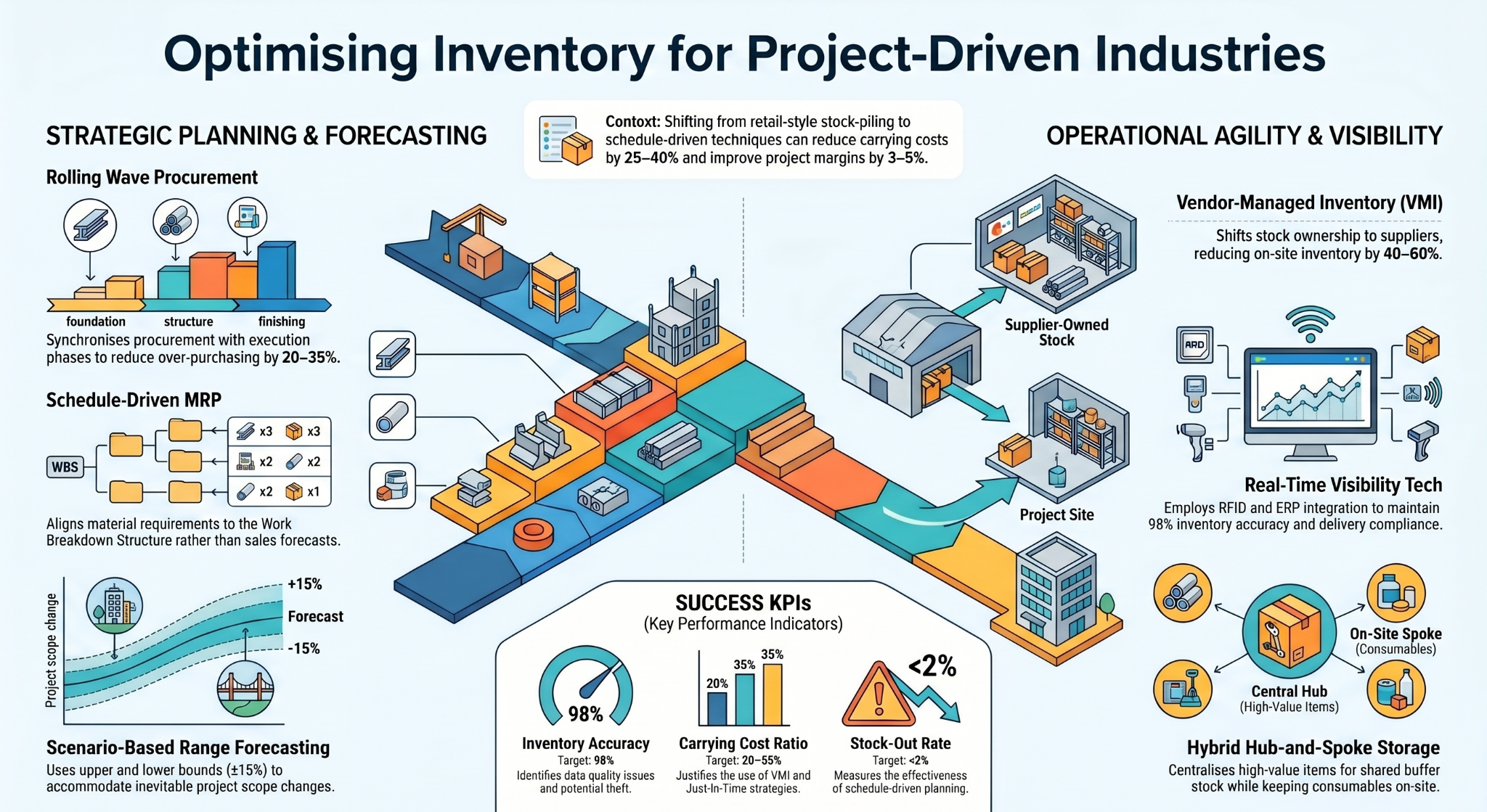
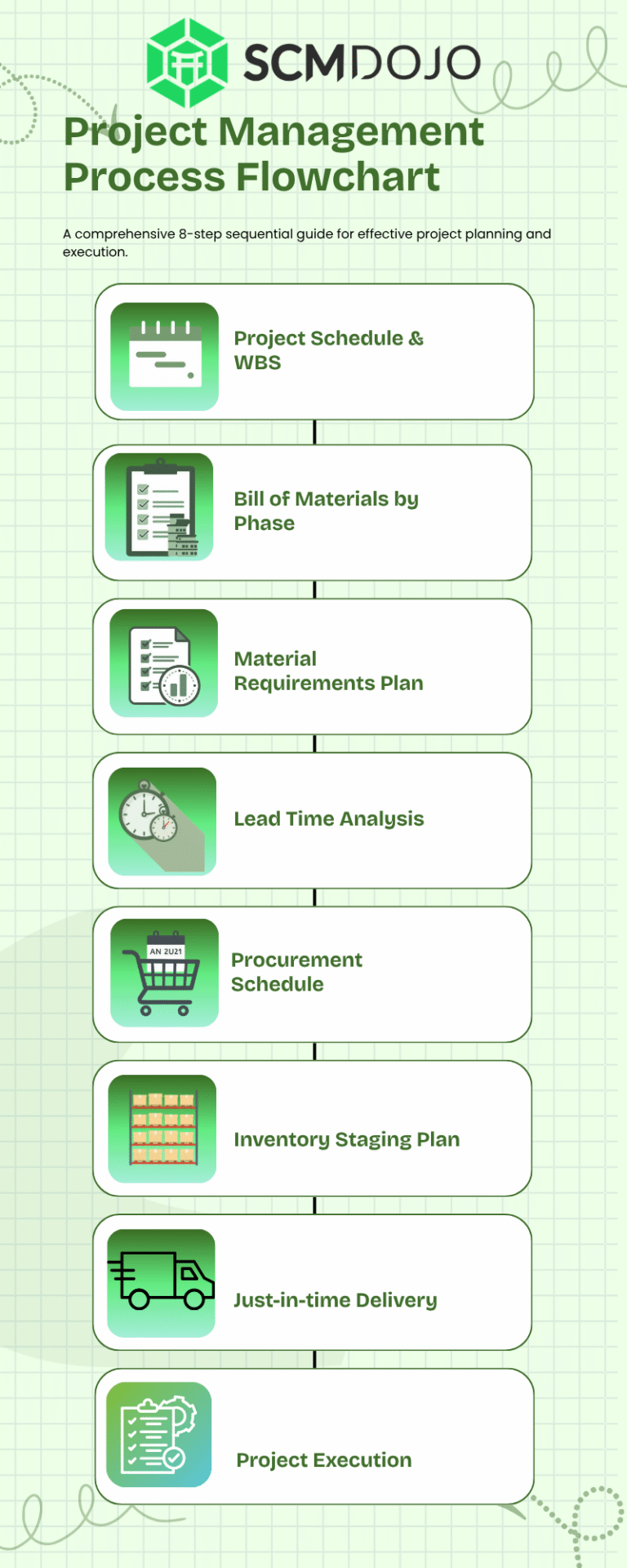
Schematic: Strategic Inventory Management for Project-Based Operations

1. Implement Rolling Wave Planning with Inventory Staging

Rolling wave planning is a hierarchical scheduling approach that synchronizes inventory procurement with project execution phases.

How It Works:

  • Near-term (0-8 weeks): Detailed material requirements and procurement orders
  • Mid-term (8-16 weeks): Aggregate forecasting based on design phase completion
  • Long-term (16+ weeks): Strategic sourcing and lead-time management

Application in Project Industries:

For a commercial construction project, you plan foundation materials (concrete, rebar, formwork) with week-level precision. Structural steel procurement runs on a 12-week rolling forecast, updated bi-weekly as design details finalize. Interior finishes are forecast monthly, allowing flexibility as owner preferences evolve.

Benefits:

  • Reduces over-purchasing by 20-35%
  • Minimizes storage space and carrying costs
  • Enables rapid scope change accommodation
  • Improves cash flow by aligning purchases with spend schedules

Project-specific MRP differs from manufacturing MRP in one critical way: demand is driven by the project schedule and work breakdown structure (WBS), not forecasted sales.

Best Practice Implementation:

Key Steps:

  1. Decompose the project schedule into discrete work packages and milestones
  2. Create phase-specific bills of materials (BOMs) instead of single project BOM
  3. Identify critical long-lead items (items with 8+ week procurement times)
  4. Reverse-schedule from need dates to purchase order dates, accounting for:
    •     Supplier lead times
    •     Transportation and customs clearance
    •     On-site receiving and inspection
    •      Storage and staging time

         5  Establish procurement windows to trigger orders at optimal times

Real-World Example:

An offshore oil & gas platform project requires 450 tons of specialized subsea piping. Instead of ordering the entire volume upfront (tying up $2.8M for 18 months), the MRP-based approach:

  • Orders 40% at month 3 (fabrication lead time: 16 weeks, needed at month 7)
  • Orders 35% at month 5 (needed at month 10)
  • Orders 25% at month 7 (final commissioning phase)

Result: Capital tied up is reduced by 60%, and flexibility to incorporate design changes improves by 40%.

3. Implement Vendor-Managed Inventory (VMI) and Consignment Agreements

For high-value, long-lead items, shifting inventory ownership to suppliers reduces project carrying costs and improves cash flow.

Types of Vendor Management Arrangements:

A      Consignment Stock:

  • Supplier maintains ownership until material is used on-site
  • Project pays only when consumption occurs
  • Ideal for: mechanical equipment, specialized hardware, safety components

B      Vendor-Managed Inventory (VMI):

  • Supplier monitors on-site stock levels and replenishes automatically
  • Project provides visibility into schedule and consumption forecasts
  • Ideal for: consumables, fasteners, small tools, PPE

C      Just-In-Time (JIT) Delivery:

  • Materials arrive in precise quantities on scheduled need dates
  • Requires reliable supplier performance and supply chain visibility
  • Ideal for: finishes, fixtures, final assembly components

Negotiation Framework:

When structuring VMI agreements:

  • Provide 12-16 week rolling forecasts to suppliers
  • Guarantee minimum purchase volumes to secure better pricing
  • Establish performance metrics: on-time delivery >98%, quality defects <0.5%
  • Include penalty and incentive clauses tied to delivery performance

Benefits:

  • Reduces on-site inventory by 40-60%
  • Improves cash flow: pay-on-use vs. pay-upfront
  • Reduces warehouse space requirements and associated costs
  • Supplier bears obsolescence risk if scope changes

4. Adopt Integrated Inventory Tracking with Real-Time Visibility

Modern project inventory management requires end-to-end visibility: from supplier warehouse through transportation to on-site storage to final installation.

Technology Stack for Project Inventory:

Function

Technology/Tool

Purpose

Demand Planning

ERP + Project Management Integration

Synchronize schedule changes with material needs

Procurement Tracking

Supplier Portal / EDI

Real-time purchase order status

In-Transit Visibility

GPS / Telematics

Location and ETA of shipments

On-Site Tracking

RFID / Barcode Scanning

Stock level accuracy and location

Consumption Tracking

Mobile Apps / Timesheets

Actual material usage vs. forecast

Reporting Dashboard

Business Intelligence Tools

KPIs: variance, aging, carrying costs

Implementation Approach:

  1. Baseline current state: Document existing inventory processes, data silos, and visibility gaps
  2. Select integrated platform: Choose ERP/project management system with native MRP and inventory modules
  3. Establish master data: Create standardized item master, BOMs, and locations across all projects
  4. Deploy in phases: Start with pilot project; expand to enterprise portfolio
  5. Train teams: Supply planners, site managers, and procurement teams need hands-on training

Key Metrics to Monitor:

  • Inventory Turnover Rate: Number of times inventory is consumed and replenished (target: 4-8x annually for projects)
  • Stockout Rate: Percentage of demand met from existing inventory (target: >95%)
  • Carrying Cost as % of Project Value: (Average inventory value × carrying cost rate) / project budget (target: <2%)
  • On-Time Delivery Rate: % of materials arriving on the scheduled need date (target: >98%)

5. Establish Centralized vs. Distributed Inventory Strategy

Large, multi-project programs must decide whether to maintain centralized inventory hubs or distribute stock to individual project sites.

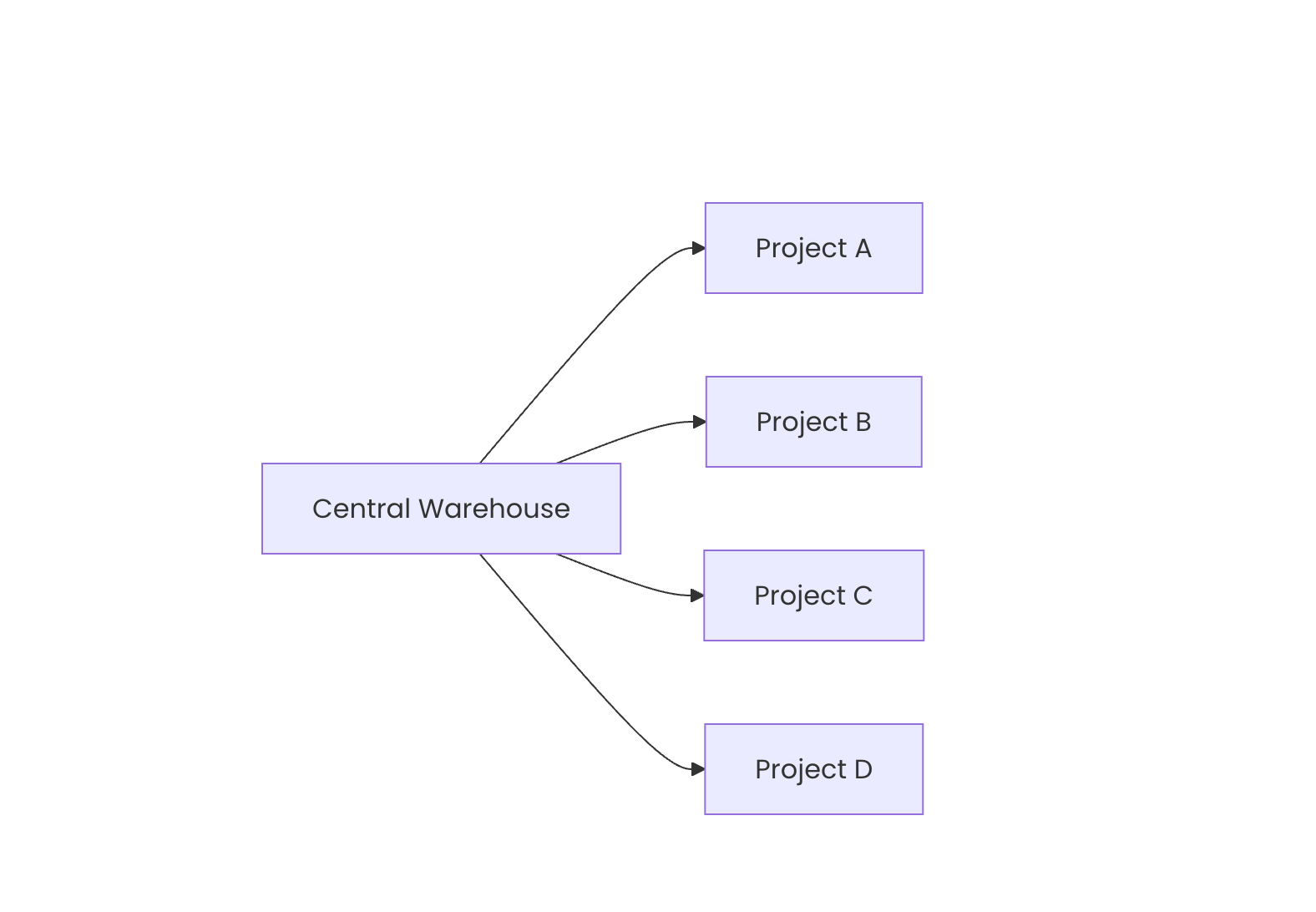
Centralized Inventory (Hub Model):

Best for: Programs with 5+ concurrent projects, reusable materials (formwork, equipment, tools)

3

Advantages:

  • Lower total inventory levels (shared buffer stock)
  • Better utilization of reusable equipment
  • Easier inventory control and auditing
  • Economies of scale in procurement

Disadvantages:

  • Higher logistics costs (inter-site transfers)
  • Potential delays if stock allocation is mismanaged
  • Requires sophisticated scheduling and visibility

Distributed Inventory (Site-Based Model):

Best for: Geographically dispersed projects, specialized/site-specific materials

Advantages:

  • Faster material availability on-site
  • Reduces inter-site logistics costs
  • Project managers have autonomy

Disadvantages:

  • Higher total inventory (duplication across sites)
  • Difficulty managing common items across projects
  • Harder to identify and reallocate excess stock

Hybrid Approach (Recommended):

Maintain centralized hub for:

  • Long-lead, high-value items (subsea equipment, large machinery)
  • Common, reusable tools and formwork
  • Emergency/contingency stock

Maintain site-based inventory for:

  • Consumables with short shelf life
  • Site-specific materials
  • Small, low-cost items

6. Deploy Demand Forecasting with Scenario Planning

Project scope changes are inevitable. Inventory strategies must be flexible enough to accommodate design modifications, scope additions, and schedule delays without excess waste.

Forecasting Approach for Projects:

A. Deterministic Forecasting (Base Case):

       Uses finalized designs and confirmed schedule

       Typical forecast accuracy: 85-90%

       Applied to 60-70% of project materials

B. Range Forecasting (Scenarios):

       Creates upper and lower bounds based on likely scope variations

       Typical range: ±15% from base forecast

       Applied to discretionary or value-engineered items

C. Sensitivity Analysis:

       Identifies materials most sensitive to scope or schedule changes

       Prioritizes flexibility in procurement for high-sensitivity items

Practical Example: Commercial Office Tower

Base Forecast: 45,000 interior wall panels

Scenario Planning:

  • Conservative (Lower Bound): 38,000 panels (scope reduction, value engineering)
  • Base Case: 45,000 panels (current design)
  • Aggressive (Upper Bound): 52,000 panels (scope expansion, premium finishes)

Procurement Strategy:

  • Firm order: 38,000 panels (firm commitment)
  • Optional commitment: 7,000 panels (supplier reserves capacity; project exercises with 4-week notice)
  • Optional commitment: 7,000 panels (different supplier; longer lead time but lower cost)

Outcome: Project maintains flexibility without carrying excess inventory or risking shortages.

7. Establish Inventory Performance Metrics and Continuous Improvement

Effective inventory management requires disciplined measurement and feedback loops.

Critical Inventory KPIs for Project Industries:

KPI

Formula

Target

Insight

Inventory Accuracy

(Actual stock / System records) × 100

>98%

Identifies data quality and theft issues

Days Inventory Outstanding (DIO)

(Avg. inventory value / Daily material consumption)

15-30 days

Lower is better; high DIO = excess stock

Stock-Out Rate

(Unplanned expedite events / Total deliveries) × 100

<2%

Measures planning effectiveness

Excess/Obsolete Inventory

(Unused materials at project close / Total inventory) × 100

<5%

Identifies forecasting accuracy problems

Carrying Cost Ratio

(Annual carrying cost / Avg. inventory value) × 100

20-35%

Justifies VMI and JIT strategies

Procurement Lead Time Compliance

(Supplier orders received by need date / Total orders) × 100

>98%

Measures supplier reliability

Material Cost Variance

(Actual cost – Planned cost) / Planned cost × 100

±5%

Identifies pricing and specification issues

Continuous Improvement Process:

  1. Monthly Inventory Reviews: Analyze KPIs by project phase and material category
  2. Variance Analysis: Investigate significant deviations from plan
  3. Supplier Performance Reviews: Quarterly assessments of on-time, quality, and responsiveness
  4. Lessons Learned Capture: Document what worked and what didn’t by project type
  5. Best Practice Standardization: Embed proven techniques into project templates and procedures

Common Pitfalls to Avoid in Inventory Management for Project Industries

1. Over-Procurement to “Hedge” Risk

       Problem: Planners buy excess material to avoid potential shortages, creating waste

       Solution: Use range forecasting and option contracts instead of carrying excess stock

2. Siloed Planning Between Projects

       Problem: Individual project managers procure independently, missing opportunities for consolidation

       Problem: No mechanism to reallocate excess from one project to another

       Solution: Centralized procurement governance and inventory sharing protocols 

3. Ignoring Supplier Lead Times

       Problem: Materials ordered too late; expedite fees and rushed shipments inflate costs

       Solution: Implement lead-time analysis as part of schedule development; set procurement triggers 12-16 weeks in advance

4. Poor Inventory Data Quality

       Problem: System records don’t match physical inventory; planners lose trust in data

       Solution: Implement cycle counting, RFID tracking, and regular physical audits

5. Inadequate Storage and Site Conditions

       Problem: Materials deteriorate due to weather exposure, poor handling, or theft

       Solution: Invest in proper storage infrastructure; implement inventory security protocols

Key Takeaway

Project inventory management success depends on three pillars: precise demand forecasting tied to project schedules, flexible procurement strategies that accommodate scope change, and real-time visibility across the supply chain.

Organizations that master these techniques reduce carrying costs by 25-40%, improve project margins by 3-5%, and dramatically improve schedule reliability. The investment in planning discipline and technology pays dividends across the entire project portfolio.

About the Author- Dr. Muddassir Ahmed

Dr. Muddassir Ahmed is a globally recognized supply chain expert, thought leader, and keynote speaker. As the Founder & CEO ofDr. Muddassir Ahmed SCMDOJO, he has built one of the world’s leading platforms dedicated to empowering supply chain professionals with cutting-edge knowledge, practical tools, and access to expert insights. With over 19 years of leadership experience spanning the UK, Europe, the Middle East, and Southeast Asia, Dr. Ahmed has held key roles at Bridgestone, Doncasters Group, Eaton, and Volvo Cars, managing multi-million-dollar supply chain operations.

His expertise spans all facets of supply chain management, with a particular focus on leveraging technology and innovation to optimize processes and build resilient supply chains.

Recognized among the Top 10 Supply Chain Influencers in the World by Supply Chain Digital, Dr. Ahmed has been instrumental in shaping industry best practices through his extensive research, vlogs, and thought leadership. Holding a PhD in Management Science from Lancaster University Management School, he is also a certified Six Sigma Black Belt.

His platform, SCMDOJO, serves a vibrant community with over 51,000 monthly visitors. Moreover, he has 72,000 newsletter subscribers, and a social media following exceeding 105,000 supply chain professionals

A sought-after keynote speaker and thought leader, sharing his insights on industry trends, best practices, and the future of supply chain management. Dr. Ahmed delivers high-impact talks on supply chain excellence, digital transformation, and strategic leadership. His mission is clear: to help supply chains thrive

You can follow him on LinkedInFacebookTwitterTikTok or Instagram

Related Posts