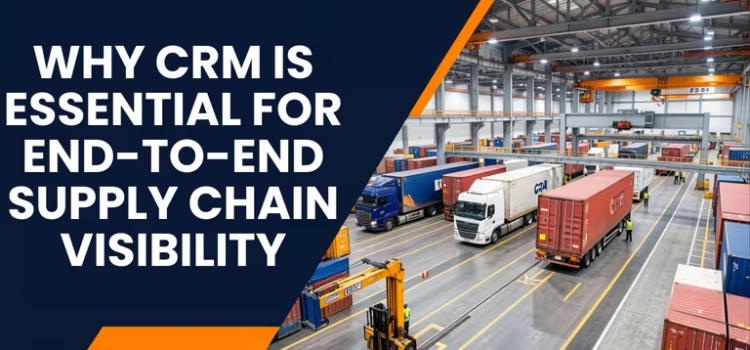
Real-time supply chain visibility with CRM is now a major concern in the struggle to remain competitive in today’s diverse international markets. Companies are no longer judged solely by how effectively they produce goods, but by how well they can track and manage all mechanisms along the supply chain, including suppliers and final consumers. Achieving this level of oversight is possible through integrated systems delivering real-time insights, allowing accurate forecasting, and supporting proactive decision-making. Without a complete picture of operations, companies risk delays, inefficiencies, and dissatisfied clients, which can significantly impact profitability and reputation.
CRM, or customer relationship management systems integration, has become a strategic mechanism for enhancing supply chain visibility with CRM. By linking information about customer contacts, order history, and communication channels to operational processes, organizations can better understand demand patterns and operational bottlenecks. This capability allows businesses not only to respond quickly to disruptions but also to anticipate challenges, streamline operations, and improve customer satisfaction. The power of CRM has been further amplified by modern AI-enabled CRM systems, which provide predictive analytics and automated insights to support proactive decision-making across the supply chain.
Understanding the Role of CRM in Supply Chains
CRM systems are not only tools to manage customer relationships; they have also become integral to supply chain visibility with CRM. These systems centralize critical information, making it easily accessible to teams in procurement, production, and logistics. By connecting customer requirements with supply chain operations, organizations can ensure that production schedules align with market demands. Such integration minimizes the risks of overproduction or understocking, both of which can be economically and operationally detrimental.
Communication between departments is also enhanced by the fact that CRM is used in managing supply chains. Information sharing among sales, marketing, and operation teams when providing information on a single CRM platform removes information silos, which frequently causes delays or mistakes. The teams are able to work better, answer the customers with the right information and adjust to the demand or supply shifts very fast. Such coordination is especially necessary in international supply chains, which can be destabilized by delays in one market and cause a ripple effect in various markets.
To build a strong foundation for end-to-end visibility across suppliers, operations, and customers, professionals often start with structured learning such as Supply Chain Visibility Fundamentals Course, which explains how real-time data and integrated systems enable proactive decision-making. 
Enhancing Forecast Accuracy with CRM
Supply chain management requires proper forecasting of its processes, and the CRM systems are essential in this. Demand prediction can be more reliable by examining previous customer information, order trends, and market trends. This predictive potential is used to ensure that companies optimize inventory stocks, organize their production cycles and efficiently distribute resources. Prediction using the CRM knowledge will be able to make the supply chains dynamic and able to react to changes without creating undue delays and wastages.
Accurate forecasting depends on measuring the right performance indicators. Programs such as Essential Supply Chain KPIs Measure, Analyze, Improve help organizations translate CRM data into actionable metrics that improve planning accuracy and operational performance.

Besides enhancing operational efficiency, proper financial planning is facilitated by proper forecasting using CRM. Companies are able to save carrying costs of excess stock at the same time reduce the risk of shortages caused by stockouts, which may have an effect on the different revenues. Moreover, predictions are also accurate because the implementation of AI CRM applications helps identify patterns and anomalies in customer behavior that the human eye might fail to recognize otherwise. These insights help organizations to make evidence-based decisions, which reinforce operational performance and customer satisfaction.
Supporting Supplier and Vendor Relationships
This is because a robust supplier and vendor relationship is key to a resilient supply chain, and supply chain visibility with CRM helps attain this objective. With interaction monitoring, contracts, and performance indicators, enterprises can evaluate supplier quality and predict potential risks before they escalate. A CRM system consolidates this data, giving teams all the tools needed to manage supplier expectations, negotiate effectively, and ensure stable operations across the supply chain.
CRM systems also contribute to collaboration with suppliers in addition to relationship management. With the availability of the appropriate demand information and order forecast, vendors are able to organize better production and deliveries. Such transparency lowers chances of delays, miscommunication and inventory mismatches. Finally, the use of CRM to deal with suppliers helps in keeping the supply chain resilient, sensitive, and focused towards the objectives of the organization.
Improving Order Management and Tracking
The achievement of end-to-end supply chain visibility is strongly dependent on efficient order management, and supply chain visibility with CRM boosts the process by connecting customer orders with internal operations. With order history, shipment statuses, and customer feedback stored in one platform, organizations can monitor each order from initiation to delivery. This transparency enables any issues, such as late deliveries or production bottlenecks, to be addressed immediately, minimizing disruptions and ensuring customer loyalty.
CRM systems also facilitate communication between the customer and the customer concerning their orders. The system creates automated updates and alerts that notify clients on the timelines of the delivery of their goods, availability of their products and any delays. Incorporation of AI CRM solutions only contributes to these possibilities by making such applications predictive and indicating remedial actions when an issue is noted. Practically, by incorporating operational control with active communication, enterprises will be able to handle orders more effectively and enhance the reliability of the supply chain as a whole.
Facilitating Demand-Driven Planning
Demand-driven planning has emerged as a fundamental element in the modern supply chain strategies and CRM systems are of prime importance in facilitating the strategy. CRM platforms create an opportunity to change production and inventory levels based on the real, rather than only forecasted, demand by providing real-time insights into the customer behavior and market trends. This responsiveness assists in avoiding overproduction and is used to minimize leftovers and also makes sure that the product is where and when the customer requires them.
Intelligence of the AI CRM technologies can boost the demand-driven planning, detecting patterns and correlations that cannot be observed instantly. The machine learning algorithms will be able to compute customer preference, seasonal, and market trends to develop actionable recommendations to implement supply chain modifications. The insights can enable the decision-makers to streamline resource allocation, enhance service levels, and keep up with competitors in the fast-moving industries.
Strengthening Risk Management in the Supply Chain
Risk management is an essential element of supply chain management, and CRM systems offer useful applications to reduce possible interruptions. Through the unification of data on the performance of suppliers, customer behaviour, and trends in operation, business entities can be able to determine its weak points and make proactive efforts to solve the weakness. This visibility enables the organizations to react swiftly to issues like delays of the suppliers, transport issues, or even drastic demand.
Scenario planning and predictive risk analysis is also done through CRM platforms. Having historical data and AI-based insights, supply chain managers may model the disruption possibilities and calculate the effects on operations. This would allow making decisions more informed and minimizing the chances of expensive surprises. With the adoption of CRM in the risk management plans, the businesses are more resilient and their continuity in the complex supply chain networks.
Enhancing Customer Satisfaction Through Supply Chain Transparency
Customer satisfaction is directly related to end-to-end supply chain visibility, and CRM systems play a significant role in realizing this visibility. Businesses can be able to control customer expectations by giving them accurate information on order status, delivery time and also the availability of products. Such a degree of openness generates confidence and long-term commitment because the clients will believe that their needs are being preempted and will be addressed in a timely manner.
CRM sites also enable the organizations to collect and process customer feedback in regard to the supply chain performance. Survey insights, complaints, and reviews can be used to make improvements in the shipping efficiency, product quality or communication. The combination of these insights and operational data will make sure that changes are made based on the reality of customer experience and will eventually build strong relationships and improve customer experience.
Supporting Collaboration Across Departments
The effectiveness of the supply chain relies on good coordination among the departments and the CRM system helps in the coordination. The centralization of data (sales, marketing, production, and logistics) provides CRM platforms with an asset to ensure that all groups of the organization are working on a common basis with respect to demand, inventory, and operational priorities. This synchronization minimizes the communication issues and makes responses quicker in case of any difficulties, which helps to streamline the work of the supply chain.
It is also enhanced through collaboration, as CRM systems can also have AI capabilities that can analyze the data and provide actionable insights. Teams are able to concentrate on key choices instead of manual data reconciliation, which liberates funds to improve creativeness and address issues. This is a joint strategy that will keep the supply chain objectives in line with the overall business objectives and the capability of the organization to react to the changing market environment proactively.
Enabling Continuous Improvement in Supply Chains
To be competitive in the modern market, constant improvement is critical and CRM systems can help achieve this objective by offering operational knowledge in the form of supply chain performance. Observing the indicators of quality of orders, delivery time, and the consistency of suppliers, the business can outline the inefficiency and make specific improvements. Tracking the progress over time is also possible and this will ensure that the improvements can be sustained and measured.
The continuous improvement is further accelerated as AI CRM technologies identify patterns and anomalies, which would not have been detected. Predictive analytics are able to recommend operational changes, redistribution of resources, or optimization of processes, and can assist organizations to focus supply chain strategies proactively. With the help of CRM as a performance measurement system, the company will be able to sustain a continuous cycle of improvement that will increase efficiency, minimize costs, and improve customer relations.
Integrating Technology for Future Supply Chains
The supply chain management of the future will greatly depend on the integrated technological solutions and CRM systems are a key point of this change. When combined with other technologies like CRM, ERP systems, AI analytics, and the Internet of Things (IoT)-enabled devices, companies will be able to attain a continuous visibility of all the stages of the supply chain. The result of this integration is to be able to track in real time, predictive maintenance and automated decision making which offers competitive advantage in a fast changing business environment.
AI CRM platforms are especially significant in facilitating such technological developments. They are responsive and resilient in supply chains because their capabilities to analyze large volumes of data, trends, and actionable insights are always available. Through the adoption of CRM-based technology integration, the organizations would be in a good position to manage any challenges they may encounter in the future and also provide better value to their customers and stakeholders.
Conclusion on the Importance of CRM
CRM systems have also developed further than the conventional customer management tools as they are now considered important features of an end to end supply chain visibility. CRM platforms allow organizations to work more efficiently and react more proactively to the market forces by centralizing information, improving teamwork, facilitating demand-based planning, and better risk management. These capabilities are further enhanced through the integration of AI CRM which offers predictive capabilities and automated decision support that drives supply chain performance.
The need to have end-to-end supply chain visibility is no longer a choice in the contemporary competitive world. Companies that are successful in utilizing CRM systems are able to streamline operations, enhance customer satisfaction and be resistant to the impact of disruption. The strategic application of CRM guarantees the businesses to be agile, informed and competent in delivering consistent value to the supplier till the customer as supply chains become more complex.