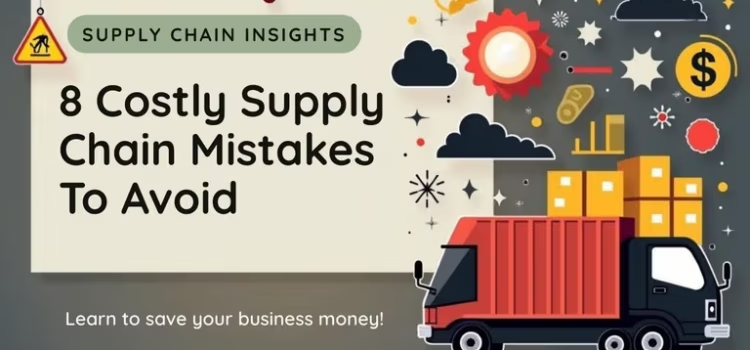
Supply chains keep business operations in full swing, but a single mistake can cause delays, raise costs, and even disappoint customers. Many companies keep repeating the same mistakes, and they are not hard to spot.
If you or your teams frequently make any of the mistakes discussed in this post, understand that it can be expensive to fix them if they are escalated. So, to avoid mistakes that drain money and damage reputation, keep reading to gain valuable insights.
Note: Every professional should understand the basics of supply chain before moving to advanced topics.
1. Neglecting Process Efficiency
Some companies install advanced systems before they clean up their existing workflows. When automation is applied to a bad process, it makes it worse. For instance, paper-based processes still exist in many warehouses, which slow things down and increase the chance of errors. The right way to introduce automation is to fix the process first and then automate.
Fix the process first with this inventory planning and control course
Here’s a two-step clean-up process:
- Document each step
- Remove waste
Once the flow works well manually, adding technology will simplify it rather than complicate the problem.
2. Focusing on Every Little Detail
Visibility is important, but chasing complete visibility across every detail is a mistake. Why? It spreads resources too thin. Instead, it makes sense to track areas that directly influence results. You don’t necessarily need access to real-time data from one end of the supply chain to the other and drown yourself in it to the point where it’s hard to see the wood for the trees. But you do need to know the points where visibility adds value and to apply solutions at those points.
One of these points is order, shipment location, and delivery, and another is understanding market demand. You can use a free keyword research tool to identify trends in search queries related to your products and services and gain valuable insights into what your target audience is looking for to adjust your inventory and sourcing strategies accordingly our inventory management fundamentals course can help.
3. Having No Back-Up Suppliers
Using one supplier may look efficient on paper. Prices can be better and relationships easier to manage. With that said, depending on a single supplier is always risky. Supplier failure can shut down production overnight due to:
- Natural disasters
- Political changes
- Financial problems the supplier may be facing
Having a few backup suppliers and building relationships with them something you’ll practice in our Free procurement course. Can protect against the effects of these eventualities. Even a partial secondary supply line can keep the business running during a disruption.
4. Using Outdated Data
Data stored across multiple systems means updates can be sporadic, which is dangerous for any supply chain. Even minor mismatches can cause big problems later.
- If product codes differ between systems, shipments may end up going to the wrong place.
- If orders are updated in one system but not others, the wrong items may get shipped.
Incomplete or outdated information makes planning unreliable. Outdated inventory data leads to stockouts or overstocking. One central, real-time data source solves most of these issues.
Companies should learn to maximise the use of the current system. SCMDOJO Course The Supply Chain Information Systems will provide them indepth knowledge.

5. Using Fragmented Workflows and Disconnected Tools
Another data-related mistake some companies make is that they still manage supply chains with spreadsheets and apps that may be disconnected from each other. As a result, teams end up working in isolation. Here are some consequences of fragmented workflows:
- People collect information from different places
- Decisions may be delayed
- Each handover between departments risks losing critical details
Integrated tools that link planning, operations, and reporting like those covered in our designing supply chain network course fix this. When everyone works from the same system, the supply chain moves faster and with fewer mistakes.
6. Being Too Dependent on Point-to-Point Integration
Point-to-point connections between systems work great for small setups. However, as more systems are added, they can become a burden. Every change requires multiple updates, and problems in one link can ripple across the network. This slows improvements and raises IT costs. A hub-based integration model removes that burden (learn how in our How to create a supply chain strategy course). Systems connect to one central platform, making changes simpler and reducing the risk of breakdowns.
7. Treating Planning and Execution as Mutually Exclusive
When planning and execution are done using different systems, schedules may be based on assumptions that are already outdated. Planners and operations teams could struggle to carry out the plans efficiently. The result is
- Missed deadlines
- Wasted resources
- Unhappy and sometimes even disgruntled customers
Planning and execution done in tandem solves this, especially with adjustments made as soon as conditions change. This turns abstract plans into realistic, actionable schedules.
8. Making Decisions in Isolation
Many companies focus only on optimizing their own part of the supply chain. This narrow view can result in the loss of network-wide opportunities. For example, sharing demand forecasts with suppliers helps them prepare materials early and reduce lead times. Coordinating with transport partners can improve delivery rates while cutting costs. Working together across the supply chain improves efficiency for everyone involved explore our Free Supply chain management training
In What Way Do These Mistakes Cost Companies?
Each mistake we discussed above carries some hidden costs. But the damage goes way beyond immediate expenses. Inefficient processes can lead to operational bottlenecks that slow down production. Poor visibility or stale data inevitably leads to bad decisions. Now think of applying those decisions to disconnected workflows.
When both planning and execution are flawed, there will be one error leading to another. The outcome? Endless rework and product recalls (if your company offers products). While you may not see any immediate losses, the budget overruns stay hidden in plain sight. They appear later as lost sales, customer complaints, and missed growth opportunities.
What to Do to Keep These Mistakes From Happening
It’s human to make mistakes, but when businesses can fix them as soon as they occur, they can see measurable gains. If numbers trend downward due to lousy slip-ups, they can go right back up when teams take quick steps to address the issues.
Having said that, it’s always better to be cautious and prevent issues from occurring. Here are some proactive steps teams can take to keep the supply chain running smoothly like a well-oiled machine:
- Audit each and every process to spot inefficiencies early on.
- Make detailed records and create small teams to address the issues.
- Use real-time tracking to monitor not just the movement of goods but also processes.
- Create a single source of truth for everyone to access the same data.
- Factor in internal and external risks and develop plans to mitigate them.
- Explore onshore sourcing options to be less reliant on international logistics.
- Invest in supplier relationships so that emergencies can be handled with greater certainty.
- Establish and maintain direct lines of communication for quick relay of updates.
Final Thoughts
Supply chain mistakes are avoidable, but even if they happen, the payoff of fixing them immediately is measurable outcomes. A simple reason for these mistakes is that many still hold on to outdated processes. But this can be changed. Bring in better systems to create stronger processes and watch your teams trip up less often.
For structured training from industry experts, explore our SCM courses online. Start with our free procurement course, inventory planning and control course, and Developing a supply chain strategy course.