When I started my blogging I wrote a blog on 8 Technical Supply Chain Competencies in Nov 2015. It was pretty basic and was more based on experience than research work. However, I did receive some good feedback on this article. On the back of that I have had opportunity to sponsor a Master’s research work to explore Components of Material Management Technical Competencies at Lancaster University.
Nurul Amira, who is also the co-author of this article, has identified 11 Components of Material Management Technical Competencies for supply chain professionals as part of her research work.
The purpose of this research project was to build a materials management competency audit tool that would be available for supply chain professionals to self-assess them selves, ask their colleagues, or direct report employees, so that relevant skills are identified which would then assist in the level of training that is provided, through the assignment of short courses, certificates or relevant materials through online training platform such as Udemy, Coursera, APICS, IoSCM or recommended books to name a few.
To develop further technical competencies that should be useful for supply chain practitioners, we have built a comprehensive and well researched Materials Management Competencies Assessment (MMCA) Tool.
The Components of Material Management Technical Competencies are identified through carrying out extensive literature review and summarising each field so that a short description below in each headings.
The survey questionnaire contains the list of skills that are required under each Components of Material Management Technical Competencies. Next to each skill, the assessor is able to tick the checkbox in which at the end. The total number of ticks are tallied and referenced according to the total numbers of skills available under each competency.
So, the higher the number tick boxes, the more you know about that specific competency and related skills. The lower the tick boxes means this is the area of improvement and you should seek to close that gap by further reading or training.
My aim to make this materials management technical competencies audit tools available online under tools, so the supply chain community members can complete online and get the results in dashboard with recommendations to close the gap!
Materials Management & Role of a Materials Manager
Materials management with specified interest in the manufacturing industry is the procurement of services, materials, equipment and supplies in the right quantities, of the right qualities, at the right time for the right price on a rolling basis without the loss of labour and time (Leenders et al., 1980; Kurian, 2013).
The role of a materials manager in the manufacturing industry is to ensure the acquisition made in terms of managing material shortages and abundance, availabilities of required materials and delivery lead times for materials required as well as transportation of finished products are well governed (Leendors et al., 1980).
Materials manager is also required to identify strategic decisions in terms of procurement with varying prices in addition to drawing up procedures that can be followed in line with the policy of the organisation (Leendors et al., 1980). Additionally, the role of a materials manager is also associated with the identification of materials required, the sourcing and procurement of the necessary materials, the introduction of the sourced materials and the assessment of the use of the materials as a value adding entity.
Connected to the basis of the requirement for a materials manager, the key competencies that are expected are outlined in the literature that follows.
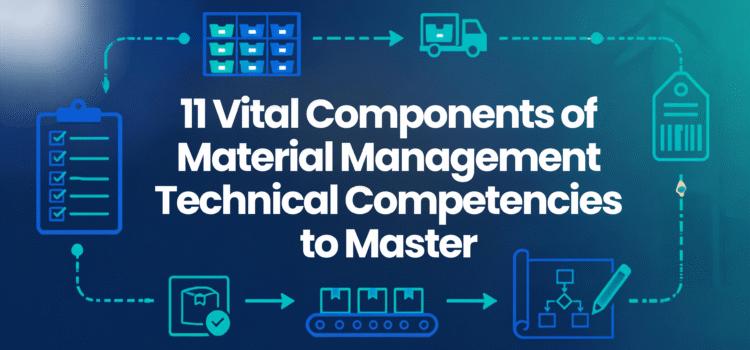
11 Components of Material Management Technical Competencies
1. Strategic Sourcing and Purchasing
Strategic sourcing and purchasing is the calculated decision making process in choosing the right materials of the right quantity, at the right time for the right time, this includes procurement decisions which involves the selection of vendors, and materials.
2. Inventory Management
Inventory management is the organisation of stock control in the manufacturing to distribution/warehouses and alternately, from the warehouses to the location of sales.
3. Material Requirements Planning
Materials Requirement Planning is the scheduling, planning and inventory control process, which dictates the manufacturing processes in terms of materials required and product output.
4. Capacity Planning
Capacity planning is the determination of the amount of products required by the organisation to meet the demands of its customers. The design capacity in turn is the amount of product demand that the organisation is capable in meeting.
5. Process Planning
Process planning is the usage of technology to assist in the manufacturing of products and in the arrangements in meeting the demands set by the organisation.
6. Demand Management and Forecasting
Demand management is the method used to forecast the demand that the organisation would potentially be looking at meeting. Forecasting are methods adopted to predict the actual demand that an organisation would be expecting during a manufacturing cycle period.
7. Sales and Operations Planning
Sales and Operations Planning is the synchronization of the entire manufacturing processes to enable effective supply chain management.
8. Risk Management
Risk management is the strategic management of processes in the manufacturing line through control of static and dynamic materials to ensure that an organisation is able to maintain profitability rather than conduct activities that would increase cost of production and inventory holding.
9. Supply Chain Continuity
Supply chain continuity is the elimination of risks that would otherwise cause unpredictable breakage in the production line, which would affect the company performance.
10. Physical Distribution Management
Physical Distribution Management is the streamlining of all processes after the manufacturing of end processes, which includes transportation, packaging, customer service and inventory control.
11. Supply Chain Resilience
Supply chain resilience is the ability of the supply chain to cope with major shock and its capability to maintain output and customer service.
Bringing It All Together
The above-mentioned Materials Management Technical Competencies are ideal core requirements to assess technical knowledge, skills, and abilities needed by for a Materials Management or Supply Chain Professionals in the manufacturing industry.
The competencies have been simplified in this self assessment tool with set of skills under each heading to ease data collection. Please include email address to ensure there is no duplication of data.
Thank you for downloading the self assessment tool in advance. And if you like to add more Components of Material Management Technical Competencies, please do write in comments or at my twitter account, so we can learn from you as well.
Frequently Asked Questions (FAQs)
What is the primary role of a Materials Manager in the manufacturing industry?
A Materials Manager is responsible for procuring services, materials, and equipment in the right quantities and qualities, at the right time, and for the best price. Their duties include managing material shortages and abundance, overseeing delivery lead times, transporting finished products, and making strategic procurement decisions that align with organizational policies.
What is the purpose of the Materials Management Competencies Assessment (MMCA) tool?
The MMCA tool is designed to help supply chain professionals self-assess or evaluate their colleagues and direct reports on critical technical skills. By identifying specific knowledge gaps, the tool helps pinpoint the exact training, courses, or reading materials required to improve a professional’s competency.
What are the 11 Components of Material Management Technical Competencies?
Based on extensive research, the 11 core competencies are:
- Strategic Sourcing and Purchasing: The calculated process of selecting vendors and procuring the right materials.
- Inventory Management: Organizing stock control from manufacturing to warehouses, and ultimately to the point of sale.
- Material Requirements Planning (MRP): The scheduling, planning, and inventory control processes that dictate manufacturing output and material needs.
- Capacity Planning: Determining the product volume needed to meet customer demand against the organization’s actual manufacturing capabilities.
- Process Planning: Utilizing technology to assist in manufacturing arrangements and meeting organizational demands.
- Demand Management and Forecasting: Using specific methods to predict and manage the actual demand expected during a manufacturing cycle.
- Sales and Operations Planning (S&OP): Synchronizing the entire manufacturing process with sales to enable cohesive supply chain management.
- Risk Management: Strategically managing manufacturing line processes to control materials, maintain profitability, and prevent unnecessary production costs.
- Supply Chain Continuity: Proactively eliminating risks that could cause unpredictable, damaging breaks in the daily production line.
- Physical Distribution Management: Streamlining all post-manufacturing processes, including packaging, transportation, customer service, and outbound inventory control.
- Supply Chain Resilience: The overarching ability of the supply chain to absorb major, unexpected shocks while maintaining output and customer service levels.
How do Supply Chain Continuity and Supply Chain Resilience differ?
While both deal with risk, Continuity is focused on proactive risk elimination to prevent day-to-day breakages in the production line. Resilience is the broader, reactive capability of the entire supply chain to absorb and recover from major, unforeseen global shocks (like natural disasters or sudden economic shifts) without halting customer service.
What is the difference between Demand Management and Capacity Planning?
Demand Management focuses outward on the customer using forecasting methods to predict exactly how much product the market will want. Capacity Planning focuses inward on the organization determining if the company’s manufacturing design and resources are actually capable of meeting that forecasted demand.
About the Author- Dr Muddassir Ahmed
Dr. Muddassir Ahmed is a globally recognized supply chain expert, thought leader, and keynote speaker. As the Founder & CEO of SCMDOJO, he has built one of the world’s leading platforms dedicated to empowering supply chain professionals with cutting-edge knowledge, practical tools, and access to expert insights. With over 19 years of leadership experience spanning the UK, Europe, the Middle East, and Southeast Asia, Dr. Ahmed has held key roles at Bridgestone, Doncasters Group, Eaton, and Volvo Cars, managing multi-million-dollar supply chain operations.
His expertise spans all facets of supply chain management, with a particular focus on leveraging technology and innovation to optimize processes and build resilient supply chains.
Recognized among the Top 10 Supply Chain Influencers in the World by Supply Chain Digital, Dr. Ahmed has been instrumental in shaping industry best practices through his extensive research, vlogs, and thought leadership. Holding a PhD in Management Science from Lancaster University Management School, he is also a certified Six Sigma Black Belt.
His platform, SCMDOJO, serves a vibrant community with over 51,000 monthly visitors. Moreover, he has 72,000 newsletter subscribers, and a social media following exceeding 105,000 supply chain professionals
A sought-after keynote speaker and thought leader, sharing his insights on industry trends, best practices, and the future of supply chain management. Dr. Ahmed delivers high-impact talks on supply chain excellence, digital transformation, and strategic leadership. His mission is clear: to help supply chains thrive
You can follow him on LinkedIn, Facebook, Twitter