JIT Purchasing different from Conventional Purchasing?
Most of us have worked in both some sort of JIT purchasing (Just In Time purchasing) and conventional manufacturing business. However, in the lean environment, the supply chain process should be capable of supporting Just in Time manufacturing. Manufacturers and suppliers have to adopt an appropriate method of supply acquisition to have availability of right material at right time at right price and in right quality. The Table by Abraham et. al. (1990) shows some of the differences between Just in Time purchasing and conventional purchasing you might be interested to read.
Get 5S – Kaizen Guide to Organize the Workplace for Flow
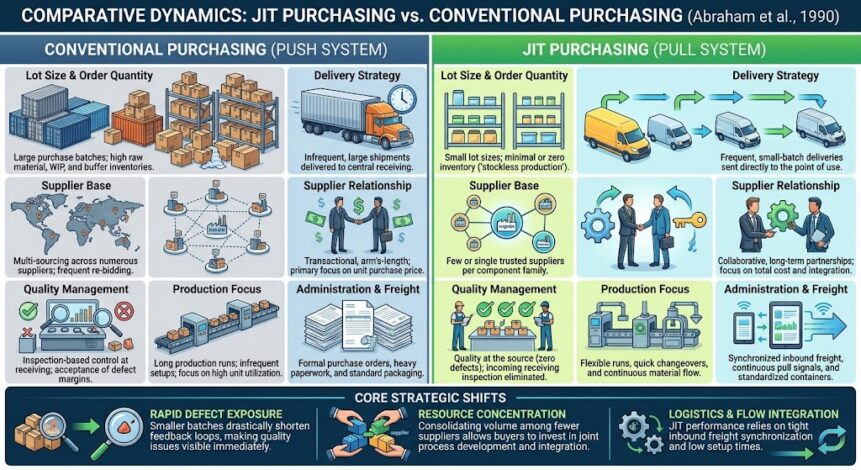
Here are 3 reasons why ‘Just in Time (JIT) purchasing’ is different from ‘conventional purchasing’:
Small Lot Sizes
What I have noticed is parts purchased in small lot sizes is one factor for improving product quality. The smaller the lot size the easier it is to inspect and uncover defects and the earlier the detection of defects.
Small Number of Suppliers
The second important criterion is the number of suppliers. Ideally dealing with a smaller number of suppliers has many advantages, as discussed in earlier sections, but in terms of purchasing the benefits are:
- long term relationship;
- Buyers can work closely with suppliers and ask them to participate fully in JIT purchasing.
- Consistent quality; it is easier to involve suppliers in the early stage so for Design
- Saving of resources; money can be concentrated on selecting, developing and monitoring one or few qualified sources.
- Lower costs; the overall volume of items purchased is higher, which eventually leads to lower cost.
- Special attention; inclined to pay special attention to buyers, since the buyers represents large accounts
- Saving on tooling; the amount spent on supplier tooling is minimal.
High Performance Standard
The next important criteria in JIT purchasing, is a formal suppliers election and evaluation program. However the main issue is for the selected suppliers to be able to support JIT purchasing. Not every supplier can be developed into JIT Supplier. Supplier’s delivery performance, product design specification paper work, bidding and packaging should be evaluated regularly with
Phases of implementing JIT purchasing
The key phases for implementing the JIT purchasing are as follows:
- Commitment;
- Top management in both the manufacturer and supplier
- Companies must gain commitment from employees to award just in time purchasing.
- Changing the system; a purchasing department must focus on changing the sourcing, pricing and procurement methods to a JIT purchasing system. Relationships with suppliers must be improved to enable a JIT purchasing procedure to be installed.
- Selection of suppliers; JIT manufacturers must select suppliers who can support JIT operation and who are willing to commit to a JIT purchasing system.
- Building relationships; once a JIT purchasing department s established it requires continuous effort to improve the relationship which will promote better efficiency in the purchasing operation.
- JIT purchasing implementation will not be successful lf inbound freight scheduling is not reliable and is left to the transportation system.
- The purchasing department will have to ensure that the transportation system is efficient and reliable ably taking responsibility of other alternatives to allow suppliers to take on that responsibility.
What are the other aspects which differentiate between JIT Purchasing and Conventional Purchasing, please do let me know.
Frequently Asked Questions (FAQs) About JIT Purchasing
What is Just-in-Time (JIT) purchasing?
JIT purchasing is a lean supply chain strategy where manufacturers acquire materials so that they arrive exactly when they are needed for production. The goal is to minimize inventory holding costs and ensure the availability of the right material, at the right time, and in the right quality.
Why does JIT purchasing prefer small lot sizes?
Purchasing parts in small lot sizes helps improve overall product quality. Smaller batches make it significantly easier and faster to inspect items, allowing for the early detection and correction of defects before they impact the entire production line.
Why do companies using JIT work with a smaller number of suppliers?
Relying on a select few suppliers allows companies to build strong, long-term relationships. This approach ensures consistent quality, saves resources on monitoring multiple vendors, lowers costs due to consolidated buying volume, and allows suppliers to be involved early in the design process.
What is required from a supplier to participate in a JIT system?
Suppliers must meet extremely high performance standards. They are regularly evaluated on precise delivery performance, product design specifications, bidding, and packaging. Not every supplier is capable of becoming a JIT partner, as it requires absolute reliability and a willingness to commit to the manufacturer’s tight schedules.
What are the key steps to implementing JIT purchasing?
Successful implementation requires several phases:
- Commitment: Securing buy-in from top management and employees at both the manufacturer and the supplier.
- System Changes: Adjusting sourcing, pricing, and procurement methods to align with JIT principles.
- Supplier Selection: Identifying and partnering with suppliers capable of and willing to support JIT operations.
- Relationship Building: Continuously improving efficiency and communication with selected partners.
- Reliable Transportation: Ensuring inbound freight scheduling is highly efficient, as JIT fails without dependable logistics.
About the Author- Dr Muddassir Ahmed
Dr. Muddassir Ahmed is a globally recognized supply chain expert, thought leader, and keynote speaker. As the Founder & CEO of SCMDOJO, he has built one of the world’s leading platforms dedicated to empowering supply chain professionals with cutting-edge knowledge, practical tools, and access to expert insights. With over 19 years of leadership experience spanning the UK, Europe, the Middle East, and Southeast Asia, Dr. Ahmed has held key roles at Bridgestone, Doncasters Group, Eaton, and Volvo Cars, managing multi-million-dollar supply chain operations.
His expertise spans all facets of supply chain management, with a particular focus on leveraging technology and innovation to optimize processes and build resilient supply chains.
Recognized among the Top 10 Supply Chain Influencers in the World by Supply Chain Digital, Dr. Ahmed has been instrumental in shaping industry best practices through his extensive research, vlogs, and thought leadership. Holding a PhD in Management Science from Lancaster University Management School, he is also a certified Six Sigma Black Belt.
His platform, SCMDOJO, serves a vibrant community with over 51,000 monthly visitors. Moreover, he has 72,000 newsletter subscribers, and a social media following exceeding 105,000 supply chain professionals
A sought-after keynote speaker and thought leader, sharing his insights on industry trends, best practices, and the future of supply chain management. Dr. Ahmed delivers high-impact talks on supply chain excellence, digital transformation, and strategic leadership. His mission is clear: to help supply chains thrive
You can follow him on LinkedIn, Facebook, Twitter