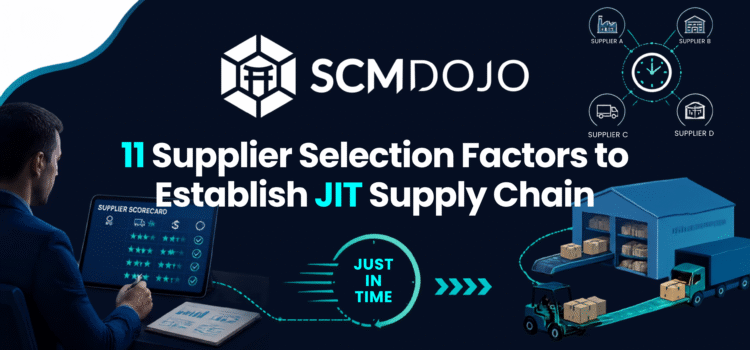
In a JIT supply chain, reliable suppliers will reduce supply uncertainty and make the supply chain more effective, therefore supplier selection is crucial. However, Purchasing in JIT environment is different and therefore it requires a slightly different mindset for selecting suppliers who can survive in JIT Supply Chain long term. Researchers1 suggested that the selection and evaluation of supplier’s ability to delivery in JIT Supply Chain should be based upon the following factors:
Get 5S – Kaizen Guide to Organize the Workplace for Flow
Get 5S – Kaizen Guide to Organize the Workplace for Flow
JIT Supply Chain- Quantitative & Qualitative Supplier Selection Factors
1. Delivery of a Quality Product
2. Delivery On-Time.
3. Frequent Deliveries.
4. Delivery in Small Quantities.
5. Delivery of Exact Quantities.
6. Supplier’s Management Policy and Philosophy
7. A Willingness and Openness to Share Data and Information
8. Attitude towards Partnership
9. Willingness to Undertake Continuous Improvement
10. Desire to Develop New Products
11. Ease of Communication at All Levels
Hall (1983) suggested capacity and willingness to improve as additional criteria to the above list.
Carr and Truesdale (1992) stated that Nissan’s supplier selection team visits supplier factories frequently. They evaluate delivery reliability similar to those above. They evaluate products from design and development through to the manufacturing processes.
The Nissan team also looked at planning, operation, tidiness, appearance of workshop, working situation and professionalism. For professionalism they looked at engineering management attitude, the number of engineers employed, how they are structured, their technical capability and their influence within the organisation. Supplier’s location and market size is of less importance to Nissan.
Aleo (1992) described the supplier selection procedures of Kodak. A selection team is formed by Kodak consisting of multi-discipline specialists. They developed a suitable decision matrix for the particular product under the evaluation. The suppliers are ranked numerically according to their ability to meet Kodak’s programmed needs.
The selection process started with a review of current documentation pertaining to their suppliers. A comparison of supplier capabilities is then recorded in the decision matrix. The team review all historical data, quality, delivery and inspection procedures. Kodak maintained an open communication with its suppliers in the area of quality improvement and advised suppliers who failed to achieve the expected quality standards. A follow-up inspection is undertaken to ensure that the agreed changes have been carried out.
Southey (1993) described the current practices of supplier appraisal as more encompassing than before. The appraisal can be divided into two areas namely quantitative and qualitative. Quantitative includes location, financial position, facilities and capacities, technical capability and standards of quality, whereas Qualitative consists of items 6-11 in list above.
Southey (1993) also suggested other general evaluation criteria when there are numerous suppliers, for example, comparison with the level and quality of similar suppliers, supplier’s relationship with competitors, supplier’s track record and potential for future improvements to sustain JIT Supply Chain.
In JIT Supply Chain, ‘Lean supply’ requires additional supplier selection criteria. Particularly in the sense of sourcing parts close to the points of manufacture so as to keep logistic cost to a minimum. The supplier must be ready to provide a service ‘locally’ wherever the manufacturer requires it in the world. As lean production develops globally, manufacturers tend to find local suppliers prepared to compete to improve leanness.
Summary:
There has been huge amount of research done to identify suitable supplier selection criteria. The above mentioned 11 quantitative and qualitative factors are just one aspect which has been identified with keeping JIT Supply Chain only in mind.
Please do comment if you have noticed more factors to establish JIT Supply Chain.
Frequently Asked Questions (FAQs) About JIT Supplier Selection
Why is supplier selection particularly crucial in a Just-In-Time (JIT) supply chain?
In a JIT environment, inventory buffers are minimized, meaning there is virtually no room for supply disruptions. Reliable suppliers are essential to reduce supply uncertainty and ensure the entire chain remains effective. Selecting a JIT supplier requires a specific mindset focused on a partner’s ability to survive and adapt in a demanding, long-term relationship.
What are the core quantitative factors for selecting a JIT supplier?
Quantitative criteria in a JIT system revolve around precise delivery and execution capabilities. The primary factors include:
- Delivery of a high-quality product.
- Strict on-time delivery.
- Capacity for frequent deliveries.
- Ability to deliver in small quantities.
- Accuracy in delivering exact quantities.
What qualitative factors are essential for a long-term JIT partnership?
Qualitative factors evaluate a supplier’s culture, mindset, and collaborative potential. Key qualitative criteria include:
- The supplier’s management policy and overall philosophy.
- A willingness and openness to share data and information transparently.
- A positive attitude toward forming a true partnership.
- A demonstrable commitment to continuous improvement (Kaizen).
- A desire to collaborate on new product development.
- Ease of communication across all levels of the organization.
How do world-class manufacturers like Nissan evaluate potential JIT suppliers?
Nissan utilizes a hands-on approach by sending selection teams to frequently visit supplier factories. Rather than just looking at paperwork, they evaluate the physical operations including workshop tidiness, planning, and working conditions. They also heavily assess “professionalism,” which involves scrutinizing the supplier’s engineering management attitude, technical capabilities, and how their engineers are structured, placing much less emphasis on the supplier’s location or market size.
What approach did Kodak use to ensure supplier reliability?
Kodak employed multi-discipline specialist teams to evaluate suppliers using a customized decision matrix. They numerically ranked suppliers based on historical data, quality standards, and inspection procedures. Crucially, Kodak maintained open lines of communication regarding quality improvement, directly advising suppliers who fell short and conducting follow-up physical inspections to ensure agreed-upon changes were implemented.
How does “Lean supply” impact JIT supplier selection criteria?
In a global JIT supply chain, Lean principles add a distinct geographic requirement to supplier selection. Lean supply emphasizes sourcing parts as close to the point of manufacture as possible to keep logistics and transportation costs to an absolute minimum. A Lean supplier must be prepared to provide dedicated, localized service wherever the manufacturer establishes operations.
Recommended Reading:
Lean and Technology: Working Hand in Hand to Enable and Energize Your Global Supply Chain (FT Press Operations Management)

Lean Supply Chain and Logistics Management

References:
1This text is adopted from research work by Sulaiman Hasan in University of Birmingham for his SUPPLY CHAIN IMPROVEMENT FRAMEWORK (SCIF)
About the Author- Dr Muddassir Ahmed
Dr. Muddassir Ahmed is a globally recognized supply chain expert, thought leader, and keynote speaker. As the Founder & CEO of SCMDOJO, he has built one of the world’s leading platforms dedicated to empowering supply chain professionals with cutting-edge knowledge, practical tools, and access to expert insights. With over 19 years of leadership experience spanning the UK, Europe, the Middle East, and Southeast Asia, Dr. Ahmed has held key roles at Bridgestone, Doncasters Group, Eaton, and Volvo Cars, managing multi-million-dollar supply chain operations.
His expertise spans all facets of supply chain management, with a particular focus on leveraging technology and innovation to optimize processes and build resilient supply chains.
Recognized among the Top 10 Supply Chain Influencers in the World by Supply Chain Digital, Dr. Ahmed has been instrumental in shaping industry best practices through his extensive research, vlogs, and thought leadership. Holding a PhD in Management Science from Lancaster University Management School, he is also a certified Six Sigma Black Belt.
His platform, SCMDOJO, serves a vibrant community with over 51,000 monthly visitors. Moreover, he has 72,000 newsletter subscribers, and a social media following exceeding 105,000 supply chain professionals
A sought-after keynote speaker and thought leader, sharing his insights on industry trends, best practices, and the future of supply chain management. Dr. Ahmed delivers high-impact talks on supply chain excellence, digital transformation, and strategic leadership. His mission is clear: to help supply chains thrive
You can follow him on LinkedIn, Facebook, Twitter