Mastering the Supply Chain Basics: The Only Way to Beat Complexity
The world of supply chain management is constantly being bombarded with buzzwords: AI, Blockchain, IBP, and hyper-automation. While these innovations are exciting, they often distract from the most fundamental truth in SCM:
Complexity is the silent killer of profitability and performance!
For many supply chain professionals, daily life is a constant cycle of firefighting, endless meetings, and wading through outdated ERP systems. We aspire to achieve digital transformation, yet we struggle with the most basic processes. Why is mastering the supply chain basics so challenging, and how can we return to these fundamentals to unlock true, high-performing SCM?
The Problem: Supply Chains Are Overloaded With “Too Many”
Across industries, the story is the same:
- Too many products that add no value
- Too many suppliers that fragment focus
- Too many distribution centers that add complexity, not efficiency
- Too many KPIs that distract instead of guide
- Too many tools that don’t talk to each other
- Too many meetings, emails, and manual interfaces
- Too many management layers slowing decisions
The result?
- Endless firefighting
- Low visibility and poor execution
- Slow decisions
- Burnout among planners
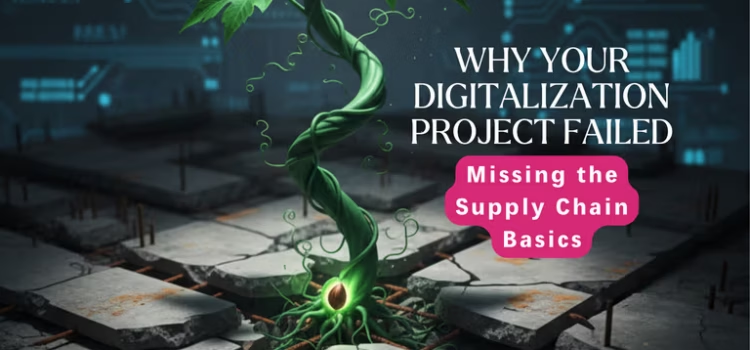
- Digitalization projects that fail because the basics are broken
Companies want to leap to AI and IBP, but you cannot automate chaos.
The Six Core Complexity Traps Killing Your Supply Chain
The biggest challenge in achieving supply chain bacis is that complexity builds up slowly, often disguised as progress. It is created by commercial decisions that look good on paper but are nightmares for the operational team.
The six primary areas where companies especially large corporations allow unnecessary complexity to take root:
1. Excessive Product & Supplier Portfolios (The A-B-C Trap)
Many companies over-sell and over-source. The result is a massive investment of time and energy into products (C-codes) and suppliers that offer almost no significant revenue or margin.
- Too Many Products: When you sell hundreds of thousands of SKUs, the complexity of forecasting, planning, and inventory management for the non-significant items becomes a massive drain on resources. You can benefit by reading further on 7 Easy Methods to Rationalize Your SKU
- Too Many Suppliers: Spreading focus across countless suppliers means you can’t dedicate enough time to forging strong, strategic partnerships with the few that genuinely drive your business. The solution here is to implement a Supplier Excellence Manual, whcih is a comprehensive document that outlines the standards, expectations, and requirements for suppliers to meet in order to maintain a strong and mutually
The Lesson from Apple: As an example of radical simplicity, Apple focuses intensely on a few core, high-impact products and utilizes a highly focused supplier strategy to achieve near-perfect execution and quality.
2. Bloated Distribution Networks (The DC Sprawl)
Adding more Distribution Centers (DCs) might seem like an easy way to save lead time or reduce shipping costs, but the trade-off in complexity is often catastrophic. Moving from one DC to two DCs creates massive spikes in planning, system interface, and team management complexity. When you reach 35, 40, or 50 DCs, the network becomes unwieldy and incredibly costly to synchronize.
SCMDOJO course on Supply Chain Network Design helps you learn what the optimum distribution network is to minimise transportation, sourcing, warehousing, and inventory costs and solve the issue of Bloated Distribution Networks.
3. KPI Overload and Management Layers
In large organizations, complexity increases in direct proportion to the layers of management and the number of metrics required to justify everyone’s existence.
- Too Many KPIs: When a Supply Chain Director spends hours every day just creating reports for multiple VPs, it’s a clear signal that the team is focused on justification rather than execution. Simple, focused KPIs are better than complex dashboards that confuse action.
- Too Many Bosses: Excessive layers of management slow decision-making, increase the need for reporting, and force operational staff to spend more time explaining their work than improving it.
We recommend simplifying your KPIs and implementing this basic Supply Chain KPI Dashboard to track, monitor and improve your supply chain performance.
4. The “Spaghetti Plate” of IT Tools
Every time a new need arises a tool for forecasting, a system for reporting we often add a new application instead of fixing the core system. Over time, this creates a disjointed “plate of spaghetti” where multiple legacy tools are poorly connected, making data unreliable and processes opaque. When the original IT architects leave, the system becomes an unmaintainable legacy burden.
5. Human-Centric Communication
Despite all the talk of digitalization, many critical interfaces between departments, suppliers, and customers are still heavily reliant on slow, human-driven methods like email and meetings.
- Excessive Meetings: The ease of creating a new meeting via tools like Zoom or Teams has led to “meeting-itis,” where professionals spend their entire day discussing and fighting fires rather than executing and planning.
- Email Overload: In many supply chains, the primary management tool is still Microsoft Excel and email. This is slow, error-prone, and burns out the team.
6. The Execution Gap
As depicted in The Handbook of E&Y (1992), most teams spend too much time discussing ideas and listing actions, but spend very little time on execution.

Discussion > Listing > Execution (Incorrect)
This leads to a sense of failure and demotivation. The focus should be reversed:
Execution > Listing > Discussion (Correct)
This requires listing only a few critical actions and committing the majority of time and effort to achieving them, building confidence and momentum.
The Roadmap to Simplicity: How to Reset Your Supply Chain
If complexity is the problem, simplicity is the solution. It requires a fundamental shift in mindset, process design, and technology adoption.
1. Focus on the High-Five Core KPIs
You cannot manage what you do not measure, but you must measure only what matters. The primary objective of the supply chain professional is to balance demand and supply. This can be achieved by prioritising just five core metrics.
| KPI Category | Focus Area | Why It Matters |
| Safety | Health & Environmental Compliance | Foundation of responsible operations and risk management. |
| Delivery | On-Time Delivery (OTD) / Fill Rate | Core customer satisfaction metric and commercial credibility. |
| Inventory | Inventory Turns / Accuracy | Drives cash flow, working capital, and minimises obsolescence risk. |
| Productivity | Throughput / Cost Per Unit | Measures operational efficiency and contribution to the bottom line. |
| Quality | Defect Rate / Compliance | Reduces waste, prevents returns, and protects brand reputation. |
Read Further: Supply Chain Metrics: Key Indicators for Success
2. Embrace the Startup Mindset to Achive Supply Chain Basics: MVP and Agility
For large companies, the best path forward is to adopt the Minimum Viable Product (MVP) and the Two-Pizza Team approach popularized by Amazon founder Jeff Bezos.
Instead of launching massive, multi-million dollar digitalization projects that require buy-in from 20 stakeholders, start small.
- The MVP Approach: Build a small, functional proof-of-concept using basic, inexpensive tools (like Excel, or simple cloud apps). That is why I made a short on MVP Everything- From Projects to Process.
- Co-Create with the Customer: Do not assume you know what the customer (internal or external) needs. Build a wireframe and involve real customers early in the process. Ask them what five things they absolutely need (e.g., “Where is my order? When is it shipping?”).
- The Two-Pizza Rule: Keep project teams small no more than eight people (what two pizzas can feed). Small teams are agile, reduce meetings, and dramatically speed up execution.
Case Study: I have successfully launched a digitalisation project across 700 clients for less than $100,000 by intentionally keeping the team to four people until the MVP was proven and launched. This focused, siloed-for-speed approach minimised stakeholder conflict and achieved results quickly, as demonstrated in client testimonials.
3. Demand User-Friendly Technology
Many ERP and planning systems are overly complex, requiring extensive training just to perform simple tasks. If you can trade complex cryptocurrency on a consumer app like your phone, you should be able to check inventory with similar ease.
The future of supply chain tech must prioritize:
- UX/UI Design: Software must be intuitive and obvious to use, mirroring the simplicity of consumer applications.
- Automation: Automate non-value-add activities like reporting, data cleaning, and routine follow-ups to free up your team for strategic work.
- Excel as a Prototyping Tool: Embrace tools like Microsoft Excel, Power Query, and Power Pivot as robust, flexible platforms for building and testing MVPs before committing to expensive ERP integrations.
Best Practice Checklist for Simplification
Use this checklist to immediately identify and reduce unnecessary complexity in your organisation and achieve the Supply Chain Basics.
| Area | Challenge (Complex) | Best Practice (Simple) |
| Products/SKUs | Managing 100,000 SKUs, 80% are C-codes. | Targeted Simplification: Use the 80/20 rule to focus 80% of effort on the 20% of products driving 80% of revenue (A-codes). |
| Decision-Making | 15+ people in a decision meeting; silos. | Two-Pizza Teams: Limit critical project teams to 8 people maximum for agility and clear accountability. |
| Technology | Complex, multi-layered ERP transactions (e.g., MD04). | User-Centric Tools: Prioritize simple, dashboard-style interfaces that make data extraction and visualization obvious. |
| Management | 5+ layers of management between planner and VP. | Flatten the Hierarchy: Remove unnecessary layers to speed up decision-making and empower operational experts. |
| KPIs | Tracking 50+ metrics (e.g., every variation of fill rate). | The High-Five Focus: Track only the five core KPIs (Safety, Delivery, Inventory, Productivity, Quality). |
| Digitalization | Launching a multi-year, multi-million-dollar project. | MVP First: Start with a minimum viable product built on agile principles and low-cost tools like Excel. |
By returning to the supply chain basics in your portfolio, your network, your metrics, and your process you can move beyond firefighting and build the stable foundation necessary to truly leverage the next wave of supply chain innovation.
To conclude this conversation with Chris Andrews on “Supply Chain Digital Transformation Tips & Best Practices” would provide you with an additional expert supply chain consultant’s perspective.
Key Takeaways to achive supply chain basics
- Supply chains fail because of complexity, not lack of technology.
- Reducing SKUs, suppliers, and KPIs produces instant performance gains.
- Big companies fail at execution due to politics, meetings, and poor fundamentals.
- Simplicity must be led from the top but driven by small, agile teams.
- MVP mindset + real customer input = successful digitalization.
- You cannot automate a broken process simplicity first, technology second.
- The “High-Five KPIs” give 80% of the value with 20% of the effort.
About the Author- Dr. Muddassir Ahmed
Dr. Muddassir Ahmed is a globally recognized supply chain expert, thought leader, and keynote speaker. As the Founder & CEO of SCMDOJO, he has built one of the world’s leading platforms dedicated to empowering supply chain professionals with cutting-edge knowledge, practical tools, and access to expert insights. With over 19 years of leadership experience spanning the UK, Europe, the Middle East, and Southeast Asia, Dr. Ahmed has held key roles at Bridgestone, Doncasters Group, Eaton, and Volvo Cars, managing multi-million-dollar supply chain operations.
His expertise spans all facets of supply chain management, with a particular focus on leveraging technology and innovation to optimize processes and build resilient supply chains.
Recognized among the Top 10 Supply Chain Influencers in the World by Supply Chain Digital, Dr. Ahmed has been instrumental in shaping industry best practices through his extensive research, vlogs, and thought leadership. Holding a PhD in Management Science from Lancaster University Management School, he is also a certified Six Sigma Black Belt.
His platform, SCMDOJO, serves a vibrant community with over 51,000 monthly visitors. Moreover, he has 72,000 newsletter subscribers, and a social media following exceeding 105,000 supply chain professionals
A sought-after keynote speaker and thought leader, sharing his insights on industry trends, best practices, and the future of supply chain management. Dr. Ahmed delivers high-impact talks on supply chain excellence, digital transformation, and strategic leadership. His mission is clear: to help supply chains thrive
You can follow him on LinkedIn, Facebook, Twitter