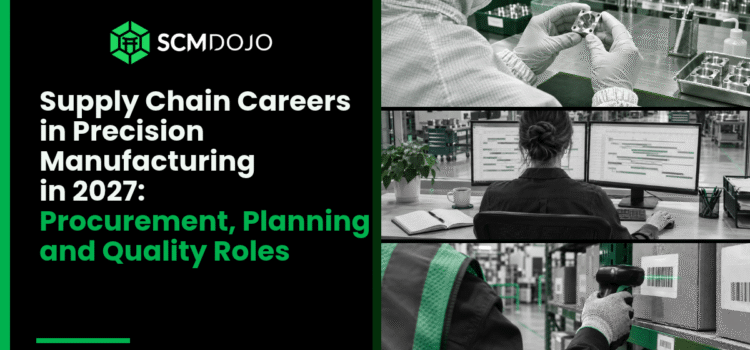

Precision manufacturing is the part of industry where tolerances are measured in microns and a mislabeled lot can stop a production line. Companies in this space make and process parts for demanding customers, including the semiconductor industry, and the work only succeeds if the right materials arrive clean, documented, and on time. That is a supply chain problem as much as an engineering one. Behind every machined, cleaned, or tested part sits a team that buys the inputs, plans the schedule, checks the quality, and ships the result. This guide looks at those careers: what the roles involve, what they pay, how to get in, and what to expect heading into 2027. The data is for the United States, and it comes from the Bureau of Labor Statistics (BLS) and the Semiconductor Industry Association (SIA).
What Makes Precision Manufacturing Supply Chains Different
A warehouse that ships consumer goods and a plant that processes parts for chip equipment both move boxes, but the similarities end quickly. In precision manufacturing, customers specify parts to exact requirements, volumes are often smaller and more varied, and the paperwork that travels with a part matters as much as the part itself. Traceability, change control, and documented procedures are part of daily life.
Job listings from a precision manufacturer show this clearly. Openings mention cleanroom protocols, gowning procedures, material entry rules, chemical processing of customer parts, and laboratory testing such as ICP-MS and LPC. Safety roles refer to compliance with national workplace safety standards and customer site requirements. In that setting, a planner, buyer, or logistics lead is not just moving inventory. They are protecting the conditions that keep a part within specification.
Where the Demand Is Coming From
The broader semiconductor industry gives a useful backdrop. A 2023 study by the SIA and Oxford Economics projected that the U.S. semiconductor workforce would grow by nearly 115,000 jobs by 2030, from roughly 345,000 to about 460,000, and estimated a shortfall of 67,000 technicians, engineers, and computer scientists. About 39 percent of that gap was in technician roles and 41 percent in engineering. More recent analyses reported in 2026, including one by McKinsey, the SEMI Foundation, and the National Science Foundation, put the possible shortfall as high as 157,000 workers by 2030.
Those figures cover technical jobs, not supply chain roles. But every new fab and every supplier that serves it needs people to buy materials, plan production, manage inventory, and ship parts. Growth in the industry tends to pull those functions along with it, which is why supply chain careers in precision manufacturing deserve attention.

The Core Roles at a Glance
The table summarizes the main supply chain and operations roles, using BLS data. Pay is the national median for May 2025 or the pay band BLS reports, and growth is the projected change in employment from 2025 to 2035. For comparison, projected growth across all occupations is about 3 percent.
| Role | Typical Entry Route | Median Pay | Outlook | Notes |
| Logistician | Bachelor’s degree, no related experience or training required | $82,320 | 17.6% growth | Analyzes and coordinates supply chains |
| Buyer or purchasing agent | Bachelor’s degree, moderate on-the-job training | $77,710 | 6% growth (whole purchasing group) | Buys materials, parts, and services |
| Purchasing manager | Bachelor’s degree | $100,000 or more band | About 4% growth | Leads sourcing strategy and teams |
| Industrial production manager | Bachelor’s degree plus 5 or more years of related experience | $126,060 | 3% growth | Runs plant operations |
| Production planning and expediting clerk | High school diploma, moderate on-the-job training | $50,000–$74,999 band | Slight decline | Schedules and tracks work orders |
| Inspector, tester, or sorter | High school diploma, moderate on-the-job training | $37,500–$49,999 band | About 2.5% growth | Checks quality of parts and products |
The pattern is worth noticing. Analytical roles such as logisticians and buyers combine a degree with strong pay and faster growth, while some routine clerical planning work is projected to shrink as software absorbs it. Quality and inspection roles are more accessible but pay less, and they are often the first step onto a ladder that leads to engineering or management.
Procurement: Buying What Precision Requires
Procurement in precision manufacturing means more than getting the lowest price. Buyers source raw materials, chemicals, tooling, consumables, and outside services, and every supplier has to meet specifications that customers care about. That makes supplier qualification, quality agreements, and risk management central to the job.
According to BLS, buyers and purchasing agents had a median annual wage of $77,710 in May 2025, and the wider group of purchasing managers, buyers, and purchasing agents is projected to grow 6 percent from 2025 to 2035. Employers typically want a bachelor’s degree, and most training happens on the job. Useful skills include reading specifications, negotiating, working in an enterprise resource planning (ERP) system, and communicating with suppliers when something goes wrong. Many buyers move into purchasing management, or into supplier quality, where they audit and develop the suppliers they once only bought from.
Planning and Scheduling: Turning Demand Into a Plan
Planners connect what customers want with what a plant can actually make. A manufacturing planner and scheduler develops and maintains production schedules to meet demand while using resources well, analyzes customer demand and inventory levels, communicates schedule changes, and monitors progress. A recent listing for this kind of role asked for two to four years of experience and advertised a pay range of $75,000 to $95,000.

The role rewards people who are comfortable with data and with people. Plans change when a machine goes down, a shipment slips, or a customer moves a deadline, and planners have to explain the consequences clearly to production, purchasing, and sales. BLS projects a slight decline for production, planning, and expediting clerks, which suggests that routine tracking is being automated. The planners who thrive will be those who can interpret systems, make judgment calls, and manage exceptions rather than just update spreadsheets.

Quality and Compliance: Proving the Part Is Right
Quality roles run from entry-level inspection to engineering. In precision manufacturing, the ladder often looks like this: an auditor or inspector checks that procedures are followed, a technician investigates and dispositions non-conforming material, and an engineer manages change control, audits, and risk assessments. Listings for these functions mention auditing gown-room procedures, managing metrology tools, handling non-conforming materials, supporting customer audits, and leading corrective actions.
BLS reports that inspectors, testers, sorters, samplers, and weighers typically need a high school diploma and moderate on-the-job training, and that employment is projected to grow about 2.5 percent through 2035. The pay is lower than for analytical roles, but the experience is valuable because quality knowledge is useful in almost every other supply chain job. Safety and compliance roles, including environmental, health, and safety coordinators and managers, sit alongside quality and are increasingly treated as part of operations.
Logistics and Warehouse: The Ladder From the Dock
Logistics offers one of the clearest career ladders in manufacturing. Operators handle shipping and receiving, check purchase orders and packing slips against shipments, enter data into the plant’s information system, and prepare labels. Supervisors lead those teams and manage inventory accuracy. Managers oversee inbound and outbound transportation, compliance with shipping regulations, inventory, purchasing, and production planning.
Pay ranges from recent listings illustrate the climb, although they come from different locations and should be read as a rough guide. A temp-to-hire logistics operator role was advertised at $42,000 to $44,000, a logistics supervisor role at $70,000 to $82,000, and a logistics manager role at $95,000 to $115,000. That is a path from the dock to a management role that does not necessarily require a four-year degree at the start, although BLS lists a bachelor’s degree as typical for logisticians.
What a Hiring Page Shows
Looking at how a real company staffs these functions makes the picture concrete. The listing page for pentagon technologies careers showed 19 open positions at the time of writing. They include logistics operators, supervisors, and a manager, a manufacturing planner and scheduler, a protocol auditor, an engineering technician, a process engineer, a laboratory technician, safety coordinators and managers, production supervisors, a facilities manager, a senior accountant, a customer service representative, and a director of operations, spread across sites in California, Oregon, Arizona, Texas, and Virginia.
Two lessons stand out. First, the supply chain function in a precision manufacturer is large and varied, covering planning, logistics, quality, safety, and customer service, not just purchasing. Second, every one of those openings was on-site, and the listing showed no remote positions. Supply chain work in a plant depends on being close to the product, so candidates should plan for shift patterns, safety gear, and hands-on responsibilities.
Skills That Travel Across These Roles
Several skills show up again and again. BLS identifies adaptability, critical and analytical thinking, and problem solving and decision making as the top skills for logisticians, and the same qualities help planners, buyers, and quality staff.
- Fluency with ERP and manufacturing information systems
- Data literacy: reading reports, spotting trends, and explaining numbers to non-specialists
- Clear written communication, because documentation is part of the product
- A safety and compliance mindset, especially around chemicals and cleanroom procedures
- Supplier and customer communication under time pressure
How to Break In
- Start where the entry bar is lowest, such as shipping and receiving, inspection, or a production coordinator role, and learn the plant’s systems.
- Ask to cross-train in planning, purchasing, or quality, since employers often prefer to promote people who know the process.
- Learn the tools: ERP basics, spreadsheets, and the metrics your site tracks, such as on-time delivery and inventory accuracy.
- Consider a bachelor’s degree or professional certificate in supply chain or operations when you are ready for analytical roles, since BLS lists a degree as typical for logisticians and buyers.
- Build a record of improvements you made, even small ones, and describe them with numbers.
What to Expect in 2027
No one can predict the year precisely, but several trends look durable. New plants and expansions will keep adding demand for planners, buyers, and logistics staff in regions with heavy investment. Employers will ask for more data skills and fewer purely clerical ones. Quality and safety expectations are unlikely to loosen in industries where a single contaminated lot can be costly. And workforce gaps in technical roles will keep pushing employers to promote from within and to hire people who are willing to learn.
Conclusion
Supply chain careers in precision manufacturing offer a rare mix of practical work and clear progression. Procurement, planning, logistics, and quality each reward different strengths, and each connects to the others. For someone entering the field, the best approach is to start close to the product, build skills in systems and data, and keep an eye on where the industry is investing. The roles are on-site and demanding, but they sit at the heart of how precise things get made and delivered.