The world of supply chain certification and professional learning is evolving faster than ever. From MIT’s world-class MicroMasters, ASCM’s gold-standard certifications (CSCP, CPIM, CLTD) to SCMDOJO Tracks, professionals have long relied on academic rigor to validate their expertise from these Supply Chain Learning Platforms.
But today, companies especially SMEs and digital-first organisations are asking:
Do we need another supply chain certification, or do we need practical, tool-driven skills our teams can apply tomorrow?
✅ For a guided learning path, explore our full range of SCM courses online.
Top 10 Supply Chain Certification & Learning Platforms in 2025
Here are the most influential supply chain certification & learning platforms shaping global supply chain learning:
SCMDOJO – Specialized, tool-driven supply chain hub
Coursera – University-backed courses & certificates
edX / MITx MicroMasters – Graduate-level rigor & pathways
Udemy– Affordable, practical, wide variety
LinkedIn Learning – Professional, career-linked learning paths
CIPS OnDemand – Procurement-focused certification & learning
ASCM (APICS) – Global benchmark supply chain certifications
ISM– Oldest procurement association with CPSM & CPSD certifications
Alison – Free, flexible fundamentals courses
Aggregators (Solutions Review, DataCamp, Skillshare) – Curated course access
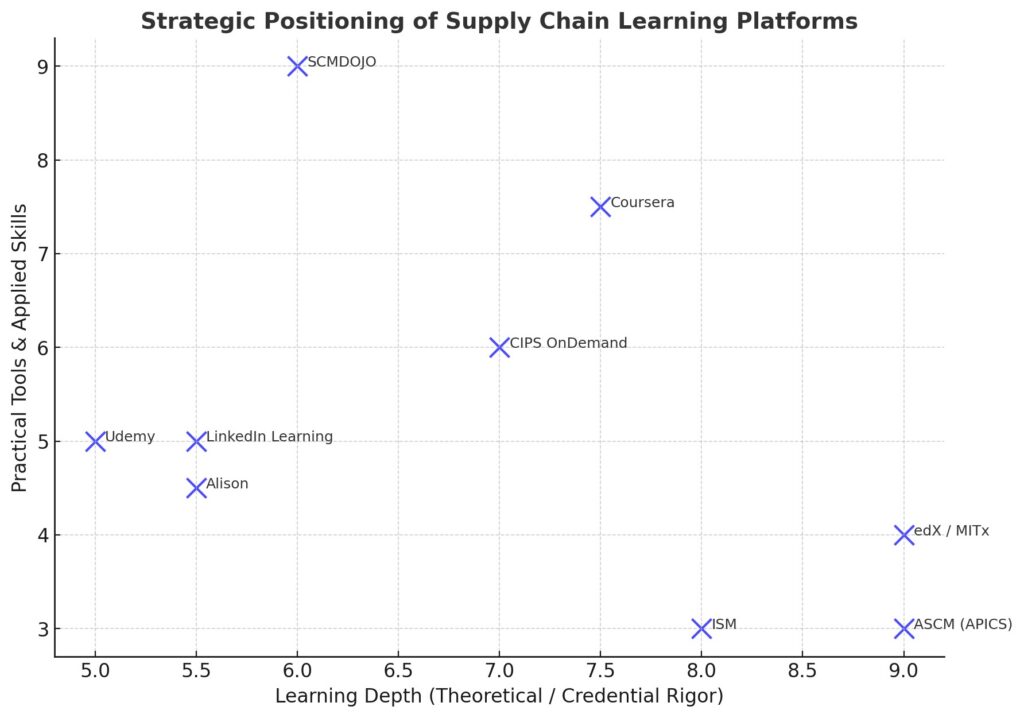
Strategic Positioning Map of Supply Chain Certification Platforms
Here’s the Strategic Positioning Map of Supply Chain Certification & Learning Platforms, similar to the one you uploaded.
- X-axis → Learning Depth (theoretical rigor, credential strength)
- Y-axis → Practical Tools & Applied Skills
Key Differentiation Factors of Supply Chain Certification Platforms
SCMDOJO’s Unique Positioning
SCMDOJO occupies a strategic position at the intersection of specialization depth and practical tool availability:
- Supply Chain-Only Focus: Unlike generalist platforms, SCMDOJO concentrates exclusively on supply chain, procurement, logistics, and operations, ensuring curriculum alignment with real job requirements
- AI-Native Tools: Free competency assessment, and SCM AI sensei – The supply chain intelligence layer – purpose-trained, not retrofitted, provides immediate workplace applicability. SCM AI sensei, stop relying on generic AI hallucinations or expensive consulting retainers. SENSEI gives practitioners, consulting firms, and software platforms instant access to a RAG-native intelligence layer built on 20 years of validated supply chain expertise
- Best Practices Library: Curated, industry-vetted frameworks (best practice templates, KPI checklists, process playbooks) reduce time-to-value
- Implementation Support: Dedicated specialists bridge the gap between learning and organizational adoption a capability absent in competitors
- Flexible Monetization: Free foundational courses + paid specializations allow both bootstrapped learners and enterprises
LinkedIn Learning’s Positioning
- Professional Network Integration: Direct visibility to hiring managers and professional network
- Role-Based Pathways: Learning recommendations tied to LinkedIn job profiles
- Enterprise Familiarity: Already embedded in many organizations’ learning stacks
edX & Coursera Positioning
- Academic Credibility: University partnerships and peer-reviewed content
- Credential Strength: Recognized by employers for hiring/promotion decisions
- Rigorous Curriculum: Theoretical depth; ideal for career transitions or advanced certifications
Udemy Positioning
- Price & Flexibility: Lowest cost; self-paced, lifetime access
- Instructor Diversity: Multiple perspectives on same topics
- Trade-off: Inconsistent quality; limited institutional support
CSCP & CIPS OnDemand Positioning
- Industry Certification Standard: Gold standard for procurement and supply chain credentials
- Trade-off: High cost, rigid exam focus, limited flexibility
SWOT Analysis: Supply Chain Learning Platforms
We compared all Top 10 platforms across their Strengths, Weaknesses, Opportunities, and Threats.
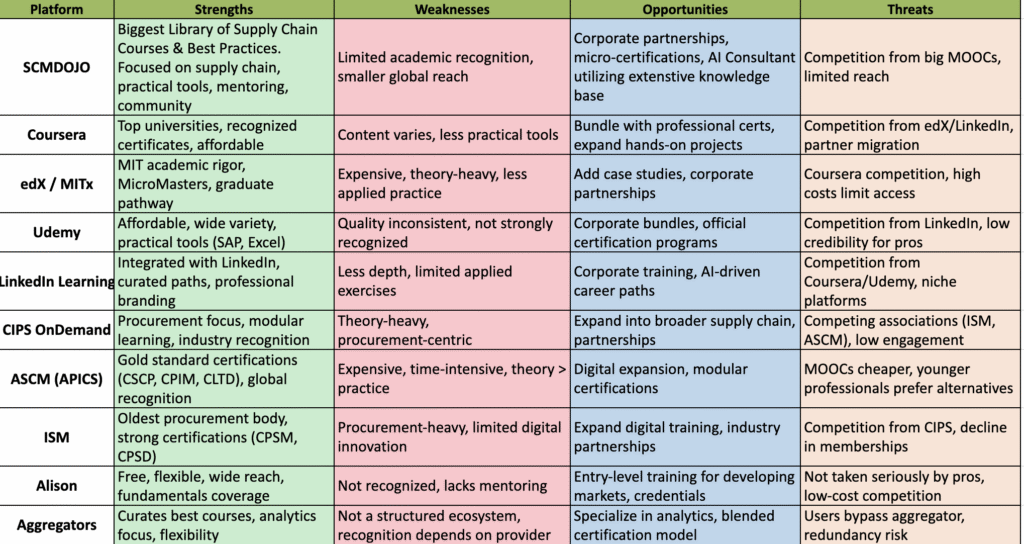
Choosing the right supply chain learning platform is no longer straightforward. The market has fragmented significantly, with everything from global MOOCs and professional certification bodies to niche practitioner platforms all competing for the attention of supply chain professionals. To help you make a more informed decision, here is an honest SWOT analysis of the major platforms in the market today.
SCMDOJO
SCMDOJO holds the largest library of supply chain-specific courses and best practices of any independent platform. Its core strengths are depth of domain focus, practical tools, expert mentoring, and a genuine practitioner community built over four years. The platform is purpose-built for supply chain, procurement, and logistics professionals rather than a broad general audience.
Its current weaknesses are limited academic recognition compared to university-backed platforms, and a smaller global reach relative to mega-platforms like Coursera or Udemy. However, its primary opportunity lies in corporate partnerships, micro-certifications, and its AI Consultant (SCMDOJO sensei), which leverages the extensive proprietary knowledge base to deliver domain-specific intelligence no generic AI tool can replicate. The main threat is competition from large MOOCs that benefit from massive marketing budgets and established brand recognition.
Coursera
Coursera’s strengths are its partnerships with top universities, the credibility of its certificates, and its relatively affordable pricing. However, content quality varies significantly by provider and the platform offers less in the way of practical, applied tools. Opportunities exist around bundling with professional certifications and expanding hands-on project work. Key threats include competition from edX and LinkedIn Learning, and the risk of partner universities migrating to their own platforms.
edX / MITx
edX brings genuine academic rigour, MicroMasters programmes, and a graduate pathway that no other platform on this list can match. Its weaknesses are cost, a heavy theoretical bias, and limited applied practice. Opportunities exist in adding corporate case studies and building stronger enterprise partnerships. The principal threats are competition from Coursera and the fact that high costs limit access for many professionals.
Udemy
Udemy’s appeal is affordability, an enormous variety of courses, and practical tools including SAP and Excel content. The weakness is inconsistent quality and limited professional recognition. Opportunities include corporate bundles and official certification pathways. Threats come from LinkedIn Learning and the persistent credibility gap with senior professionals.
LinkedIn Learning
LinkedIn Learning benefits from direct integration with the world’s largest professional network, curated learning paths, and strong professional branding. Its weaknesses are limited depth and fewer applied exercises compared to specialist platforms. The opportunity is significant in AI-driven career path recommendations and corporate training. Threats come from Coursera and Udemy on content volume and from niche platforms on depth.
CIPS OnDemand
CIPS has strong industry recognition in procurement and a modular learning structure. The limitation is that it is heavily theory-focused and procurement-centric, which restricts its appeal across the broader supply chain function. The opportunity is to expand into supply chain more broadly and grow through partnerships. Competing associations such as ISM and ASCM and low engagement levels are the primary threats.
ASCM (APICS)
ASCM holds the gold standard certifications in supply chain, including CSCP, CPIM, and CLTD, with global recognition that no other platform on this list matches for formal credentialing. The weaknesses are cost, time intensity, and a theory-over-practice bias. Opportunities exist through digital expansion and modular shorter-form certifications that appeal to younger professionals. The threat is that cheaper alternatives and a generational preference shift are gradually eroding its dominance.
ISM
ISM is the oldest procurement body in the world and offers strong certifications including CPSM and CPSD. Its weakness is limited digital innovation and heavy procurement focus. Opportunities exist in expanding digital training and building industry partnerships. Competition from CIPS and a broader decline in association memberships represent significant threats.
Alison
Alison’s core strength is accessibility. It is free, flexible, and covers fundamentals well, making it valuable for entry-level professionals and developing markets. The weakness is that it lacks recognition among experienced professionals and offers no meaningful mentoring. Opportunities exist in emerging markets and entry-level credentialing. The threat is that the professional community does not take it seriously and low-cost competitors are entering the same space
Comparison of Supply Chain Learning Websites
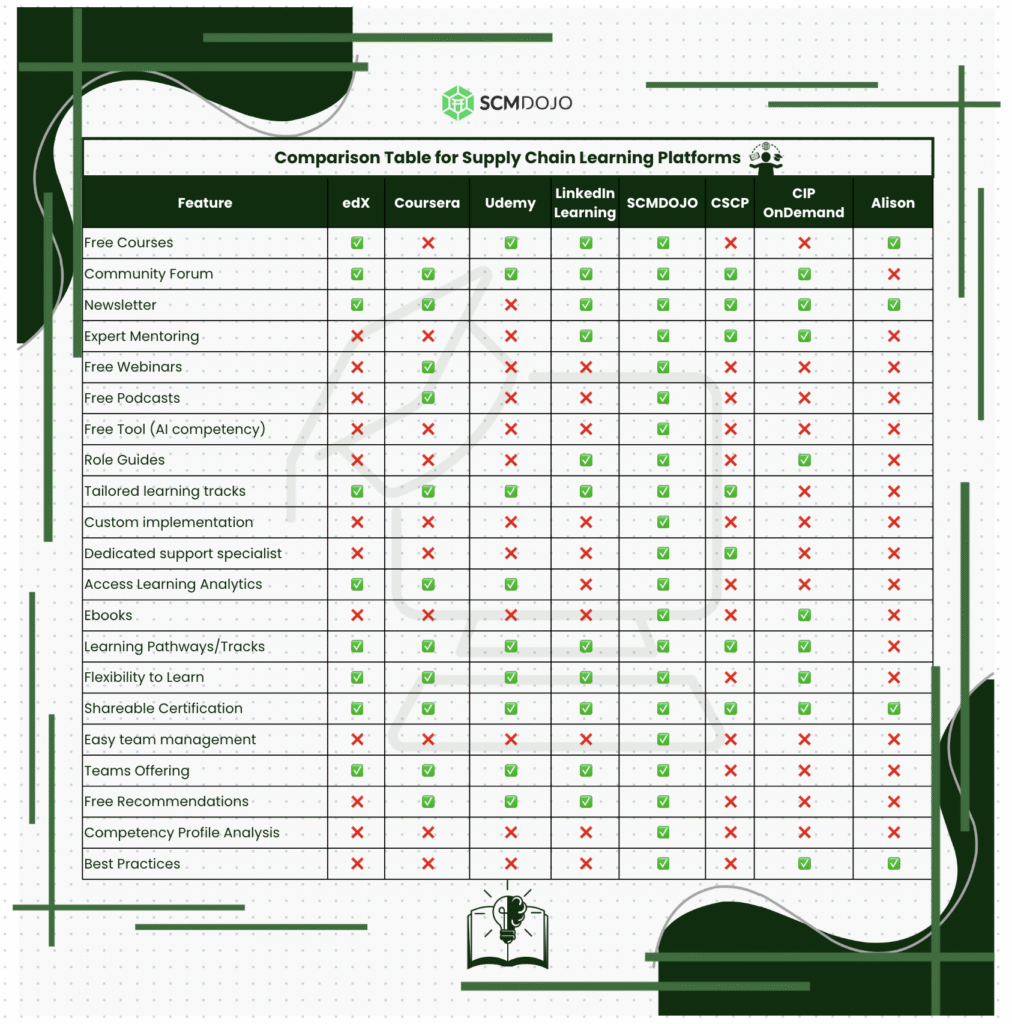
Beyond the SWOT, the most practical question for any supply chain professional or L&D leader is simply: which platform actually does what you need?
The comparison table below maps 21 features across eight platforms: edX, Coursera, Udemy, LinkedIn Learning, SCMDOJO, CSCP (ASCM), CIPS OnDemand, and Alison.
The standout finding is clear. SCMDOJO is the only platform in this comparison that offers all of the following simultaneously: free courses, community forum, newsletter, expert mentoring, free webinars, free podcasts, a free AI competency tool, role guides, tailored learning tracks, custom implementation, dedicated support, learning analytics, eBooks, learning pathways, flexibility, shareable certification, easy team management, a teams offering, free recommendations, competency profile analysis, and best practices.
No other platform in the comparison ticks all 21 boxes.
To put the gaps in context:
edX offers academic rigour but has no expert mentoring, no free webinars or podcasts, no eBooks, no custom implementation, and no competency profile analysis.
Coursera has no expert mentoring, no free tools, no eBooks, and no competency profile analysis.
Udemy offers breadth and affordability but has no expert mentoring, no free webinars or podcasts, no custom implementation, no dedicated support, no eBooks, and no competency profile analysis.
LinkedIn Learning has no free tools specific to competency, no custom implementation, no dedicated support, no eBooks, no easy team management, and no competency profile analysis.
CSCP (ASCM) has strong certification recognition but lacks free tools, role guides, custom implementation, learning analytics, eBooks, easy team management, free recommendations, competency profile analysis, and best practices.
CIPS OnDemand has community and certification but lacks role guides, custom implementation, learning analytics, easy team management, free recommendations, and competency profile analysis.
Alison covers the basics accessibly but lacks expert mentoring, free webinars, free podcasts, free tools, role guides, custom implementation, dedicated support, eBooks, easy team management, teams offering, free recommendations, and competency profile analysis.
The conclusion is straightforward. For supply chain professionals who need more than a certificate, who need practical tools, domain-specific mentoring, competency assessment, and a platform that works at both the individual and team level, SCMDOJO offers the most complete feature set in the market today.
The addition of SCMDOJO SENSEI, the world’s first AI supply chain consultant trained exclusively on practitioner knowledge, extends that advantage further into territory no other platform on this list is currently competing i
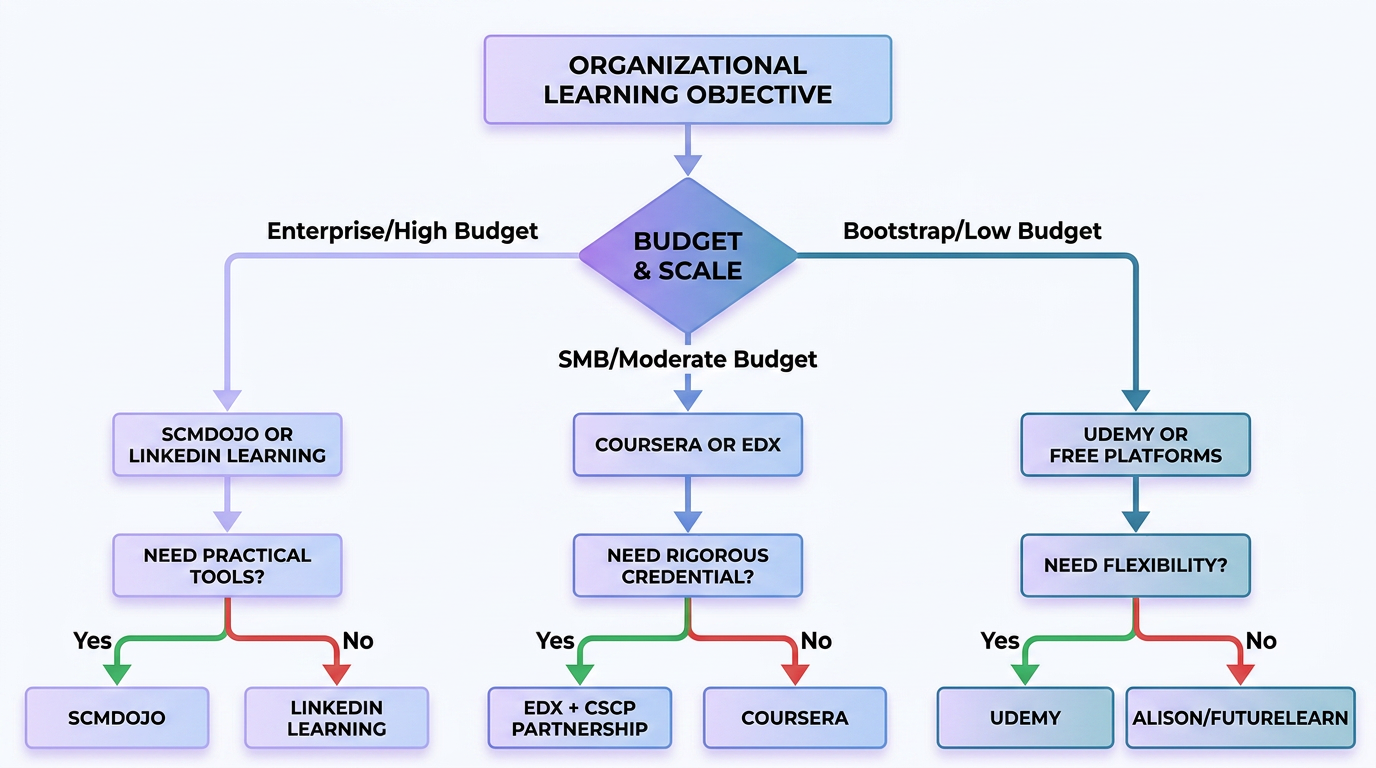
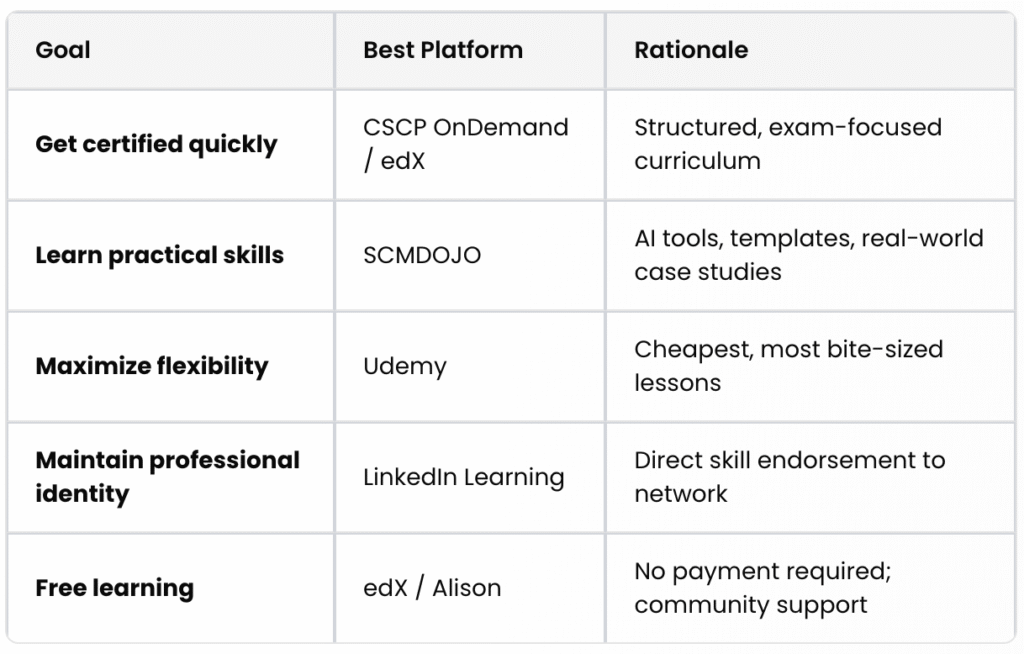
Supply Chain Learning Platforms – Selection Matrix by Organisational Need
The image below shows the selection matrix for enterprise needs.
1. For Enterprise Teams (100+ learners)
Winner: SCMDOJO
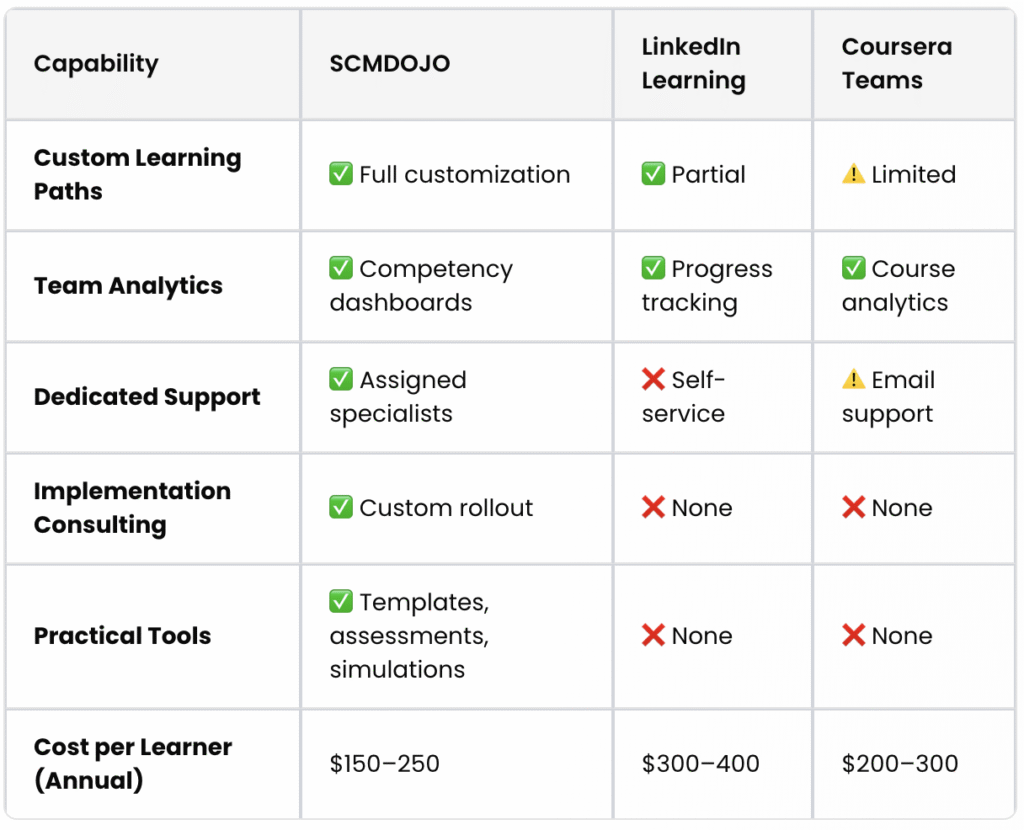
Recommendation: SCMDOJO for organizations requiring hands-on tool adoption, change management, and measurable competency improvement. LinkedIn Learning for organizations prioritizing ease-of-use and professional network integration.
2. For Individual Professionals (Self-Directed)
Winner: Depends on Motivation
3. For Procurement Teams (Specialized Focus)
Winner: SCMDOJO or CIPS OnDemand
SCMDOJO Advantage:
- Procurement-specific courses (strategic sourcing, contract management, supplier risk)
- Free AI competency assessment for procurement roles
- Best practices library for procurement processes
CIPS OnDemand Advantage:
- International procurement certification
- Regulatory and compliance-focused curriculum
- Industry-recognized credentials (globally portable)
4. For Logistics & Warehousing
Winner: SCMDOJO
- Dedicated warehouse management, transportation, and distribution courses
- Real-world case studies in 3PL operations
- Practical tools for inventory management and KPI tracking
5. For S&OP / IBP Practitioners
Winner: SCMDOJO
- Recent comprehensive S&OP / IBP course launch
- Integrated with demand planning and supply planning modules
- Hands-on simulation and scenario planning tools
Feature-by-Feature Competitive Comparison
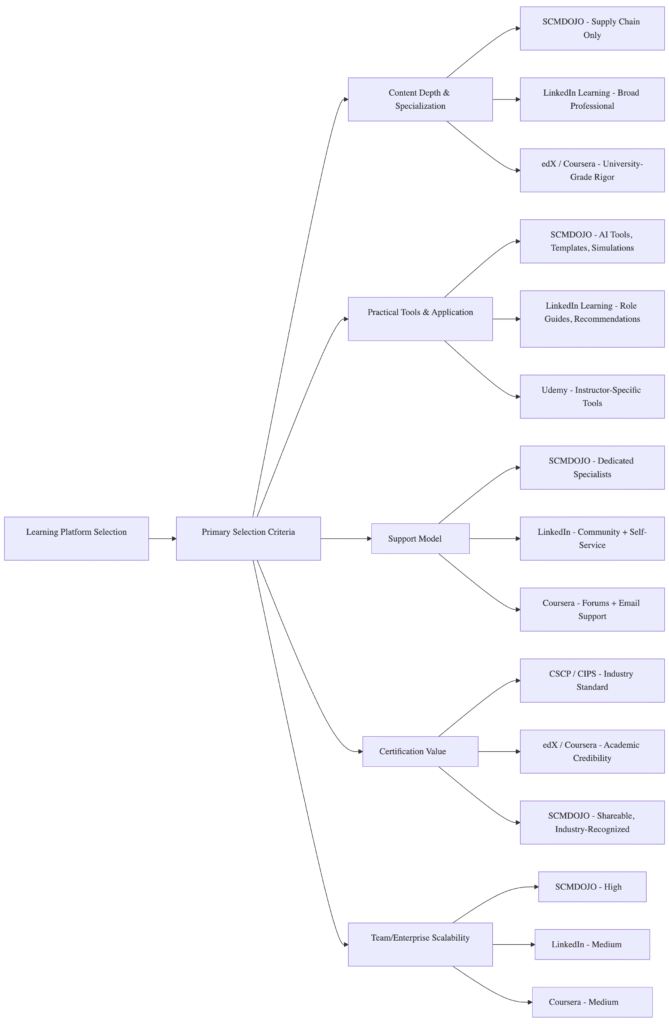
Strategic Positioning Argument: Why Choose SCMDOJO?
1. When Practical Tools & Applied Skills Matter Most
- SCMDOJO is uniquely positioned at the high end of practical tools and applied learning (templates, AI-driven assessments, simulations, best practices).
- Unlike MITx/ASCM/ISM, which emphasize theoretical depth and credentials, SCMDOJO equips professionals with ready-to-use tools for day-to-day supply chain problem-solving.
- Companies needing hands-on upskilling for their teams will find SCMDOJO superior.
2. For Fast-Growing or Mid-Sized Companies
- SMEs and fast-scaling organizations often lack resources for expensive global certifications (CSCP, MIT MicroMasters).
- SCMDOJO offers cost-effective, modular learning that can be quickly deployed across teams.
- Better choice than ASCM or edX, which require heavy investment in time and money.
3. When Flexibility and Tailored Learning Are Needed
- SCMDOJO provides curated learning paths, eBooks, guides, and mentoring, customizable to specific supply chain roles (planning, logistics, sourcing).
- Platforms like Coursera and LinkedIn Learning provide structured but less role-specific training.
- For organizations with diverse roles in supply chain teams, SCMDOJO ensures sharper alignment.
4. For Companies Prioritizing Digital Transformation
- SCMDOJO integrates modern tools (AI competencies, digital assessments, tech-driven templates) that align with Industry 4.0 trends.
- Traditional providers (ISM, CIPS) focus on procurement theory and policies, which may lag behind digital-first supply chains.
- Tech-driven companies gain more value with SCMDOJO’s future-focused content.
5. When Speed of Implementation Is Key
- SCMDOJO content is immediately actionable (plug-and-play tools).
- ASCM/ISM certifications can take months or years; MITx MicroMasters takes even longer.
- Firms needing rapid upskilling during market shifts (e.g., post-COVID supply disruptions) will benefit more from SCMDOJO.
In summary,
SCMDOJO is strategically stronger when:
- Rapid Upskilling Needed: Plug-and-play templates, AI tools, role-specific paths.
- SMEs & Scaling or Large Firms: Cost-effective, no long academic commitments.
- Digital-First Companies: Aligned with the digitalisation drive and modern supply chain tools.
- Customisation Required: Learning paths by job role (planner, buyer, logistics lead).
Not ideal when:
❌ You need a globally recognized supply chain certification (CSCP, CPSM, MITx).
❌ Your focus is purely academic or academic-to-MBA progression.
Strategic Selection Framework of Supply Chain Certification Platforms
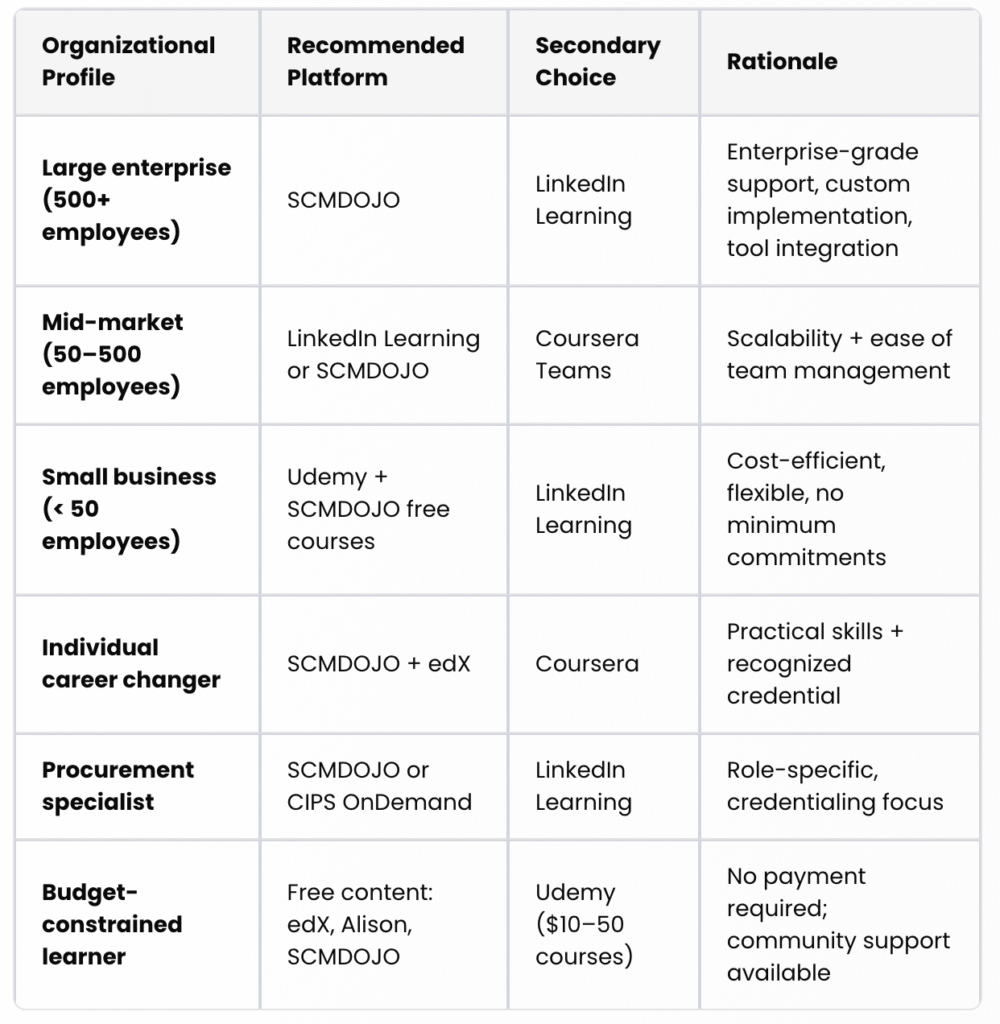
The above table can be substantiated by the offering of SCMDOJO. If you purchase the SCMDOJO Expert Plan for only $89/month (annual plan), you will get access to all 82+ High Quality On-Demand Courses, 44+ Best Practices, eBooks, Apps and Live Training Sessions with supply chain and procurement experts.
✅ If you are new to the field, start with our basics of supply chain resources to build a strong foundation.
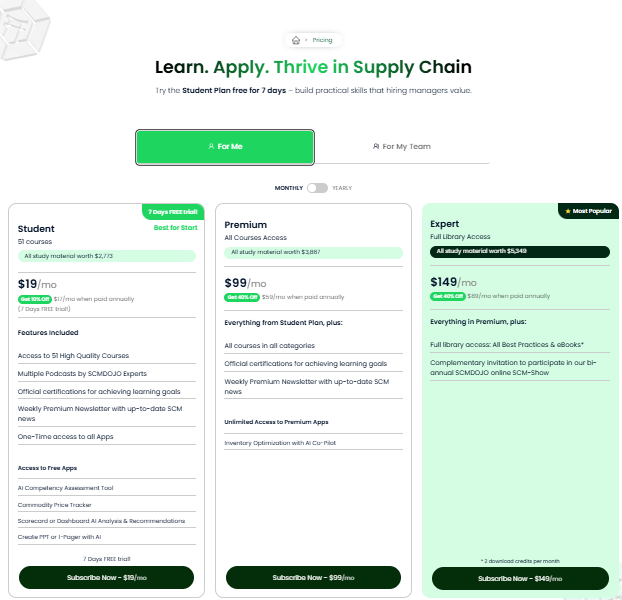
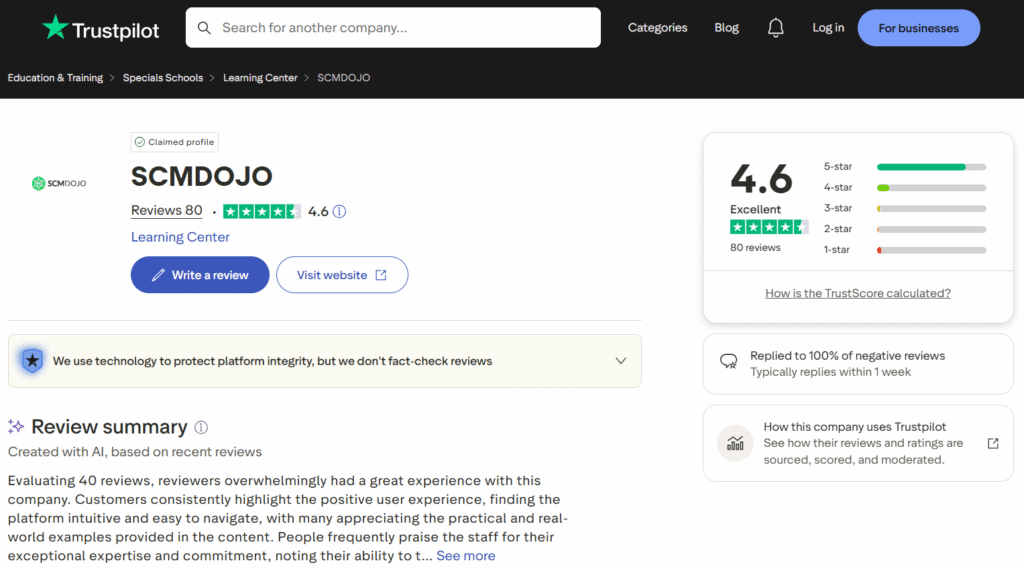
Customer feedback on the courses can be reviewed on the pages of the Supply Chain Track, Procurement Track, and Logistics Track. And also on Trustpilot reviews.
While we recognise that Large corporations need prestigious credentials for their employees, it is, in most cases, not good ROI, which I have explained in this short YouTube Video.
Recommendations by Use Case
Use Case 1: Enterprise Upskilling Initiative (200+ Learners)
Recommended Platform: SCMDOJO
Rationale:
- Custom learning pathways aligned to competency gaps
- Dedicated implementation team for change management
- AI competency tool for baseline assessment and progress tracking
- Best practices library accelerates adoption
- Team analytics enable ROI measurement
Implementation Approach:
- Conduct baseline competency assessment (SCMDOJO’s AI tool)
- Design tailored learning tracks by role (Procurement, Planning, Logistics, S&OP)
- Assign dedicated support specialist for team management
- Monthly cohort reviews and adjusted curriculum
- Measure impact via competency dashboard and operational KPI improvement
Use Case 2: Individual Professional Development (Career Transition)
Recommended Platform Stack:
- Primary: SCMDOJO (practical skills, role guides, best practices)
- Secondary: edX or Coursera (credentialing, theoretical depth)
- Supplementary: LinkedIn Learning (network visibility)
Rationale:
- SCMDOJO builds hands-on competency and portfolio
- edX/Coursera credential signals credibility to new employers
- LinkedIn Learning keeps network updated on skill progress
Use Case 3: Low-Cost, High-Flexibility Learning
Recommended Platform: Udemy (courses $10–50) + Free Courses on SCMDOJO / edX / Alison
Caveat: Quality varies; recommend instructor reviews and peer recommendations before enrollment
Critical Gaps in the Current Ecosystem
- No Unified Supply Chain Competency Standard: Professionals must navigate multiple certification bodies (APICS, CIPS, ISM, ILT)
- Limited AI/Digitalization Content: Most platforms lag industry adoption of AI, RPA, digital twins, and predictive analytics
- Supply Chain Resilience & ESG: Emerging as critical skills; few platforms offer mature curricula
- Nearshoring & Regional Supply Chain Strategy: Geopolitical shift requires localized curriculum; platforms are slow to adapt
- Soft Skills Gap: Leadership, change management, cross-functional collaboration under-emphasized across platforms
Final Take: Certification vs Practical Learning
The debate between supply chain certification and practical learning platforms isn’t about which is better, but about fit for purpose.
- If you need prestige and career recognition → go for ASCM (CSCP), MITx, ISM, or CIPS.
- If you need immediate skills, digital alignment, and cost efficiency → SCMDOJO is the smarter choice.
In a world where supply chains are disrupted overnight, speed and adaptability matter as much as certifications.
👉 For many companies in 2026, SCMDOJO may well be the future of supply chain learning.
FAQs
1. How Do I Choose Between Different Supply Chain Learning Platforms? Evaluate platforms based on your immediate career needs rather than just brand name. Look for platforms that offer content relevancy (recent case studies), instructor expertise (10+ years in the field), and practical tools. If you need academic rigor, university-backed platforms are great. If you need hands-on templates, AI-driven assessments, and immediate workplace applicability, specialized platforms like SCMDOJO are the better choice.
2. What’s the Difference Between Supply Chain Courses and Supply Chain Certifications? Courses are designed for immediate knowledge building and skill development, often varying in length from a few hours to a few weeks. Certifications are structured, rigorous pathways (taking weeks to months) that end in an industry-recognized credential or exam to prove verified expertise to employers.
3. Are Supply Chain Certifications Worth It? Yes, if you choose the right one. Supply chain certifications signal verified expertise to hiring managers, and certified professionals often earn a premium in the market. However, it is critical to pursue certifications from platforms led by industry experts with real-world experience, ensuring the knowledge you gain actually translates to day-to-day operations.
4. What’s the ROI of Supply Chain Certifications? On average, certified supply chain professionals see a salary increase of 12-18% over non-certified peers and gain access to more relevant job opportunities. While traditional certifications can cost anywhere from $1,500 to $5,000, modern platform subscriptions often provide access to multiple pathways for a fraction of the cost, making the payback period much shorter.
5. Which Supply Chain Learning Platform Is Best for Beginners? Beginners should look for platforms that offer foundational courses with clear progression paths, real-world case studies, and an affordable entry point. Specialized platforms often provide tailored learning tracks specifically for beginners (like Logistics or Procurement basics), which prevents the confusion of navigating generalist sites that mix supply chain content with unrelated topics.
About the Author- Dr. Muddassir Ahmed
Dr. Muddassir Ahmed is a globally recognized supply chain expert, thought leader, and keynote speaker. As the Founder & CEO of SCMDOJO, he has built one of the world’s leading platforms dedicated to empowering supply chain professionals with cutting-edge knowledge, practical tools, and access to expert insights. With over 19 years of leadership experience spanning the UK, Europe, the Middle East, and Southeast Asia, Dr. Ahmed has held key roles at Bridgestone, Doncasters Group, Eaton, and Volvo Cars, managing multi-million-dollar supply chain operations.
His expertise spans all facets of supply chain management, with a particular focus on leveraging technology and innovation to optimize processes and build resilient supply chains.
Recognized among the Top 10 Supply Chain Influencers in the World by Supply Chain Digital, Dr. Ahmed has been instrumental in shaping industry best practices through his extensive research, vlogs, and thought leadership. Holding a PhD in Management Science from Lancaster University Management School, he is also a certified Six Sigma Black Belt.
His platform, SCMDOJO, serves a vibrant community with over 51,000 monthly visitors. Moreover, he has 72,000 newsletter subscribers, and a social media following exceeding 105,000 supply chain professionals
A sought-after keynote speaker and thought leader, sharing his insights on industry trends, best practices, and the future of supply chain management. Dr. Ahmed delivers high-impact talks on supply chain excellence, digital transformation, and strategic leadership. His mission is clear: to help supply chains thrive
You can follow him on LinkedIn, Facebook, Twitter