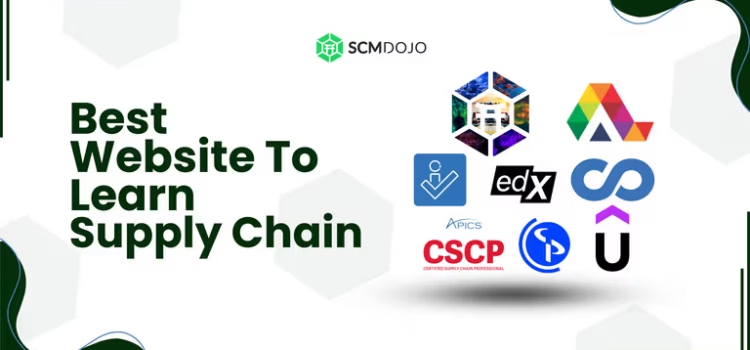
Ready to unlock the secrets of the supply chain? These websites offer a treasure trove of knowledge to elevate your skills and drive business success. We have compiled this information after careful and in-depth research.
Before we deep dive into the details of each website, look at the summarised value proposition table we have made for you:
Which Platform to Choose?
| Feature | edX | Coursera | Udemy | LinkedIn Learning | SCMDOJO | CSCP | CIPS OnDemand | Alison |
| Free Courses | ✅ | ❌ | ✅ | ✅ | ✅ | ❌ | ❌ | ✅ |
| Community Forum | ✅ | ✅ | ✅ | ✅ | ✅ | ✅ | ✅ | ❌ |
| Newsletter | ✅ | ✅ | ❌ | ✅ | ✅ | ✅ | ✅ | ✅ |
| Expert Mentoring | ❌ | ❌ | ❌ | ✅ | ✅ | ✅ | ✅ | ❌ |
| Free Webinars | ❌ | ✅ | ❌ | ❌ | ✅ | ❌ | ❌ | ❌ |
| Free Podcasts | ❌ | ✅ | ❌ | ❌ | ✅ | ❌ | ❌ | ❌ |
| Free Tool (AI competency) | ❌ | ❌ | ❌ | ❌ | ✅ | ❌ | ❌ | ❌ |
| Role Guides | ❌ | ❌ | ❌ | ✅ | ✅ | ❌ | ✅ | ❌ |
| Tailored learning tracks | ✅ | ✅ | ✅ | ✅ | ✅ | ✅ | ❌ | ❌ |
| Custom implementation | ❌ | ❌ | ❌ | ❌ | ✅ | ❌ | ❌ | ❌ |
| Dedicated support specialist | ❌ | ❌ | ❌ | ❌ | ✅ | ✅ | ❌ | ❌ |
| Access Learning Analytics | ✅ | ✅ | ✅ | ❌ | ✅ | ❌ | ❌ | ❌ |
| Ebooks | ❌ | ❌ | ❌ | ❌ | ✅ | ❌ | ✅ | ❌ |
| Learning Pathways/Tracks | ✅ | ✅ | ✅ | ✅ | ✅ | ✅ | ✅ | ❌ |
| Flexibility to Learn | ✅ | ✅ | ✅ | ✅ | ✅ | ❌ | ✅ | ❌ |
| Shareable Certification | ✅ | ✅ | ✅ | ✅ | ✅ | ✅ | ✅ | ✅ |
| Easy team management | ❌ | ❌ | ❌ | ❌ | ✅ | ❌ | ❌ | ❌ |
| Teams Offering | ✅ | ✅ | ✅ | ✅ | ✅ | ❌ | ❌ | ❌ |
| Free Recommendations | ❌ | ✅ | ✅ | ✅ | ✅ | ❌ | ❌ | ❌ |
| Competency Profile Analysis | ❌ | ❌ | ❌ | ❌ | ✅ | ❌ | ❌ | ❌ |
| Best Practices | ❌ | ❌ | ❌ | ❌ | ✅ | ❌ | ✅ | ✅ |
Download Free Comparison Table PDF
Let’s look at each website one should learn about the supply chain from in detail:
SCMDOJO
SCMDOJO offers specialized supply chain courses and solely focuses on supply chain management. You can get free access to AI tool competency and many more practical tools within specific courses. Another fantastic thing about SCMDOJO is that they have the availability of guides, podcasts, ebooks, and best practices that help an aspirant of supply chain management learn a lot.
Moreover, SCMDOJO provides a vibrant range of courses related to supply chain management with specialized topics. It is the best website for learning about the supply chain. Plus, SCMDOJO is SC-focused and does not cover other industry topics.
| Pros | Cons |
| Specialized Supply Chain Courses | Advance Courses are not free |
| Availability of AI tool Competency | No mobile app |
| Availability of guides, best practices, & ebooks | |
| Monthly/Annual Plans | |
| Team Offering |
Download Free Supply Chain KPIs Cheat Sheet PDF
Watch videos on SCMDOJO’s YouTube channel to learn more about its products, pricing, and features! Click here!
LinkedIn Learning
LinkedIn Learning is owned and operated by LinkedIn. It is an online learning platform that provides video courses with the availability of expert mentors and role guides. However, one of the main features that makes it stand out is its ability to be an offline viewing resource. But when discussing a platform, various other things come to mind, including: Do they have access to free podcasts & webinars? Do they have ebooks and guides? Are there any best practices? Unfortunately, LinkedIn doesn’t have these options.
| Pros | Cons |
| Availability of Expert Mentors | No free podcasts & webinars |
| Role Guides | No ebooks & guides |
| Offline viewing | No best practices |
Learn More About LinkedIn Learning VS SCMDOJO Here
Coursera
Coursera is one of the most well-known websites because of its wide variety of courses and broad focus. However, when there is a wide variety, a few courses need more consistency and up-to-date information. Also, supply chain courses on Coursera need to be updated and made more consistent with expert monitoring.
Moreover, Coursera offers minimal best practices and ebooks. Still, the good thing is that they have free webinars and podcasts that help people evolve in their respective fields.
| Pros | Cons |
| Wide Variety, broad focus | No expert monitoring |
| Free webinar & podcast | Part of broader programs |
| Gamify learning with leaderboards | Inconsistency |
Get To Know More About Coursera VS SCMDOJO Here
CIPS OnDemand
CIPS onDemand has a flexible learning structure that does not put pressure or force on a particular person. It provides a very lenient platform and space for learning; however, it offers no annual subscription, as it has a pattern known as the CIPS level 4 diploma, which costs $1920 (GBP 1536).
Where there is availability for newsletters, there are no free podcasts, webinars, or practical tools.
| Pros | Cons |
| Expert Monitoring | No free practical tools |
| Availability of newsletter | No free podcasts |
| Highly theoretical | Offer less practical & real-world examples |
Read More About CIPS onDemand VS SCMDOJO Here
Udemy
Similarly, Udemy offers a wide range of courses that need more structure. However, flexible learning is the most enormous privilege that Udemy provides its users. Fewer interactive sessions and no expert monitoring affect the studying pattern differently.
Udemy offers monthly plans and a few free courses. Additionally, Udemy only offers certification for paid courses. There are multiple courses that Udemy offers as it has a wide range of courses, but as it targets many sectors, it needs to improve in many places as well. The broader the spectrum of courses, the more chances are there for inconsistency. Supply Chain is a topic that needs to be updated and filled with practical and real-life case studies.
| Pros | Cons |
| Wide Range of Courses | Variable Quality, Inconsistency |
| Flexible Learning | Lack of Structure |
| Offers Certifications but only for paid courses | Less Interaction |
| Monthly Plan | No Formal Accreditation |
Learn More About Udemy VS SCMDOJO Here
CSCP Supply Chain
One of the first things that struck everyone when they pursued the CSCP Supply Chain Certification from ASCM is its theoretical nature. Additionally, the CSCP program focuses heavily on the theoretical aspects of supply chain management. It covers concepts in detail but offers very little in terms of practical exercises, real-world case studies, or detailed models.
It is globally recognized but has high prices for supply chains that offer no practical approach. Moreover, it provides a very rigid learning structure.
| Pros | Cons |
| Globally recognized | No practical approach |
| Highly academic | High price |
| Rigid Structure |
A Detailed Review: CSCP VS SCMDOJO Here
edX Supply Chain Courses
edX offers detailed and high-quality academic patterns but needs to provide practical approaches. edX supply chain courses are more theoretical and educational, focusing on foundational knowledge and concepts.
Moreover, edX courses are developed by top university professors and offer a broad spectrum of supply chain courses. However, they are costly and do not offer AI tool competency, ebooks, best practices, or guides.
| Pros | Cons |
| Offers Supply Chain Courses | No Ebooks, best practices, or guides. |
| Courses developed by top university professors | No AI tool Competency |
| Wide Range | High prices |
Learn More About edX Supply Chain Course VS SCMDOJO Here
Alison Supply Chain Courses
Alison offers a wide range of courses with flexible learning patterns, but due to their wide range, supply chain courses need to be more consistent and updated. Supply chain courses must be updated with timely and efficient real-life case studies because the ever-expanding information keeps them interesting.
Alison is a self-paced platform that only some people recognize. However, one of the significant drawbacks of Alison’s Supply Chain Courses is the need for instructor interaction. Additionally, a course depends on the format given by an instructor. Hence, the avoidance will only grow with time if the instructor cannot improve how to interact with the viewer and does not use real-life case studies.
| Pros | Cons |
| Flexible Learning | Lack of Instructor Interaction |
| Diverse Course Offerings | Variable Course Quality |
| Self-Paced | Limited Industry Recognition |
| Free Courses but Costy Certification | Less Practical Application |
Learn More About Alison Supply Chain Course VS SCMDOJO Here
Frequently Asked Questions: Supply Chain Learning Platforms
What makes a specialized platform like SCMDOJO different from generalist sites like Coursera or Udemy? Specialized platforms focus exclusively on supply chain management, logistics, and procurement. Unlike generalist sites that mix supply chain topics with unrelated industries, specialized hubs provide purpose built tools like AI competency assessments, role guides, and ready to use best practice playbooks that practitioners can immediately apply to their jobs.
Are there high quality platforms that offer free supply chain training? Yes, several major platforms offer free introductory content. Platforms like SCMDOJO, Coursera, edX, and LinkedIn Learning provide free courses or trial periods to let learners explore fundamentals. Alison also features entirely free courses, though they typically require a paid fee if you want a verified certificate.
Which platforms are best if I am looking for university backed or highly academic credentials? If your primary goal is academic depth or university prestige, edX and Coursera are the leading choices. They partner with top global institutions (such as MIT) to deliver graduate level rigor and structured pathways like MicroMasters, making them highly recognized by traditional corporate hiring managers.
What is the difference between highly academic certifications and practical learning tracks? Traditional certifications like ASCM’s CSCP or the CIPS Diploma focus heavily on theoretical frameworks, global industry standards, and rigid exam preparation, which can require a major financial and time investment. Practical learning tracks focus on immediate operational execution, giving professionals plug and play models, spreadsheets, and dashboards to solve daily workplace bottlenecks.
Do these supply chain platforms offer solutions tailored for corporate teams? Most major platforms feature specialized enterprise tiers. General platforms like LinkedIn Learning and Udemy offer broad scalable content libraries for corporate upskilling. For targeted supply chain transformations, specialized platforms provide dedicated support specialists, learning analytics, custom deployment capabilities, and team management dashboards to measure operational improvements.
About the Author – Dr. Muddassir Ahmed
Dr. Muddassir Ahmed is a globally recognized supply chain expert, thought leader, and keynote speaker. As the Founder & CEO of SCMDOJO, he has built one of the world’s leading platforms dedicated to empowering supply chain professionals with cutting-edge knowledge, practical tools, and access to expert insights. With over 19 years of leadership experience spanning the UK, Europe, the Middle East, and Southeast Asia, Dr. Ahmed has held key roles at Bridgestone, Doncasters Group, Eaton, and Volvo Cars, managing multi-million-dollar supply chain operations.
His expertise spans all facets of supply chain management, with a particular focus on leveraging technology and innovation to optimize processes and build resilient supply chains.
Recognized among the Top 10 Supply Chain Influencers in the World by Supply Chain Digital, Dr. Ahmed has been instrumental in shaping industry best practices through his extensive research, vlogs, and thought leadership. Holding a PhD in Management Science from Lancaster University Management School, he is also a certified Six Sigma Black Belt.
His platform, SCMDOJO, serves a vibrant community with over 51,000 monthly visitors. Moreover, he has 72,000 newsletter subscribers, and a social media following exceeding 105,000 supply chain professionals
A sought-after keynote speaker and thought leader, sharing his insights on industry trends, best practices, and the future of supply chain management. Dr. Ahmed delivers high-impact talks on supply chain excellence, digital transformation, and strategic leadership. His mission is clear: to help supply chains thrive
You can follow him on LinkedIn, Facebook, Twitter