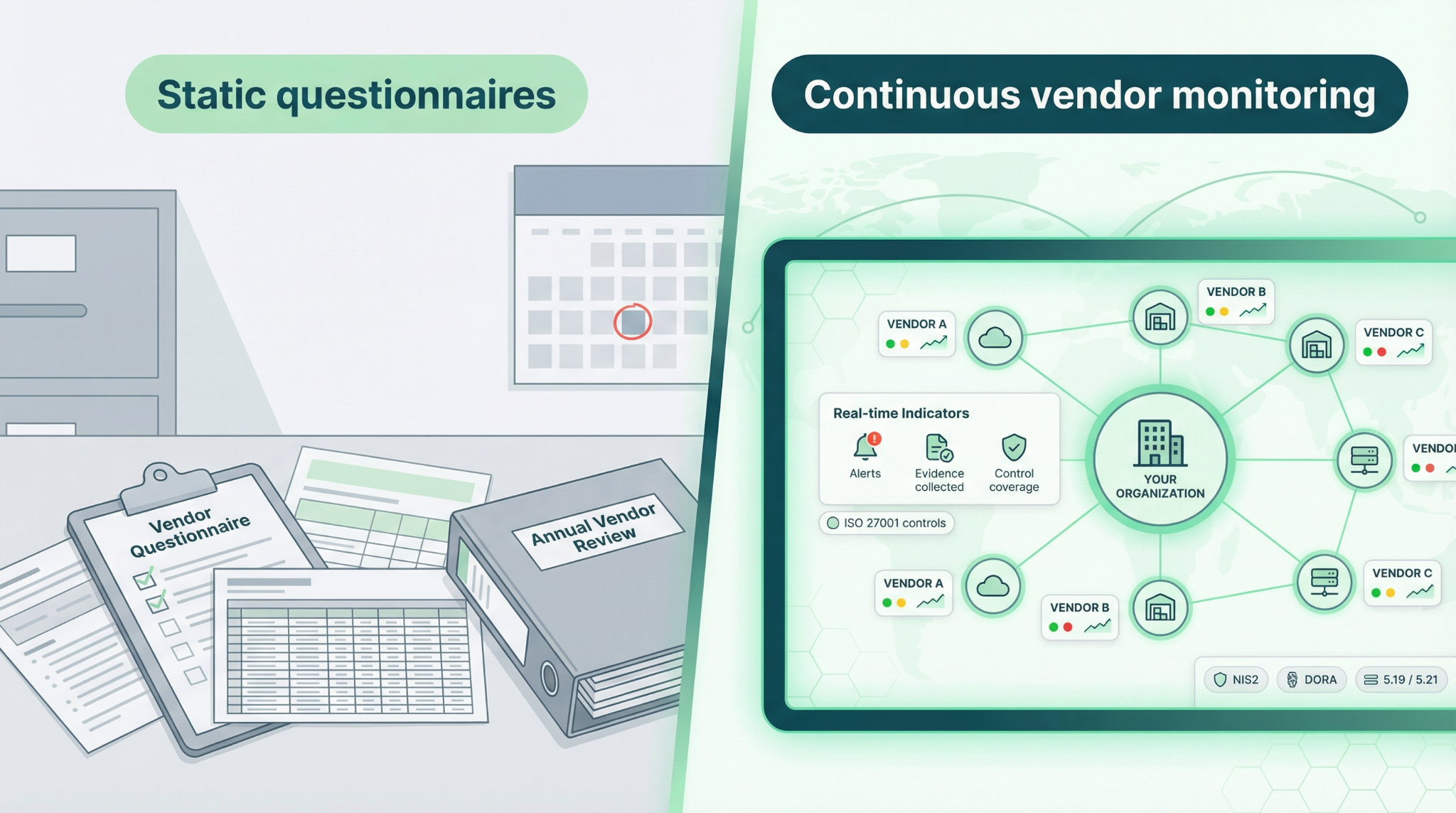
Third-party breaches have become routine. In 2023, 45 percent of organizations suffered vendor-driven business interruptions, according to Gartner (gartner.com). Auditors now demand daily proof of supplier security, and ISO 27001’s 2022 update makes that expectation explicit.
A new class of platforms delivers continuous evidence. We reviewed the landscape and narrowed it to five options that combine live monitoring, ISO mapping, and lean workflows. Each section reveals our scoring criteria and shows where every tool excels.

How we scored each platform
Selecting the best tool only works if the yardstick is public. We published ours so you can borrow it for your next vendor-risk RFP.
First, we tied every criterion to ISO 27001’s practical demands. Auditors need live evidence that suppliers meet Annex A controls, so ISO control coverage carries the most weight. A platform that maps vendor answers to 5.19 and 5.21 immediately earns extra points.
Next is evidence collection and automation. We favored integrations that pull proof such as vulnerability data, SOC 2 reports, or configuration telemetry without a chase-the-vendor email thread. If a product simply mails larger spreadsheets, it lost points.
Good data is worthless if it arrives once each quarter. That is why continuous monitoring breadth matters. Engines that scan external attack surfaces daily and flag breaches or leaked credentials within hours scored higher.
Software also must fit the rest of your stack. Integration and workflow flexibility covers connectors for Jira, ServiceNow, or Slack plus open APIs for custom needs.
Even the smartest engine fails if nobody signs in. Usability and adoption cost rate clean interfaces, predictable pricing, and an experience suppliers do not resent.
We also awarded bonus credit for specialized features that solve current pain points such as SBOM ingestion, fourth-party mapping, AI-driven risk predictions, or managed-service options that close head-count gaps.
Each factor carries the weight we listed above. Together they form a 100-point scale that produced our top five. With scoring covered, we can move on to the platforms themselves, starting with the highest performer.
1. Vanta: compliance automation plus continuous vendor evidence in one place
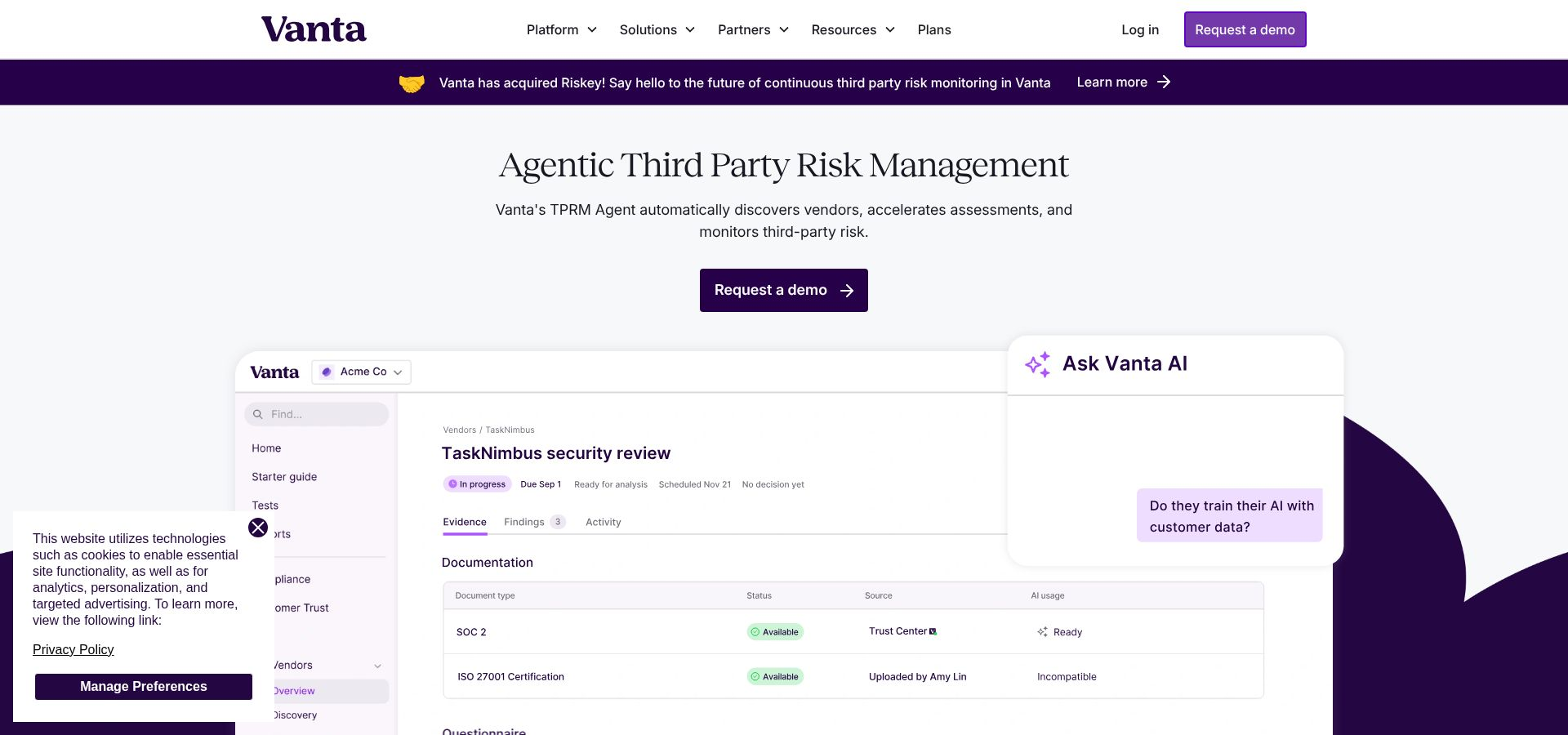
Vanta ranks first because it brings third-party risk management into the same system you use to run your own ISO 27001 program. Instead of treating suppliers as a separate spreadsheet project, Vanta connects vendor oversight to continuous control evidence, so you can show auditors a current, end-to-end trail for supplier relationships, not a point-in-time packet. This is exactly where Vanta’s TPRM module stands out, with its AI-driven assessments, automated evidence collection, and continuous monitoring built directly into your compliance workflow.
At its core, Vanta’s approach is hybrid. It combines four evidence paths, then ties them back to ISO 27001:
- Verified artifacts through the Vanta Exchange: When a supplier already maintains a security profile in the Exchange, you can inherit real documentation, such as SOC 2 reports, ISO certificates, penetration test letters, and policies, without restarting the same questionnaire cycle.
- AI-powered security reviews: Upload vendor documents and Vanta’s AI extracts key findings and gaps, turning long reports into usable assessment output.
- ISO-mapped questionnaires: For vendors not covered by existing artifacts, you can send concise assessments mapped to ISO 27001 and other frameworks, then track responses and follow-ups inside the vendor record.
- Continuous external monitoring (Riskey): Vanta adds ongoing signals, such as SSL and configuration issues, vulnerability intelligence, and breach exposure, so vendor posture stays current between reassessments.
That combination matters for ISO 27001 because supplier evidence is not just “collected.” It is mapped, monitored, and attached to the same audit story as your internal controls. Vendor evidence for Annex A supplier controls (including 5.19 and 5.21) can sit alongside your first-party control evidence, which reduces scramble during audit season.
Vanta also focuses on keeping the workflow lightweight. A procurement intake form helps standardize vendor onboarding and risk tiering, and vendor discovery can surface shadow vendors you might not realize are in use. For lean teams, that “find it, tier it, assess it, monitor it” loop is often the difference between a defensible program and a busy inbox.
Best fit: mid-market and enterprise teams that want one platform to manage ISO 27001 compliance and vendor security evidence together, especially in cloud-heavy environments where automation and integrations matter.
Key limitations to plan for: Vanta is primarily oriented around security and privacy. If your third-party risk scope is heavily weighted toward financial health, ESG, sanctions, or geopolitical exposure, you will likely need complementary tools. Some advanced workflow needs are also more limited today, such as highly customized residual risk scoring, broader fourth-party monitoring, and multiple parallel intake forms.
Pricing model: Vanta’s core compliance automation is typically priced as an annual subscription, with vendor risk management sold as an add-on that scales with the number of vendors under review (final pricing is quote-based).
One-line differentiator: Vanta is built to prove your ISO 27001 controls and your suppliers’ controls in the same system, with continuous evidence that stays audit-ready instead of expiring every quarter.
2. Security Scorecard: massive coverage and board-ready grades for vendor portfolios
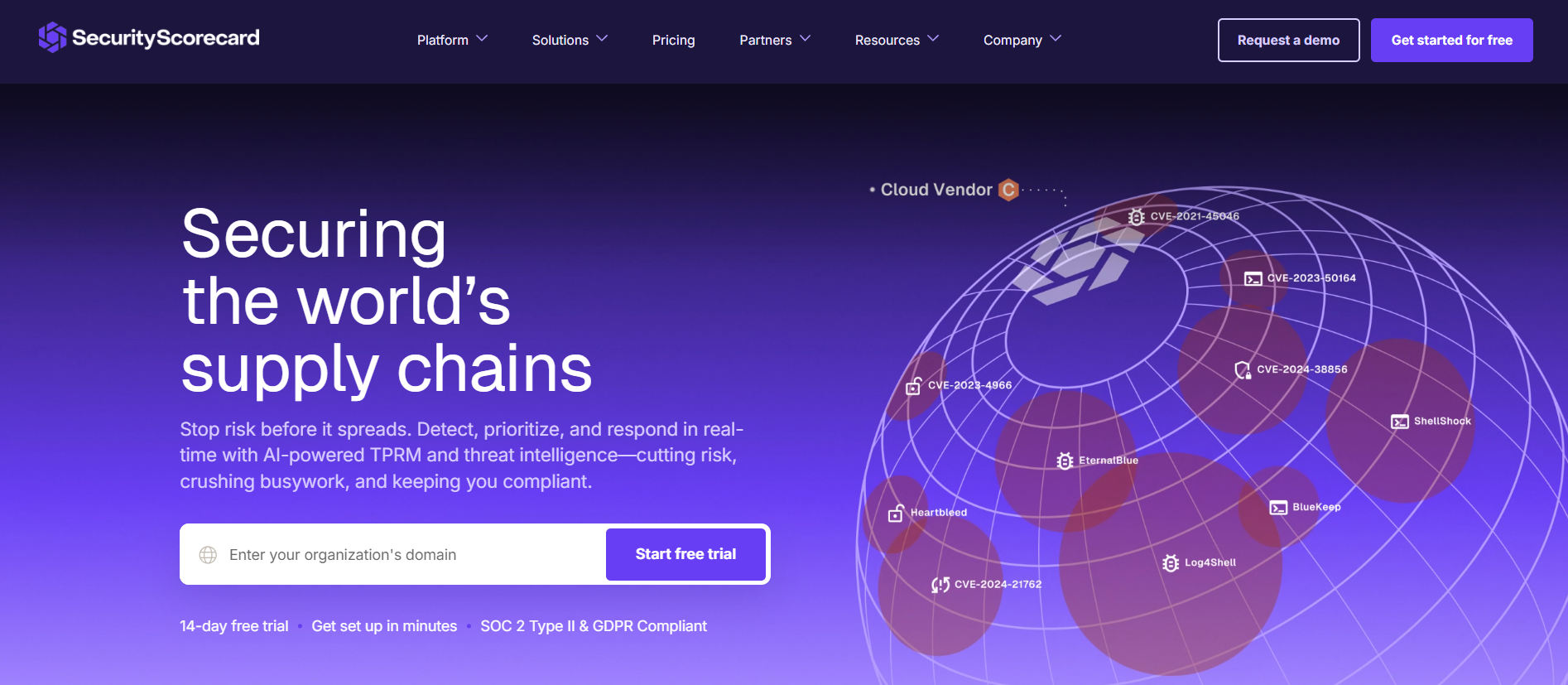
SecurityScorecard is built for one scenario above all others: you have a long supplier list, you need an instant baseline, and you cannot wait for questionnaires to come back. The platform continuously scans 12M+ companies and assigns each vendor an A to F grade across 10 risk factors, including network security, DNS health, patch cadence, endpoint security, IP reputation, web application security, leaked credentials, hacker chatter, social engineering, and information leak.
That scale changes day-to-day vendor risk operations. Upload a new supplier list and you often get a starting view immediately, which helps teams apply ISO 27001 risk treatment where it matters most. Instead of treating every supplier the same, you can triage by grade, then reserve deeper review time for the vendors driving the most exposure.
SecurityScorecard also goes beyond raw outside-in signals when you need artifacts. Its marketplace and Trust Portal let vendors share documentation and compliance data to supplement ratings. For organizations building an ISO 27001 supplier file, that combination is useful: live telemetry to show ongoing monitoring, plus shared documents to support due diligence.
Continuous monitoring and audit trail: SecurityScorecard’s core value is always-on scanning with alerts for meaningful changes. It also keeps score trends over time, which helps you demonstrate that monitoring is continuous and that remediation efforts changed the vendor’s posture.
Vendor collaboration: Outside-in tools can generate false positives, especially when retired assets linger in DNS. SecurityScorecard addresses this with a vendor dispute process through the Trust Portal, so suppliers can contest findings and share updated context.
Managed assessments: If your team does not have the bandwidth to run every assessment directly, SecurityScorecard offers MAX (Managed Assessment eXperience) to delegate parts of the vendor assessment process.
Integrations: SecurityScorecard is designed to feed enterprise workflows. It integrates with platforms such as ServiceNow and Archer, supports ticketing connections like Jira, and provides an API to push ratings and findings into your risk register or remediation process.
Pricing model: Pricing is typically tiered by vendor count and feature bundle. There is a free option for individual company lookups, while large enterprise programs often negotiate multi-year agreements. At the high end, deals can reach six figures annually.
Best fit: large enterprises, especially in financial services, that manage thousands of suppliers and need fast, board-friendly cyber exposure reporting without waiting on vendor participation.
Key limitations for ISO 27001 TPRM: SecurityScorecard is primarily cyber-focused and does not automate your own ISO 27001 certification program. Because scoring methodology is proprietary, it can be harder to defend the “why” behind a grade compared to tools that let you fully customize scoring logic. Many teams also pair it with a workflow-centric GRC or IRM platform to handle intake, approvals, contracts, and cross-functional remediation tracking.
One-line differentiator: the broadest vendor intelligence coverage in the market, with 12M+ companies scanned daily, so you can get an immediate risk baseline for almost any supplier.
3. BitSight: cyber ratings that translate vendor risk into financial impact
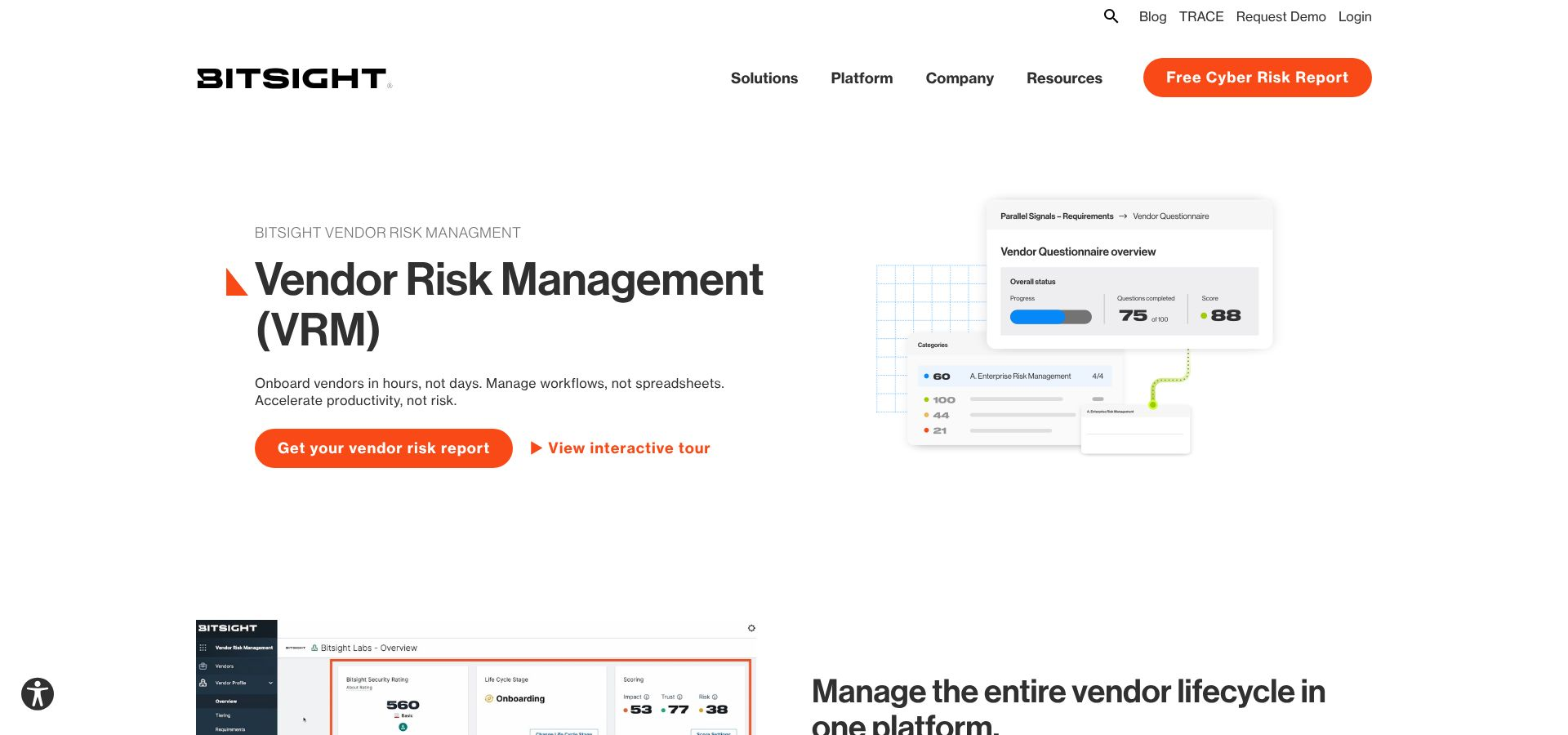
BitSight is the option to shortlist when your biggest internal challenge is not finding vendor issues, it is getting the business to care. The platform pairs outside-in security ratings with actuarial modeling, so a vendor’s cyber posture is tied to both breach likelihood and projected financial impact. That framing changes risk conversations with finance leaders and boards because it replaces “this score looks low” with “this exposure has a real cost.”
Core approach and evidence: BitSight continuously collects external signals similar to other rating providers, then rolls them into a 250–900 rating score. Underneath the score, security teams can still review the technical drivers, such as open ports, malware infections, patch latency, SSL and email security posture, and dark web credential exposure. On top of that, BitSight adds financial quantification outputs that are designed to support prioritization and budget decisions.
Continuous monitoring: Data refreshes daily and score history is tracked over time. That trendline is useful when you need to prove ongoing supplier monitoring and show that a remediation plan actually reduced risk instead of just generating documentation.
ISO 27001 fit: BitSight can map findings to common frameworks, including ISO 27001, and it works well as an input into clause 8 risk treatment and clause 9 monitoring. What it does not do is run your ISO 27001 program for you. It is a vendor risk intelligence layer, not a first-party compliance automation platform.
Integrations and workflows: BitSight is designed to feed enterprise systems, not replace them. It integrates with tools such as ServiceNow and Archer, supports connections to Jira, and offers an API so you can push vendor risk data into your GRC workflows and risk register. Moody’s investment is also part of why BitSight often lands in programs where cyber risk is discussed alongside broader financial risk.
Scalability and benchmarking: BitSight tracks hundreds of thousands of companies globally and is often associated with regulated environments. It also offers peer analytics so you can benchmark a vendor, or your portfolio, against industry peers rather than treating every score in isolation.
Pricing model: BitSight generally sits at the higher end of the ratings market, with costs that scale by vendor count. Renewal increases are commonly reported, so organizations that want cost stability often lean toward multi-year agreements.
Best fit: organizations that need dollar-denominated third-party cyber risk reporting for executive stakeholders, especially in regulated industries, and teams that already have a GRC platform to manage questionnaires, approvals, and remediation workflows.
Key limitations for ISO 27001 TPRM: BitSight does not manage vendor questionnaires, contract workflows, or the full assessment lifecycle. It also does not automate your own ISO 27001 evidence collection. If you need end-to-end supplier onboarding and documentation management in one system, you will likely pair BitSight with a dedicated TPRM workflow tool.
One-line differentiator: a vendor ratings platform that turns outside-in cyber telemetry into actuarial financial impact estimates, so third-party risk is easier to prioritize and easier to fund.

4. Panorays: fewer questionnaires, faster reviews, and a shared path to remediation
Panorays is a strong fit when your vendor risk program is getting stuck in the same place every quarter, with long questionnaires, slow response cycles, and endless follow-ups. The platform is designed to reduce that friction without turning assessments into shallow checkbox exercises.
Its model is straightforward. When you onboard a supplier, Panorays runs two tracks in parallel:
- Outside-in scanning of the vendor’s internet-facing footprint, including web apps, cloud assets, and dark web exposure, which rolls into a live cyber score.
- A dynamic questionnaire engine that adjusts depth based on the vendor’s risk tier, so low-risk suppliers are not forced through a heavyweight assessment meant for critical processors.
Those inputs feed a composite risk rating, which makes it easier to justify decisions during intake and re-assessment. Panorays also auto-fills parts of the assessment using publicly available information about the vendor, which can reduce manual back-and-forth during initial reviews.
ISO 27001 mapping: Panorays supports questionnaire templates mapped to common frameworks, including ISO 27001 and NIST. It is not a first-party compliance automation platform, but it can help you collect and organize supplier evidence in a way that aligns with ISO-style oversight.
Vendor collaboration: This is one of Panorays’ clearest strengths. Suppliers can see the same findings you see, along with guided remediation steps. That shared view tends to move the conversation from “prove it” to “fix it,” which is exactly what you want when an assessment uncovers real issues.
Continuous monitoring: Panorays continuously scans vendor digital assets and monitors dark web sources for leaked credentials and data. Score changes and alerts help you avoid the common ISO gap of relying on last quarter’s answers when the vendor’s posture changes mid-cycle.
Integrations and workflow: Panorays can connect into existing GRC, ticketing, and procurement workflows through integrations and APIs. The integration ecosystem is not positioned as the main differentiator, but it is built to fit into a broader governance process.
Scalability and coverage: Panorays is well suited to mid-market and enterprise programs managing hundreds of vendors. One trade-off is coverage depth. Its data lake is smaller than platforms like SecurityScorecard and BitSight, so visibility into obscure regions or smaller vendors may lag.
Audit readiness: You can export assessment outputs that combine scan findings and questionnaire evidence, but reporting is generally less customizable than in enterprise GRC suites.
Pricing model: Panorays is typically mid-range, priced higher than a basic ratings feed and lower than a full IRM platform. Pricing scales by vendor count and is usually quote-based.
Best fit: security and procurement teams that want quicker vendor assessments, less supplier fatigue, and a practical way to blend automated signals with documented evidence.
Key limitations for ISO 27001 TPRM: no first-party ISO 27001 compliance automation, potential coverage gaps versus the largest ratings databases, and less flexible reporting than enterprise GRC tools.
One-line differentiator: a vendor risk platform that keeps depth where it matters by scaling questionnaire effort to risk tier, while still adding continuous outside-in monitoring for day-to-day assurance.
5. OneTrust Vendorpedia: multi-domain vendor risk for teams juggling privacy, security, and ethics
OneTrust Vendorpedia is built for organizations whose supplier reviews extend well beyond cyber posture. If your vendor assessments include GDPR obligations, DPAs, sustainability claims, and ethics attestations alongside security controls, OneTrust is designed to keep those workstreams in one place. OneTrust is also renaming Vendorpedia to Third-Party Risk Exchange, which reflects how it positions the product as a shared ecosystem of vendor evidence rather than a single questionnaire tool.
Core approach: OneTrust combines three levers:
- Pre-completed vendor profiles: A library of 6,000+ Trust Profiles that can include artifacts such as ISO certificates, SOC reports, DPAs, privacy policies, and related documentation.
- Multi-domain assessments and workflows: Configurable questionnaires and routing across security, privacy, ethics, and ESG-style supplier requirements.
- Integrated risk signals through partners: Continuous monitoring is typically delivered through integrations rather than a native scanner, which can be a good fit if you already standardize on certain data sources.
ISO 27001 mapping depth: OneTrust supports 50+ pre-mapped frameworks, including ISO 27001, SOC 2, HIPAA, GDPR, CCPA, PCI DSS, NIST, CMMC, and others. Cross-framework mapping can help you avoid re-collecting the same evidence repeatedly. One nuance to understand is that ISO mapping and broader compliance automation live within OneTrust’s larger GRC footprint, so teams often license and configure multiple modules to get the full benefit.
Evidence collection and artifacts: The strongest accelerant is the Trust Profile library. When a vendor is already covered, you can start with existing certificates and policies instead of waiting on outreach. OneTrust also supports AI-assisted evidence ingestion, but expert notes flag a constraint: AI document scanning is limited to PDFs only, which can affect teams dealing with diverse evidence formats.
Continuous monitoring: OneTrust’s monitoring is generally partner-powered, not native. It can pull cyber risk signals through integrations with providers such as SecurityScorecard, RiskRecon, and HackNotice, and it can support ethics and reputational screening through a Dow Jones Risk & Compliance integration (sanctions, watchlists, adverse media). This model can be effective, but it means your “continuous” coverage depends on which partners you license and how you configure triggers and reassessments.
Vendor collaboration and UX: OneTrust includes a vendor portal for assessment responses and evidence uploads, plus automated reassessment schedules and notifications. The trade-off is complexity. Expert feedback highlights a dense interface and a heavier learning curve, including an Ease of Use score of 6/10 and common G2 themes like difficult setup and implementation. Support perception is also a watch item, with a 1.5/5 Trustpilot rating cited in the expert notes.
Integration ecosystem and scalability: OneTrust is widely deployed in large enterprises. Expert notes cite 14,000+ customers managing 3.7M vendors, with integrations spanning enterprise workflow and data platforms. The flip side is that OneTrust’s ecosystem has grown through 11 acquisitions, which can create a more fragmented product experience across modules.
Pricing model: OneTrust is modular and quote-based. Expert-provided benchmarks include a median annual spend of about $10,514 (Vendr, 278 transactions) and a Privacy Essentials Suite (including TPRM) around $44K/year (Spendflo). Implementation is typically an additional cost, and total spend can increase as modules are added.
Best fit: large organizations with dedicated GRC and privacy teams that need to run vendor risk across multiple domains, especially if reputational, ethics, or sanctions screening is part of the supplier program.
Key limitations for ISO 27001 supply-chain programs: complexity and time-to-value can be significant, continuous monitoring is integration-dependent, costs can climb as modules are added, and evidence workflows may emphasize collection over remediation guidance. If your primary need is fast, security-only vendor oversight with native continuous monitoring, you will want to compare this model to more security-centric platforms.
One-line differentiator: OneTrust is the enterprise option for managing vendor security, privacy, ethics, and ESG evidence together, powered by pre-completed Trust Profiles and an integration-heavy monitoring model, provided you can invest in configuration and adoption.
COMPARISON TABLE
Tool | Best For | ISO 27001 Fit | Monitoring Type | Questionnaires | Price Range |
Vanta | Mid-market & enterprise | Native — maps to Annex A controls directly | Continuous (native) | Yes + AI-assisted | $$$ |
SecurityScorecard | Large enterprise, financial services | Supplementary | Daily outside-in scans | Via Trust Portal | $–$$ |
BitSight | Regulated industries, board reporting | Supplementary | Daily outside-in scans | Via integrations | $$$$ |
Panorays | Mid-market, lean teams | Partial — framework templates | Continuous + dynamic questionnaires | Yes — risk-tiered | $$ |
OneTrust Vendorpedia | Large enterprise, multi-domain | Deep — 50+ frameworks incl. ISO 27001 | Partner-powered | Yes — multi-domain | $$$$ |

Frequently Asked Questions
Q: What is the best TPRM software for ISO 27001 compliance? Vanta is the strongest all-in-one option for ISO 27001 because it manages both your own compliance program and vendor risk in a single platform, with evidence mapped directly to Annex A controls. For large enterprises that need broader vendor coverage, SecurityScorecard or BitSight pair well as a complementary layer.
Q: What is TPRM and why does it matter for supply chains? TPRM (Third-Party Risk Management) is the process of identifying, assessing, and continuously monitoring the security and compliance posture of your suppliers and vendors. In supply chains, a single vendor breach can expose your entire operation ISO 27001’s 2022 update (Annex A controls 5.19 and 5.21) now makes formal supplier oversight a mandatory requirement.
Q: Can TPRM software replace vendor questionnaires entirely? Not entirely, but the best platforms dramatically reduce reliance on them. Tools like Vanta and Panorays combine automated outside-in scanning with AI-assisted assessments, so questionnaires are shorter, smarter, and risk-tiered reserving detailed reviews for high-risk vendors only.
Q: What is the difference between TPRM and GRC platforms? GRC (Governance, Risk & Compliance) platforms manage your organization’s overall risk and compliance posture. TPRM is a subset focused specifically on third-party and vendor risk. Some platforms like OneTrust Vendorpedia bridge both, while dedicated TPRM tools like Panorays focus purely on vendor oversight with deeper automation.
Q: How does ISO 27001 Annex A 5.19 apply to vendor risk management? Annex A control 5.19 requires organizations to define and implement processes for managing information security risks associated with suppliers and third parties. In practice, this means documenting vendor risk tiers, collecting evidence of supplier security controls, and maintaining continuous oversight exactly what modern TPRM platforms automate.