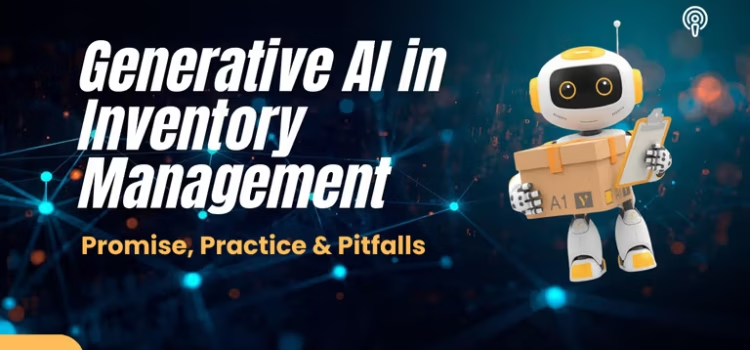
Have you used Generative AI in Inventory Management? I am sure you have by now. But has it worked out? This blog explains in detail the Promise, Practice, and Pitfalls of using AI in Inventory Management
There is a moment I remember clearly. I was sitting with the inventory planning team of a mid-sized manufacturing company in the UAE a company carrying over AED 200 million in stock, drowning in spreadsheets, and struggling to answer a deceptively simple question:
“Why do we keep running out of this component when we have fifteen weeks of cover on everything else?”
The team had data. They had an ERP. They had reports. What they did not have was intelligence a fast, contextual, reasoning capability that could connect the dots across siloed datasets and give them an answer in minutes rather than days.
That, in essence, is what Generative AI promises to change.
In the last two years, the conversation around Artificial Intelligence in supply chain has shifted dramatically. We have moved from narrow machine learning models that predict demand in isolation, to large language models and multimodal AI systems that can read, reason, draft, analyse, and execute across entire inventory workflows.
The question for supply chain managers is no longer whether to engage with Gen AI it is how to engage with it intelligently, without falling into the very traps it sets. This article is about exactly that.

What Generative AI Actually Is And What It Is Not
Let me start with a grounding statement that will save you from a great deal of confusion: Generative AI is not a forecasting engine. It is not a database. It is not an ERP replacement.
It is a reasoning and generation system trained on vast amounts of text and data, capable of producing human-quality outputs analysis, recommendations, drafts, summaries, translations, and code in response to a prompt.
When you interact with a Gen AI tool like Gemini Pro, ChatGPT, Claude Sonnet 4.6, or an enterprise-grade solution like SCMDOJO AI SENSEI, you are interacting with a model that has learned patterns from billions of documents. It understands context. It can reason across domains. It can take your messy inventory data, your procurement policy, your supplier lead time history, and produce a coherent analysis that would have taken a junior analyst three days to prepare.
But and this is critical it can also be wrong. Confidently, fluently, persuasively wrong. That is the double-edged nature of this technology, and every supply chain professional must understand it before deploying it.
|
The Benefits: Where Gen AI Genuinely Transforms Inventory Management
Having worked across dozens of supply chain transformations from FMCG to industrial manufacturing, from retail to healthcare distribution I have seen firsthand where Gen AI creates real, measurable value. Let me be specific.
1. Accelerated Root Cause Analysis
One of the most time-consuming and skill-intensive activities in inventory management is root cause analysis. Why did we have a stockout? Why did inventory turn deteriorate last quarter? Why is the days-on-hand for this SKU category climbing while demand is flat?
These questions traditionally require an experienced analyst to pull data from multiple systems, cross-reference reports, and synthesise findings into a narrative. With Gen AI in inventory management, a supply chain manager can feed in structured data exports transaction logs, supplier lead time records, forecast accuracy reports and ask the model to identify patterns, correlations, and likely causes.
What used to take two to three days can now take two to three hours.
2. Policy Generation and Documentation
Inventory management depends on clear, consistently applied policies: safety stock policies, ABC-XYZ classification rules, excess and obsolete inventory review procedures, cycle counting schedules. In most organisations I visit, these documents either do not exist, exist in someone’s head, or exist in a version last updated three years ago.
Gen AI can draft, refine, and update these policies at speed. You provide the context your company structure, your SKU profile, your service level targets and the model produces a working document. A first draft of professional quality that compresses the time from intention to implementation.
A critical caveat here: if you are using a general-purpose Gen AI tool like ChatGPT, Gemini or Grok, there is a real chance the policy output contains technically inaccurate recommendations plausible-sounding but not grounded in supply chain best practice. These models are trained on general internet data, not supply chain expertise.
|

3. Scenario Modelling and Decision Support
Supply chain managers face decisions under uncertainty constantly. What happens to our inventory position if our primary supplier in Southeast Asia goes down for six weeks? What should our safety stock be if demand variability increases by 30%? How do we rebalance our distribution network if we open a new warehouse?
Gen AI especially when integrated with your data can serve as a rapid scenario modelling partner. You describe the situation; it reasons through the implications; it generates options with trade-offs. The rigour of the final decision still rests with you. But the speed of reaching an informed position improves dramatically.
4.Supplier Communication and Negotiation Drafting
How much time does your procurement and inventory team spend writing emails to suppliers? Chasing delivery confirmations, negotiating lead time reductions, escalating quality issues, requesting updated forecasts? This is high-volume, language-intensive work that consumes disproportionate analyst bandwidth.
Gen AI handles this with ease. Feed it the context the supplier relationship, the specific issue, the tone required and it produces a draft communication in seconds. Your team reviews, adjusts, and sends. The cognitive load of writing from scratch is eliminated. The time savings compound across hundreds of supplier interactions.
5. Training and Knowledge Transfer
There is a chronic problem in many supply chain organisations: institutional knowledge lives in people, not in systems. When an experienced inventory planner leaves, they take years of contextual understanding with them.
Gen AI, when deployed correctly as a knowledge platform, can partially address this. Systems like SCMDOJO AI SENSEI are built on curated supply chain knowledge, allowing teams to ask questions, access best practices, and build capability without waiting for a training course or a consultant to become available.
| Application Area | Traditional Approach | With Gen AI | Time Saving |
| Root Cause Analysis | Manual data pull + analyst review | Automated pattern ID + narrative | 60–75% |
| Policy Documentation | Drafting, legal review, iteration | AI first draft + human refinement | 50–70% |
| Scenario Planning | Spreadsheet modelling, manual output | Prompted scenario with trade-offs | 40–60% |
| Supplier Communication | Individual drafting by analyst | AI draft + review and send | 70–80% |
| New Planner Onboarding | Shadowing + months of experience | AI knowledge base + guided querying | 30–50% |
Table 1: Gen AI impact across core inventory management activities
Use Cases in Practice: What Good Looks Like
Let me move from the general to the specific. The following use cases represent the highest-value, most immediately deployable applications of Gen AI in inventory management context.
Use Case 1: The Intelligent Inventory Health Report
Every week or month, most organisations run some version of an inventory health review slow movers, high-cover items, stockouts and near-misses, excess and obsolete positions. This report is essential for executive decision-making, yet it is typically produced by an analyst spending half a day extracting data and half a day formatting it into a PowerPoint.
A Gen AI-enabled workflow changes this entirely. The data feeds automatically. The model reads the output, identifies the five to ten most significant issues, drafts the narrative commentary, flags items requiring decision, and produces the report in minutes. The analyst’s role shifts from data production to insight validation a fundamentally more valuable use of their skills.

Use Case 2: ABC-XYZ Reclassification Analysis
ABC-XYZ segmentation is the backbone of good inventory policy, but most organisations do it once and forget it. Markets change. Customer behaviour shifts. New products launch. Old products decline.
Gen AI can not only assist with the analysis itself but can also draft the change communication, update the relevant policy documents, and flag items where the classification change implies a material shift in safety stock or reorder parameters. This closes the gap between analysis and action a gap where a great deal of supply chain value typically leaks away.
Use Case 3: Excess and Obsolete (E&O) Review and Action Planning
Excess and obsolete inventory is where cash goes to die. Most organisations know their E&O position is worse than it should be. Most also know that the process for reviewing, approving write-downs, and executing disposition is slow, political, and resource-intensive.
Gen AI in inventory management can accelerate the diagnostic phase substantially. It can analyse the E&O portfolio, categorise items by cause demand shortfall, forecast error, supplier MOQ misalignment, product lifecycle and draft the case for action for each category. What previously required weeks of analyst work can be compressed into a structured output that management can review, challenge, and act upon in a single session.

Use Case 4: Demand Signal Interpretation
One of the harder problems in inventory management is integrating qualitative demand signals a key account manager’s comment about a customer changing their order pattern, a news article about a competitor’s product recall, a procurement team’s note about a raw material shortage with the quantitative demand plan.
Traditional systems are not designed for this. They run on numbers. Gen AI is designed precisely for this kind of multimodal reasoning. It can read the qualitative signals, assess their potential inventory implications, and produce a recommended adjustment to the demand plan with a clear rationale. The planner reviews, accepts, or modifies. The cognitive work of connecting signal to implication has been done.
Plantryx is a good example where they have integrated qualitative demand signals in inventory optimization and supply chain using AI
The Hallucination Problem: The Risk Nobody Talks About Enough
Now we must address the uncomfortable reality.
Generative AI hallucinates. That is the industry term for what happens when the model generates a response that sounds plausible, is expressed with confidence, and is simply wrong. Not wrong in an obvious, easily spotted way. Wrong in the kind of subtle, contextually embedded way that an experienced supply chain professional might not immediately question because the rest of the analysis is coherent and useful.
I have seen this happen with inventory data. A model, asked to analyse a safety stock position, cited a calculation methodology that was internally consistent but applied parameters in a way that would result in a 40% understatement of required cover. The output looked right. The logic was explained clearly. The number was wrong.
For an inventory manager who acts on that number adjusting reorder points, reducing safety stock holdings, changing supplier ordering parameters the downstream consequence is a stockout. A stockout leads to lost sales, customer dissatisfaction, expediting costs, and the kind of firefighting that erases weeks of efficiency gains in a single week of chaos.
This is not a theoretical risk. It is an operational risk that must be managed.
Why Hallucinations Occur in Inventory Contexts
Gen AI models are trained on general data not your company’s specific inventory data, supplier relationships, or operational constraints. When you ask a model a question that requires highly specific numerical or contextual precision, it will attempt to answer using patterns learned from training data. If your situation diverges from those patterns as most real inventory situations do the model will interpolate or extrapolate in ways that can introduce material error.
The risk is highest when the model is asked to perform precise calculations without being given the underlying data; when it is asked about specific regulatory or contractual requirements; when it is asked to make predictions without access to current trend data; or when the user has not provided sufficient context to anchor the model’s reasoning.
⚠ Critical Warning for Practitioners
Never act on a Gen AI-generated numerical recommendation safety stock levels, reorder points, EOQ calculations, or financial estimates without independently validating the calculation against your source data. Treat the model’s output as a working hypothesis, not a final answer. The model does not know what it does not know.
Mitigation: How to Use Gen AI Safely
The answer is not to avoid Gen AI. The answer is to deploy it with the right governance architecture.
- Separate reasoning from calculation. Use Gen AI for interpretation, narrative, and pattern identification. Use your ERP, planning system, or dedicated analytics tools for the actual calculations. Feed the calculation outputs into Gen AI for interpretation but do not ask the model to do the maths from scratch.
- Require sourcing on all factual claims. Any Gen AI tool in a professional inventory context should be configured to cite the source of its assertions. If it cannot cite a source, treat the assertion as an informed hypothesis, not a fact.
- Build validation checkpoints into the workflow. Before any Gen AI output informs an inventory decision a reorder, a write-down, a safety stock adjustment a qualified human reviewer must validate the key numbers against the primary data source.
- Train your team on prompt discipline. The quality of Gen AI output is directly proportional to the quality of the input. Poorly framed prompts produce hallucination-prone outputs. Invest in training your planners and analysts to provide rich, precise context.
- Start narrow, not broad. Do not try to automate everything at once. Identify one high-frequency, well-defined task the weekly inventory health commentary, the supplier escalation drafting, the E&O category analysis and prove value there before expanding.
How Supply Chain Managers Should Integrate Gen AI into Their Daily Work
I want to be practical here. Not a technology roadmap. Not a three-year transformation programme. A framework for how an individual supply chain manager, or a small inventory planning team, can integrate Gen AI into their working week right now.
I call it the DRAFT principle and yes, I chose the name deliberately, because the most immediate value Gen AI delivers is in drafting.
| Principle | What It Means | Inventory Application |
| D — Direct | Give the model direct, specific context | “Here is our ABC-XYZ data for 450 SKUs. Identify the top 10 items where classification has changed by more than one category in 90 days and summarise the inventory policy implications.” |
| R — Review | Always review AI output critically | Check every number the model cites against your source system before acting on it. |
| A — Anchor | Anchor AI reasoning in your data | Upload your actual lead time data, demand history, and supplier records. Do not ask the model to assume generic values. |
| F — Frame | Frame questions around decisions | “Should we reduce safety stock for Category B items given our Tier 1 supplier’s lead time reduction?” not “Tell me about safety stock.” |
| T — Track | Track AI outputs and outcomes over time | Build a simple log of AI-generated recommendations and their real-world outcomes. Learn where the model is reliable and where it is not. |
Table 2: The DRAFT Principle A Practical Framework for Gen AI in Inventory Management
The supply chain managers who will extract the most value from Gen AI over the next five years are not the ones who automate the most. They are the ones who establish the clearest division of labour between human judgement and machine capability and who maintain that discipline even when the technology is impressive, even when it is fast, even when it sounds right.
Because in inventory management, sounding right and being right are not the same thing. And the consequences of the gap between them land on your service level, your working capital, and ultimately your customer.
6. Essential Considerations for Supply Chain Managers Adopting Gen AI in Inventory Management
- Embrace data-driven decision making with critical oversight. Leverage the deep insights AI provides but pair them with critical oversight. Treat AI outputs as powerful recommendations, not infallible directives. Understand the underlying assumptions and validate critical outcomes against your business intuition and source data.
- Prioritise data quality and integration. The efficacy of any AI system is inextricably linked to data quality. Champion initiatives to ensure data accessibility, cleanliness, and seamless integration across all relevant systems from sales and orders to inventory levels and supplier performance.
- Foster a culture of continuous learning and adaptation. AI models are designed to continuously learn and adapt from new data. Cultivate an organisational culture that mirrors this adaptability encouraging teams to actively engage with AI outputs, provide feedback, and participate in refining the models over time.
- Balance automation with human expertise. AI should augment human capabilities, not replace them wholesale. Complex, strategic decisions particularly those involving nuanced qualitative factors, ethical considerations, or unforeseen disruptions still require human judgment. Create a clear division between tasks AI can run autonomously and those requiring human review.
- Deploy strategically with phased implementation. Identify high-impact areas for AI deployment and implement in phases demand forecasting, inventory optimisation, or warehouse logistics. A phased approach allows for testing, learning, and refining the AI systems in manageable segments, building confidence and demonstrating tangible ROI.

- Invest in training and skill development. For AI to be effective, your workforce needs the skills to interact with, interpret, and manage AI-driven systems. Invest in training programmes that empower your teams to understand AI concepts, analyse AI-generated insights, and oversee automated processes.
The Bigger Picture: Gen AI as a Capability Multiplier, Not a Replacement
I have spent twenty years watching supply chains struggle with one fundamental constraint: the gap between the complexity of the environment and the cognitive bandwidth of the people managing it. Supply chains are getting more complex — more SKUs, more suppliers, more channels, more volatility, more regulatory requirements. Human bandwidth is not scaling at the same rate.
Generative AI narrows that gap. It does not close it that would require a level of contextual understanding and judgment that current AI systems do not possess. But it meaningfully expands what a competent supply chain team can analyse, communicate, and act on in a given week.
The right mental model is this: not AI replacing the inventory planner, but AI enabling the inventory planner to do the work of three to be more analytical, more proactive, more strategic, and less consumed by the mechanical tasks of report production, document drafting, and communication management.
The organisations that will win in the next decade of supply chain competition are not those with the most AI. They are those with the best combination of human expertise and AI capability deeply integrated, clearly governed, and ruthlessly focused on decisions that create real inventory and service level outcomes.
The organisations that will win in the next decade of supply chain competition are not those with the most AI. They are those with the best combination of human expertise and AI capability deeply integrated, clearly governed, and ruthlessly focused on decisions that create real inventory and service level outcomes.
Key Takeaways
1. Gen AI transforms inventory management through accelerated analysis, policy generation, scenario modelling, and communication drafting.
2. The hallucination risk is real and must be managed through rigorous validation governance.
3. Use the DRAFT principle (Direct, Review, Anchor, Frame, Track) to deploy Gen AI practically in your daily workflow.
4. The winning formula is human expertise amplified by AI capability not human expertise replaced by it.
5. Start narrow. Prove value. Then scale.
6. For supply-chain-specific AI, general tools carry hallucination risk. Domain-specific platforms like SCMDOJO AI SENSEI are purpose-built for inventory and procurement workflows.
|
Frequently Asked Questions: Generative AI in Inventory Management
What is the main difference between traditional AI and Generative AI in inventory management?
Traditional AI runs on structured data using defined mathematical formulas to handle tasks like demand forecasting and safety stock calculations. Generative AI operates on language and meaning, making it ideal for analyzing unstructured data, drafting policies, and providing contextual decision support.
Can Generative AI be used as a primary forecasting engine?
No. Generative AI is a reasoning and text generation system, not a calculator or an ERP replacement. While it can interpret calculation outputs and identify patterns within data trends, precise mathematical forecasting should still be handled by your primary analytical software or ERP system.
What is the hallucination problem in AI inventory tools?
A hallucination occurs when an AI model confidently generates a response that sounds highly plausible but is factually or mathematically incorrect. In an inventory context, an AI tool might cleanly explain a safety stock calculation but subtly misapply the parameters, which can lead to severe stockouts if a planner drops their guard.
How can supply chain managers safely mitigate AI hallucination risks?
Managers should separate reasoning from calculation. Let your analytical software handle the math, and feed those outputs into the AI for narrative interpretation. Most importantly, a qualified human reviewer must independently validate every single numerical recommendation against the primary data source before any inventory adjustments are made.
What is the DRAFT principle for deploying Gen AI in daily workflows?
The DRAFT principle is a practical framework designed to keep AI deployments accurate and safe:
-
Direct: Give the model highly specific data and explicit context.
-
Review: Critically check every number and recommendation before acting.
-
Anchor: Base the AI reasoning entirely on your actual company metrics.
-
Frame: Shape your prompts around specific decisions rather than broad topics.
-
Track: Log AI outputs over time to evaluate where the model is most reliable.
Why are general purpose AI tools risky for specialized supply chain workflows?
General purpose tools are trained on broad internet data, meaning their policy or operational drafts can include technically inaccurate recommendations that look professional but fail in practice. Domain specific platforms are safer because their underlying engines are trained exclusively on verified practitioner knowledge and supply chain frameworks.
About the Author- Dr. Muddassir Ahmed
Dr. Muddassir Ahmed is a globally recognized supply chain expert, thought leader, and keynote speaker. As the Founder & CEO of SCMDOJO, he has built one of the world’s leading platforms dedicated to empowering supply chain professionals with cutting-edge knowledge, practical tools, and access to expert insights. With over 19 years of leadership experience spanning the UK, Europe, the Middle East, and Southeast Asia, Dr. Ahmed has held key roles at Bridgestone, Doncasters Group, Eaton, and Volvo Cars, managing multi-million-dollar supply chain operations.
His expertise spans all facets of supply chain management, with a particular focus on leveraging technology and innovation to optimize processes and build resilient supply chains.
Recognized among the Top 10 Supply Chain Influencers in the World by Supply Chain Digital, Dr. Ahmed has been instrumental in shaping industry best practices through his extensive research, vlogs, and thought leadership. Holding a PhD in Management Science from Lancaster University Management School, he is also a certified Six Sigma Black Belt.
His platform, SCMDOJO, serves a vibrant community with over 51,000 monthly visitors. Moreover, he has 72,000 newsletter subscribers, and a social media following exceeding 105,000 supply chain professionals
A sought-after keynote speaker and thought leader, sharing his insights on industry trends, best practices, and the future of supply chain management. Dr. Ahmed delivers high-impact talks on supply chain excellence, digital transformation, and strategic leadership. His mission is clear: to help supply chains thrive
You can follow him on LinkedIn, Facebook, Twitter