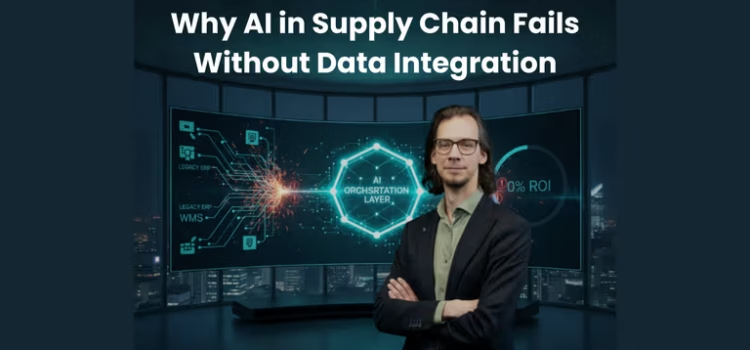
Supply chain leaders everywhere are talking about supply chain data integration, AI, predictive analytics, autonomous planning, Agentic workflows, and digital twins. But in reality, most organizations are still struggling with something far more basic: their data doesn’t connect.
In a recent episode of The Supply Chain Show, I sat down with Jethro Borsje, Chief Product & Technology Officer at Lobster, to unpack a hard truth many executives avoid confronting:
“If you don’t have a data strategy in place, AI doesn’t really matter.” — Jethro Borsje
This article distills that conversation into a clear message for supply chain leaders:
“AI is not your starting point. Data integration is.”
Also read our article on Master the Supply Chain Basics: Foundation for Digital Success, which emphasizes more on this topic.
The Real Problem: Fragmentation Across the Supply Chain
Modern supply chains operate across:
- ERP systems (SAP, Oracle, Dynamics)
- WMS and TMS platforms
- Carriers, suppliers, customers
- Legacy EDI, APIs, spreadsheets, emails
Each system works in isolation. Together, they create friction.
Jethro describes the consequence clearly:
“Fragmentation creates delays, manual work, and blind spots in decision-making.”
This fragmentation doesn’t just slow operations it directly impacts:
- On-time delivery
- Forecast accuracy
- Scalability
- Supplier relationships
- Customer satisfaction
Most importantly, it destroys trust in data, which is fatal for any digital initiative.
Why AI Becomes a Buzzword Without Integrated Data
Organizations often jump straight to AI because it feels transformational.
But AI without trusted, timely data is like building a skyscraper on sand.
Jethro puts it bluntly:
“Optimization and AI are just buzzwords if you don’t have a data foundation.”
Without supply chain data integration:
- Forecasts are wrong
- Signals arrive too late
- Exceptions are detected manually
- Automation amplifies errors instead of eliminating them
AI doesn’t fix broken data flows it exposes them.
Supply Chain Maturity: Integration Is the Real Level-Up
In supply chain maturity models, true progress happens when companies move beyond internal optimization and integrate upstream and downstream.
That is where most organizations stall.
ERP systems were never designed to cover:
- Supplier collaboration
- Carrier orchestration
- Multi-partner ecosystems
- Real-time visibility
As I shared in the discussion:
“The hardest part isn’t building new software. It’s syncing data across systems.”
Integration lead times become the bottleneck not innovation.
Why No-Code Integration Is a Game Changer
Traditional supply chain data integration depends on scarce, expensive developers and long IT projects.
Lobster takes a different approach: no-code, visual integration.
“People who understand the business flow can now build integrations themselves — without writing code.” — Jethro Borsje
Instead of:
- Custom Java code
- Complex APIs
- Long dependency chains
Teams work with:
- Visual data trees
- Drag-and-drop field mapping
- Reusable connectors
- Business-logic-driven design
This dramatically reduces:
- Time to integration
- IT dependency
- Cost of change
- Risk of misinterpretation
Legacy Systems Aren’t the Enemy Ignoring Them Is
One of the biggest myths in digital supply chain transformation is that legacy systems must be replaced.
Reality is different.
“If the connection works, it works. Migrating technology alone brings no business value.” Jethro Borsje
EDI, AS2, FTP, and decades-old protocols still run mission-critical supply chains especially in automotive, manufacturing, and healthcare.
Winning platforms embrace coexistence, not forced modernization.
Governance, Security, and Speed Are Not Trade-Offs
Another misconception: automation sacrifices control.
In reality, modern supply chain data integration platforms embed:
- Governance
- Access control
- Automated testing
- Data lineage
- Monitoring and audit trails
“Automation without governance is a risk that’s why controls must be built in by design.”
The goal is speed with guardrails, not speed at any cost.
The Human Barrier: Culture, Not Technology
Perhaps the most important insight from the conversation had nothing to do with software.
“The biggest barrier isn’t technology it’s our lack of imagination.” Jethro Borsje
Many teams are conditioned to accept:
- Manual workarounds
- Excel emails
- Weekly firefighting
- Siloed thinking
Digital transformation fails when people cannot imagine a different operating model.
Visualization, collaboration, and shared understanding are often more powerful than new tools.
What Excites the Future: Context-Aware AI
Looking ahead, Jethro highlighted Model Context Protocol (MCP) the ability to inject enterprise data into large language models securely.
“When LLMs understand your operational context, productivity reaches a new level.”
This is where AI becomes truly operational not generic, but situational.
But again, this future depends on one thing:
clean, connected, trusted data.
Why supply chain AI initiatives fail, the root causes, and their business implications are summarised in the table below.
| Root Cause | Business Impact |
| Fragmented systems | Delayed decisions |
| Manual data handling | Errors & rework |
| No data governance | Low trust |
| Poor integration | AI inefficiency |
| Legacy isolation | Scalability limits |
Similarly, what comes before AI in Supply Chain is Foundation Elements, and why it matters is listed in the table below.
| Foundation Element | Why It Matters |
| Data integration | Single source of truth |
| Governance & control | Risk mitigation |
| Visualization | Faster alignment |
| Business-led integration | Speed & accuracy |
| Continuous learning | Adoption & scale |
Key Takeaways
- AI cannot fix broken supply chain data.
- supply chain data Integration is the real foundation of digital maturity.
- No-code platforms unlock speed without sacrificing governance.
- Legacy systems must be integrated, not replaced.
- Culture and imagination block transformation more than technology.
- Context-aware AI is the future but only with trusted data.
In this article, we have tried to answer the following questions:
- Why does AI fail in supply chain?
- What is the biggest challenge in supply chain digitalization?
- How do you integrate ERP, TMS, WMS data?
- What comes before AI in supply chain?
If you have further questions on this topic, please do message me on LinkedIn, which I am more than happy to answer.
About the Author- Dr. Muddassir Ahmed
Dr. Muddassir Ahmed is a globally recognized supply chain expert, thought leader, and keynote speaker. As the Founder & CEO of SCMDOJO, he has built one of the world’s leading platforms dedicated to empowering supply chain professionals with cutting-edge knowledge, practical tools, and access to expert insights. With over 19 years of leadership experience spanning the UK, Europe, the Middle East, and Southeast Asia, Dr. Ahmed has held key roles at Bridgestone, Doncasters Group, Eaton, and Volvo Cars, managing multi-million-dollar supply chain operations.
His expertise spans all facets of supply chain management, with a particular focus on leveraging technology and innovation to optimize processes and build resilient supply chains.
Recognized among the Top 10 Supply Chain Influencers in the World by Supply Chain Digital, Dr. Ahmed has been instrumental in shaping industry best practices through his extensive research, vlogs, and thought leadership. Holding a PhD in Management Science from Lancaster University Management School, he is also a certified Six Sigma Black Belt.
His platform, SCMDOJO, serves a vibrant community with over 51,000 monthly visitors. Moreover, he has 72,000 newsletter subscribers, and a social media following exceeding 105,000 supply chain professionals
A sought-after keynote speaker and thought leader, sharing his insights on industry trends, best practices, and the future of supply chain management. Dr. Ahmed delivers high-impact talks on supply chain excellence, digital transformation, and strategic leadership. His mission is clear: to help supply chains thrive
You can follow him on LinkedIn, Facebook, Twitter