Coronavirus Impact on Supply Chain is still very much unknown. The unfortunate outbreak of the Coronavirus (COVID-19) in Wuhan, a critical industrial and transportation serving several global markets, has led to several restrictions and limitations for several businesses. In the business world, the response to the outbreak would see a massive impact on the current global supply chain, the spread can be seen in this map.
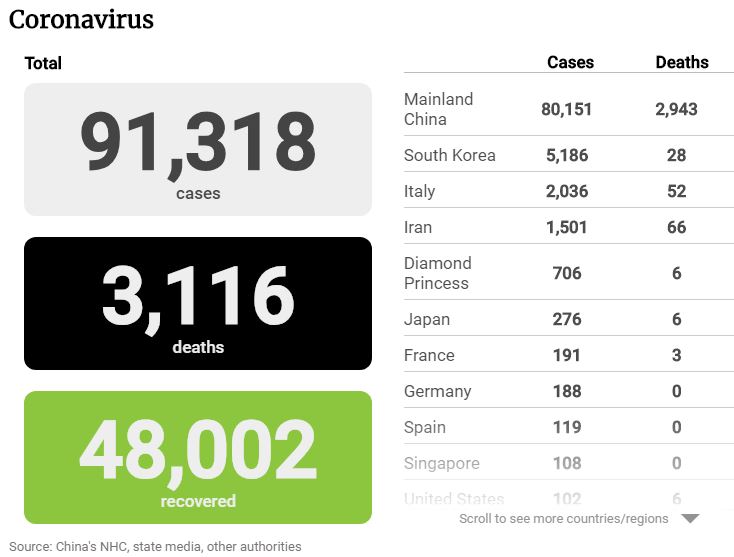
At the time of writing of this article, the reported cases were 91,318 and 3,116 deaths with 48,002 cases of recovery. But the fear amongst organizations and containment and preventive actions are only growing.
Severe disruptions to incoming and outbound air consignments, trucking, rail cargo, and other transportation means alongside massive port congestion for vessels are generally some gigantic effects to make most expectations. And although its long-term effects have not entirely played out yet, there are already some lessons about making better preparation as a business towards protecting future sales. It has already hit 1 Trillion USD of China economy and the Airline industry. Electronics and a few other industries which are heavily depended on supply from China will be impacted.
The best response is to have several considerations in place and ready to absorb such hits, as options usually turn out to be more limited when the outbreak takes a full swing. Nevertheless, even if your supply chain is not adequately ready, developing a practical consideration in response to the outbreak can be very tough, especially considering the scale of the problem and the rate it is expanding.
What Can Experts and Supply Chain Managers Do to Limit Coronavirus’s Impact on Supply Chain?
The creation of a clear supply chain response to the outbreak may be challenging, following the growth scale of the virus. The best approach is to prepare and take advantage of other possible options available before considering a total lockdown. Some measures can be applied now towards mitigating the Coronavirus impact on Supply Chain.
5 Things Business Should Do to Combat the Coronavirus Impact on Supply Chain
Should the outbreak continue, below are 5 Things business should do to combat the Coronavirus impact on Supply Chain:
- Identify Critical Suppliers in Affected Areas
- Secure Alternate Sources and Increase
- Educate Employees and Critical Suppliers
- Monitor Potential Disruptive Risks and Usage of Dual-Sourcing Strategies for Crucial Components.
- Create Backup Plans and Test for Supplier’s Outage.
Identify Critical Suppliers in Affected Areas
Supply chain experts and professionals should begin analysis on every aspect of the business supply chain to identify areas appropriately affected and how to develop alternate solutions towards solving them. The accuracy of information becomes a singular service during the early periods of any emerging disasters. Reports on its impact tend to be slightly rose-tinted. Nevertheless, stick to a more dependable source on data and information relating to the effects.
In the Hubei Province, most distributors, suppliers, or warehouses are all facing lockdown. The Hubei Province is one of the most affected regions and covers key locations like Jiangsu, Guangdong, Shanghai, Zhejiang, and more. Do you have supply coming from this area? If yes, please share your experience in comments.
Secure Alternate Sources and Increase Inventory
Secure Alternate Sources and Increase Inventory as a buffer where possible (I know I have advised against it generally!).
Any supply-chain design intended to limit the Coronavirus impact on Supply Chain would entail more backup capacity for distribution, production, and supply outages. The use of alternate sources and plans can limit the risk. Having a firm knowledge of suppliers considered to be in the exposed or vulnerable regions can massively impact your business response time to other demands. There is also a need to initiate mitigation measures and effectively use time as a competitive benefit. The decision to secure alternate sources from other nations apart from China can help raise your inventory levels.
As the idiom goes “one man’s loss is another man’s opportunity”. While Coronavirus Impact on Supply Chain of China is significant, it has given opportunity to other competing countries to gain their market share. An example of this Pakistan Textile Industry which is running on overcapacity due to the orders diverted from China to Pakistan Textile mills.
Educate Employees and Critical Suppliers
Educate Employees and Critical Suppliers on how to react and find contingencies.
The welfare of employees is paramount to any plan destined to succeed, as they remain a vital resource. The business ought to educate all employees alongside critical suppliers about the Coronavirus and its impact on Supply Chain. Also, the symptoms related to the virus and possible precautionary measures to take. The loss in productivity from absent employees can be significantly cost less compared to a potential downtime from shutting down the entire business process due to sick staff or from site disinfection.
Monitor Potential Disruptive Risks and Usage of Dual-Sourcing Strategies for Crucial Components.
Monitor Potential Disruptive Risks and Usage of Dual-Sourcing Strategies for Crucial Components. In this case, Single-Sourcing is definitely Not a Good Idea!
The use of real-time risk monitoring tools for the supply chain can deliver continuous monitoring solutions to keep everyone in the supply chain process updated. The updates could include key developments concerning lockdowns, government policies, updates on possible transportation interruptions, and assessment of the overall logistics networks. The reduction in supplier size has developed into a norm that permits the formation of significant strategic associations with several key suppliers. Nevertheless, given the organic nature of supply chain risks, businesses should take the consideration and responsibility of creating strategic cost-benefit analysis on the additional cost of sourcing from other supply areas or nations. The review of alternate suppliers can be valuable in reducing the Coronavirus impact on Supply Chain.
Create Backup Plans and Test for Supplier’s Outage.
Create Backup Plans like inhouse manufacturing or alternative manufacturing methods like 3D printing.
The Supply Chain plan should include contingency strategies in occasions where the expectations may include facing the quarantine process due to the virus. A long-term approach would be the recommendation of setting up good business relations with trusted contract manufacturers or logistics providers who feature the ability to manufacture and transport similar products from different locations. If required, they can be engaged in creating new production lines set up in the shortest possible time. Also, to become productive and serve impending demands, there is a need to evaluate local sources to aid production facilities with a steady supply in cases of outbreaks. Spreading the risk help deliver the supply chain as well as keeping the economies of scale and transportation costs on the low side.
In Conclusion
These considerations to Combat Coronavirus impact on Supply Chain take pinpoint plans to limit the contingencies in critical areas. The careful implementation of these considerations may include backup plans for transportation, communications, supply buffer, and cash flow.
The involvement of suppliers and customers in developing these plans can consequently help create a better second source separate from the primary business area. Although this consideration to Combat Coronavirus’s impact on Supply Chain includes less risk attached, better administration, quality supervision, and lesser costs needs to be evaluated as you can’t replace the experience of the main source. Similarly, economies of scale differ following the supply size associated with individual supply sources.
Along with this, there are several other cases which causes massive supply chain risk and we should be ready to combat. This is indeed a serious situation which I hope, can we resolve quickly.
Frequently Asked Questions: Combating Pandemic Supply Chain Disruptions
What immediate steps should supply chain managers take during the early stages of an outbreak?
Managers must map and analyze every aspect of their supply chain to identify critical suppliers located in highly affected or locked-down regions (e.g., Hubei Province during COVID-19). It is essential to rely on accurate, dependable data rather than optimistic or “rose-tinted” early reports to understand the true scale of the disruption.
How should businesses adjust their inventory and sourcing strategies?
Companies must secure alternate sources ideally from different countries or regions and temporarily increase inventory as a buffer against production and distribution outages. Relying on a single source (single-sourcing) is highly risky during a global crisis; implementing dual-sourcing strategies heavily mitigates this vulnerability.
Why is educating employees and suppliers considered a critical supply chain strategy?
The welfare of employees directly impacts productivity. Educating staff and critical suppliers on virus symptoms, precautionary measures, and contingency plans prevents massive, unmanaged downtime. A temporary loss in productivity from absent employees is far less costly than being forced to shut down an entire facility due to widespread illness or mandatory site disinfection.
What role does real-time monitoring play in combating supply chain disruptions?
Real-time risk monitoring tools keep all stakeholders updated on rapid developments like government lockdowns, policy changes, and transportation interruptions. This continuous stream of data allows businesses to quickly perform cost-benefit analyses on shifting to alternate suppliers before competitors crowd the market.
What backup manufacturing plans can protect a business from total supplier outages?
Businesses should test their contingency strategies by setting up standby relationships with trusted contract manufacturers or logistics providers in different geographic locations. They should also explore alternative manufacturing methods, like in-house production or 3D printing, to quickly set up new production lines if primary suppliers face quarantine or shutdown.
Recommended Reading

Disaster Recovery, Crisis Response, and Business Continuity: A Management Desk Reference


Business Continuity from Preparedness to Recovery: A Standards-Based Approach

About the Author- Dr Muddassir Ahmed
Dr. Muddassir Ahmed is a globally recognized supply chain expert, thought leader, and keynote speaker. As the Founder & CEO of SCMDOJO, he has built one of the world’s leading platforms dedicated to empowering supply chain professionals with cutting-edge knowledge, practical tools, and access to expert insights. With over 19 years of leadership experience spanning the UK, Europe, the Middle East, and Southeast Asia, Dr. Ahmed has held key roles at Bridgestone, Doncasters Group, Eaton, and Volvo Cars, managing multi-million-dollar supply chain operations.
His expertise spans all facets of supply chain management, with a particular focus on leveraging technology and innovation to optimize processes and build resilient supply chains.
Recognized among the Top 10 Supply Chain Influencers in the World by Supply Chain Digital, Dr. Ahmed has been instrumental in shaping industry best practices through his extensive research, vlogs, and thought leadership. Holding a PhD in Management Science from Lancaster University Management School, he is also a certified Six Sigma Black Belt.
His platform, SCMDOJO, serves a vibrant community with over 51,000 monthly visitors. Moreover, he has 72,000 newsletter subscribers, and a social media following exceeding 105,000 supply chain professionals
A sought-after keynote speaker and thought leader, sharing his insights on industry trends, best practices, and the future of supply chain management. Dr. Ahmed delivers high-impact talks on supply chain excellence, digital transformation, and strategic leadership. His mission is clear: to help supply chains thrive
You can follow him on LinkedIn, Facebook, Twitter