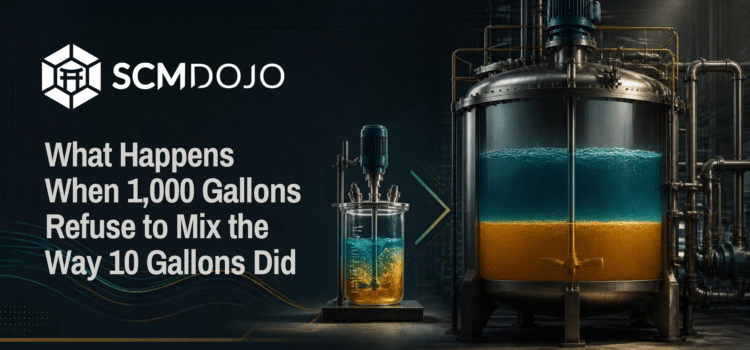
A recipe that works perfectly in a small container has a way of feeling foolproof, especially once it’s been tested and refined enough times to seem reliable. Multiplying every ingredient by a hundred looks like simple math on paper.
Scaling that same formula up to industrial volume rarely plays out the way the math suggests it should. Something that blended smoothly and evenly at ten gallons can behave in unexpected ways once the same ratios are attempted at a much larger volume.
That gap between small batch success and large batch performance usually comes down to what happens inside industrial grade mixing tanks once volume changes, since the physics involved shifts considerably along with the size of the container itself.
For supply chain leaders, that gap is more than an engineering footnote. Mixing sits at the front end of production for food, beverages, pharmaceuticals, coatings, and chemicals, so a batch that fails there ripples downstream into missed production schedules, scrapped inventory, and delayed shipments.
The Handbook of Industrial Mixing, a standard industry reference, notes that the cost of poor mixing in the U.S. chemical industry alone was estimated at $1 billion to $10 billion in 1989, and that yield losses of around 5% due to poor mixing are typical.

Bigger Changes More Than Volume
Increasing a vessel’s size doesn’t just mean more material to move, it changes the distances that material has to travel to blend evenly throughout the batch. What took seconds to circulate in a small container can take considerably longer once the container grows.
Part of the reason is geometry itself. When a tank is scaled up with the same proportions, its volume grows with the cube of its dimensions while its surface area grows only with the square, so a larger vessel has less surface per unit of volume for heating, cooling, or gas exchange. Power behaves even more dramatically: under turbulent conditions in geometrically similar tanks, the power an impeller draws rises with the cube of its speed and the fifth power of its diameter.
Circulation patterns shift as well, since a larger tank creates more space for material to settle, separate, or move unevenly if the mixing setup isn’t designed to account for that added volume. What worked at a smaller scale doesn’t automatically translate upward.
The power, impeller size, speed, and flow pattern required at larger scale cannot simply be determined by multiplying the small-batch values. Proper scale-up depends on vessel geometry, product properties, and the mixing objective, including circulation, blending, suspension, or shear requirements.
Engineers typically choose a scale-up rule, such as holding impeller tip speed constant or holding power per unit volume constant, and each rule changes a different set of conditions in the larger tank. No single rule preserves everything at once. Guidance on bioprocess scale-up points out that blend times are generally not held constant and tend to increase as vessels get bigger. That is why process teams validate their approach at pilot scale rather than trusting straight multiplication.
There Is a Hidden Current Inside the Tank
Impellers and agitators create flow patterns that aren’t always visible from outside the vessel, pushing material through the tank in currents that determine how evenly everything actually blends together. Those currents don’t reach every corner equally.
Poorly moving areas, sometimes called dead zones, can develop wherever the flow pattern fails to reach effectively. Material sitting in those pockets can behave differently from the rest of the batch, even though everything technically shares the same tank.
In thick or shear-thinning materials, this problem often takes the form of a cavern: a well-mixed region around the impeller surrounded by fluid that is barely moving. Research on non-Newtonian blending has found that even when the cavern itself is thoroughly stirred, the lack of transfer to material outside it makes blending the whole batch impractical. Computational fluid dynamics (CFD) modeling is now widely used to map local flow patterns and identify dead zones before equipment is built or modified.
Knowing where those currents actually travel matters more than simply running the mixer longer. A longer cycle doesn’t help material that the flow pattern never reaches in the first place, no matter how much time gets added to the process.
Not Every Liquid Wants to Move the Same Way
Thin liquids move through a tank with relatively little resistance, following the current created by an impeller without much difficulty. Thick syrups and creams behave very differently, resisting flow in ways that can leave portions of a batch barely moving at all.
Suspensions add another layer of complexity, since solid particles can settle out of a liquid if circulation isn’t strong enough to keep them evenly distributed throughout the mix. Powders introduce their own challenges around incorporation and clumping near the surface.
For suspensions, engineers commonly rely on the Zwietering criterion, which defines the “just suspended” condition as the point where no particles rest on the tank floor for more than one to two seconds. The classic correlation used to predict that speed has its own limits, however; researchers have reported that it applies only up to roughly 2% solids by weight, well below the loading of many industrial slurries.
Matching the mixing approach to the actual material matters considerably more than applying one standard method across every product a facility handles. What works well for a thin liquid can fail completely once applied to something thicker or more complex.

The Goal Is Making the Bottom Match the Top
Consistency throughout a large batch isn’t a minor detail, it’s often the entire point of the mixing process itself. Ingredients need to be distributed evenly, not concentrated near the top or settled toward the bottom where they’re harder to reach.
Regulated industries treat this as something to be measured, not assumed. In pharmaceutical manufacturing, blend uniformity sampling plans are expected to represent the entire blender or batch, and high variation between sampling locations is read as a sign of poor uniformity. Uniformity can also be lost after mixing ends: a 2021 review in Pharmaceutics found that an initially well-mixed blend can segregate again during storage, transfer, or later processing steps. For supply chain teams, that means the handling between the tank and the packaging line deserves the same attention as the mixing cycle itself.
Temperature consistency matters just as much as ingredient distribution, since uneven heating or cooling can affect texture, stability, and how well certain components blend into the rest of the batch. A tank that’s warmer at the top than the bottom creates its own problems.
The finished product ultimately reflects whatever inconsistency existed inside the tank during mixing. A batch that looks uniform once packaged can still trace quality issues back to areas that never fully blended the way the rest of the batch did.
Why Mixing Failures Become Supply Chain Problems
A batch that fails a quality check rarely stays contained within the plant. Rejected product has to be reworked or scrapped, replacement raw materials must be sourced, and production slots planned for other items get consumed by remakes. Customers waiting on that output feel the delay as late orders, short shipments, or stockouts.
The consequences grow when a flawed batch escapes detection. A joint study by the Food Marketing Institute and the Grocery Manufacturers Association estimated the average direct cost of a food recall at $10 million, before accounting for brand damage and lost sales. Regulators also scrutinize blending closely. In a recent warning letter, the FDA reported that a lot it sampled from a Florida drug manufacturer failed both assay and content uniformity specifications, and it criticized the company for not adequately validating its manufacturing processes.
Treating mixing performance as part of scale-up planning, contract manufacturer qualification, and capital equipment decisions helps protect the reliability that downstream partners depend on. Asking suppliers how a process was validated at scale, not just at bench level, is a simple question that can prevent expensive surprises.
Getting mixing right also creates upside, not just avoided losses. The same Handbook of Industrial Mixing reports that one large multinational chemical company estimated its lost value from poor mixing at $100 million per year in 1993, while pulp and paper mills that adopted improved mixer technology documented average chemical savings of 10 to 15%. For procurement and operations teams, those figures make a strong case for treating mixing equipment as a lever on raw material usage, yield, and delivery reliability rather than a commodity purchase.

Conclusion
Scaling production isn’t simply a matter of making a small recipe bigger, even though that’s exactly how it tends to look on paper before the actual mixing begins. The physics inside a container changes as the container itself grows larger.
Distance, flow, energy, and material behavior all shift once volume increases, creating challenges that a small batch recipe never had to account for in the first place. What worked in a test kitchen doesn’t automatically survive the jump to industrial scale.
Recognizing that gap ahead of time tends to prevent a lot of frustration once production actually begins. The formula might stay the same on paper, but the equipment and approach behind it usually need to change right along with the volume. For supply chains built on consistent, on-time output, getting that change right is what keeps a scale-up from becoming a disruption.