Walk into almost any boardroom at a top company nowadays, and you’re likely to see piles of data. Dashboards of reds and greens show everything from on-time-in-full (OTIF) to working capital movements. But when the CFO or the head of supply chain asks what caused a $300 million spike in excess inventory, the typical response is not to look at the data. It’s to scramble. It takes analysts weeks of slogging through spreadsheets, tracing the root causes of cross-functional decisions, to find an explanation.
Walk into almost any boardroom at a top multinational company nowadays, and you’re likely to see piles of data. Dashboards painted in a spectrum of reds, yellows, and greens show everything from on-time-in-full (OTIF) delivery rates to granular working capital movements and raw material pricing indices. But when the Chief Financial Officer or the head of supply chain points to the screen and asks what precisely caused a $300 million spike in excess inventory over the last quarter, the typical response is not to seamlessly drill down into the data for an immediate answer.
Instead, the response is a scramble.
It takes teams of analysts weeks of slogging through disconnected spreadsheets, navigating through deeply entrenched departmental silos, and manually tracing the root causes of cross-functional decisions just to find a plausible explanation. By the time the root cause is identified, the market has shifted, the fiscal quarter has closed, and the opportunity to correct the course has vanished.

Companies today are more connected and more transparent about the physical movement within their supply chains than they ever have been. They have invested billions in tracking shipments, monitoring port congestion, and implementing advanced ERP systems. What they are significantly less connected and transparent about is why things are happening within their own four walls.
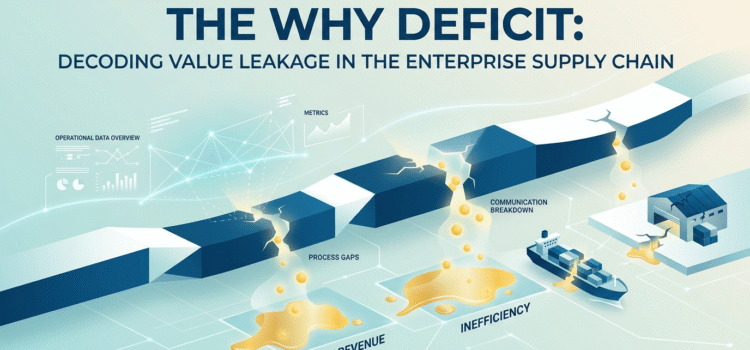
That missing link the elusive “why” is the source of massive, structural value leakage for modern enterprises. In today’s VUCA (volatile, uncertain, complex, and ambiguous) world, the way companies have historically reviewed performance over traditional, annual, or even quarterly cycles simply isn’t going to work anymore. If you want to start recapturing enterprise value and stanch the bleeding of margin that leaks between the sales, finance, and supply chain silos, you have to fundamentally rewire how you analyze performance. You have to do what professional sports franchises do: You have to build Post-Game Analysis (PGA), or the “Decision Replay,” into your company’s DNA, and then you must supercharge it with Artificial Intelligence.
The Structure of Value Leakage in Disjointed Decision-Making
To truly understand why we’re talking about Post-Game Analysis or Decision Replays at all, you have to first understand the anatomy of disjointed decision-making. Companies aren’t just organizations of people occupying different roles or functional areas; they are incredibly dense networks of disparate, localized, and often conflicting decisions. These decisions are interlinked with one another in complex, non-linear, and frequently counterintuitive ways.
Consider the ripple effect: When a commercial manager decides to lower a price point to hit a regional revenue target, that action artificially inflates short-term demand. That demand signal ripples backward, impacting warehouse space constraints, stressing production capacity, and forcing procurement to buy raw materials at premium spot-market rates.
When your organization is structured such that sales, finance, and supply chain teams all make their own localized decisions based on their own unique set of Key Performance Indicators (KPIs), their own distinct planning cycles, and their own differing time horizons, value leakage is not just a risk it is inevitable. Sales teams are incentivized on top-line revenue; supply chain teams are evaluated on cost reduction and inventory turns; finance teams are measured on working capital efficiency and margin protection.
Because these decisions are often based on “tribal knowledge” unwritten rules, gut feelings, and localized heuristics rather than empirical, shared data these competing KPIs are never harmonized at a granular level. A supply chain planner might override a system-generated baseline forecast with their own judgment-based forecast for a specific customer. Why? Perhaps because they remember a stockout from three years ago that cost them their bonus, but there is no written record of this rationale. A procurement officer might delay a bulk buy because of a whispered rumor that marketing has put a major Q3 promotion on hold.
Over multiple planning cycles, thousands of these micro-decisions compound. The result is significant value leakage manifesting as millions of dollars in excess inventory, exorbitant expedite fees to air-freight goods at the last minute, or massive write-offs for obsolete stock.
The Cognitive Trap: Why Human Intervention Fails at Scale
The core issue exacerbating this value leakage is the human element. For decades, the prevailing logic in supply chain management was that human planners needed to constantly supervise and tweak the output of planning software. But human cognition is ill-equipped to handle the hyper-dimensionality of modern global supply chains.
When humans intervene in algorithmic planning, they introduce cognitive biases. The recency bias causes a planner to over-order stock simply because a supplier was late last month, regardless of whether that supplier’s long-term reliability is 99%. Confirmation bias leads commercial teams to inflate sales forecasts because they subconsciously seek data that supports their aggressive growth targets, ignoring macroeconomic indicators that suggest a consumer downturn.
Every time a human planner touches the plan, leadership must ask a critical question: Are they making it better, or are they making it worse? Studies and operational audits increasingly show that manual overrides introduce systemic latency and noise. They create the infamous “bullwhip effect,” where small fluctuations in retail demand are amplified into massive, chaotic swings in production and inventory further upstream. To eliminate this execution gap, organizations must transition away from relying on the flawed, localized memories of their workforce and move toward a mathematically rigorous system of record for decision-making.
Enter the Decision Replay
Post-Game Analysis is an established, non-negotiable concept in professional sports. After a Sunday game, NFL teams don’t just look at the final score to figure out how to improve; they spend Monday in the film room. They watch the game tape. They review play after play, analyzing how their players lined up, how defensive coverages shifted, how decisions were executed under pressure, and what exactly went wrong or right during a specific microscopic matchup. It is a relentless, granular analysis of performance versus intent.
While many forward-thinking executives have wanted to apply this level of scrutiny to their corporate operations for years, the reality is that most supply chain organizations simply lacked the infrastructure, the computational power, and the centralized data architecture to do it.
That landscape is rapidly changing with the advent of agentic AI and the Enterprise Knowledge Graph. Post-Game Analysis for the supply chain is about creating a digital film room. It connects every single decision that goes into your Sales and Operations Planning (S&OP) process and maps it directly to how those plans were physically executed in the real world. PGA helps teams close the gap between the theoretical plan and the actual financial results by connecting the dots between execution and strategic intent.
Through an AI-powered Decision Replay platform, an enterprise can automatically archive every planning decision, every manual override, and every parameter change that has occurred across the global enterprise. It then continuously and autonomously compares those intended plans against realized outcomes. Using advanced, multi-level causal analysis, the AI platform absorbs huge volumes of plan-versus-actual data across hundreds of cycles to pinpoint exactly where the value leaked.
The Engine of Truth: The Enterprise Knowledge Graph
To execute a true Decision Replay, you cannot rely on traditional relational databases that trap data in rigid rows and columns. You need an architecture that understands relationships. This is where the Enterprise Knowledge Graph (EKG) becomes the most critical asset in the modern IT stack.
An EKG maps the entire business suppliers, components, factories, shipping lanes, distribution centers, retail shelves, and end-consumers as a network of interconnected nodes and edges. But it doesn’t just map physical assets; it maps the business logic, the financial constraints, and the decision parameters. Platforms like o9 Solutions utilize this “Digital Brain” to capture not just the physical supply chain attributes, but the complete semantic reality of the enterprise.
When a decision is made, the Knowledge Graph records the context. It records what the inventory levels were at that exact second, what the supplier lead time was believed to be, and who applied the manual override. By digitizing the environment in this way, the AI has a perfect, high-fidelity replica of the past to analyze. It shifts the organization from relying on 80% tribal knowledge to utilizing 80% digitized, institutional knowledge.

Finding the Source: Unpacking the $300M Anomaly
Let’s return to the boardroom scenario: the sudden, unexplained $300 million inventory increase. In a traditional company, identifying the cause is a forensic nightmare. But with an AI agent enabled with PGA capabilities, the system does not simply report a red variance on a dashboard; it acts as an autonomous forensic accountant.
The AI digs into its archived decision logs and conducts a root-cause analysis in seconds. It might highlight that the inventory overage was not a sudden, unpredictable black-swan event, but rather the slow-moving, predictable end result of a specific sequence of disjointed decisions:
- Commercial Optimism: Sales teams were frequently overriding the baseline forecasts generated by Machine Learning, inflating demand projections by 15% to align with stretch revenue goals mandated by the board.
- Stale Parameters: Safety stock policies in the ERP system hadn’t been updated in over eighteen months. They were still calibrated for pandemic-era shipping delays, meaning the system was ordering massive buffer stocks even though global freight lead times had normalized.
- Misaligned Factory Incentives: Plant managers, measured strictly on Overall Equipment Effectiveness (OEE) and factory utilization rates, chose to over-produce these specific, high-margin SKUs to keep their assembly lines running at 98% capacity, willfully ignoring early point-of-sale data indicating that end-consumer demand was rapidly cooling.
By mapping these root causes and ranking them by their exact monetary impact, Post-Game Analysis cuts through departmental finger-pointing. It allows C-Level leaders to look at the objective truth and focus their transformation efforts on the most critical behavioral and process failures.
From Diagnostic to Prescriptive: Closing the Execution Gap
Diagnosing the issue is, of course, only half the challenge. What truly separates an AI-powered PGA system from a glorified analytics dashboard is its ability to transition from diagnostic (telling you what happened and why) to prescriptive (telling you what to do next).
With an AI agent conducting the Post-Game Analysis, executives are not just handed a post-mortem report that requires human translation and debate. They are provided with specific, contextual, algorithmic recommendations for corrective action. The system might recommend dynamically lowering inventory targets across European distribution centers, reallocating available manufacturing capacity to a faster-moving product line, or permanently stripping a specific sales team of their ability to manually override ML-generated forecasts because their historical bias consistently destroys working capital.
More importantly, the AI learns. It ingests the outcome of the Post-Game Analysis and self-tunes. It incorporates the reality of supplier delays, forecast inaccuracies, and production bottlenecks into the next iteration of the planning cycle. This creates a self-healing supply chain that becomes smarter and more resilient with every cycle it completes.
Change Management: Building a High-Agency Culture
Deploying an AI-powered Post-Game Analysis is not merely a technological software implementation; it is a profound transformation of the organization’s entire operating culture. You are fundamentally changing how people are evaluated and how power is distributed.
To maximize the ROI of these systems, senior leaders must push their enterprises toward becoming “high-agency” organizations. A high-agency culture is one where decision-making power is democratized, but accountability is absolute. Planners, account managers, and procurement officers are no longer spending 80% of their weeks wrestling with Excel macros to figure out what is happening. Instead, they have the digitized knowledge base and causal awareness available to them in real time.
If an account manager wants to see the cost-to-serve implications of launching a localized promotion, they don’t need to ask the analytics team for a two-week study. They consult the AI agent, run fifty different stochastic “what-if” scenarios, and have the optimal playbook in their hands before lunch.
However, getting the workforce to trust the AI requires radical transparency. When the AI recommends a change, it must provide “explainable AI” showing the math and the logic behind the recommendation. When the business goes wrong, the culture must shift from a punitive mindset (hunting for a scapegoat) to an engineering mindset (fixing the algorithm). Constant change and adaptation can no longer be a management slogan printed on breakroom posters; it must become a required, automated, and psychologically safe response.

The Autonomous Future and Enterprise Value
For Chief Supply Chain Officers and Chief Financial Officers, the mandate is clear. The era of managing complex global supply chains through isolated spreadsheets, siloed S&OP meetings, and gut instinct is definitively over. The margin for error in today’s macroeconomic climate is too thin, the cost of capital is too high, and the speed of consumer shifts is too fast.
By implementing an AI-driven Post-Game Analysis layer powered by an Enterprise Knowledge Graph, companies can finally align their planning with their execution. They can root out the systemic biases that lead to the bullwhip effect. They can automate the vast majority of their near-term operational execution, achieving a “touchless” planning environment where routine decisions are made by self-tuning algorithms, freeing human talent to focus purely on strategy, relationship building, and exception management.
By connecting the dots between strategy, planning, execution, and learning, enterprise leaders can stop perpetually reacting to the surface-level symptoms of supply chain volatility. They can start addressing the root causes of value leakage, optimizing their working capital, unlocking hundreds of millions of dollars in trapped cash, and turning their supply chains from a cost-center into a highly resilient engine for competitive advantage and sustainable growth.