For supply chain managers, AI Supply Planning is no longer something out of science fiction. Instead, it’s a real force in decision-making. If you’re not already using it, you will be soon. The question is, how do you maintain quality and accountability to ensure the right planning decisions are made?
In this article, we’ll discuss how “human in the loop” works to keep AI Supply Planning systems on the right path. We’ll also look at ways to improve security, including using a free VPN when on the road. And we’ll examine how AI can be a powerful partner for supply chain planners in the future.
Why You Need a Human in the Loop
Artificial intelligence excels at processing huge amounts of data and identifying patterns. That makes it incredible at analysing previous demand and using it to plan for the future. But it lacks both context and accountability. Supply chain professionals need to set objectives, provide oversight, and own the outcomes.
Human in the loop (HITL) lets you master the efficiency of automation along with the precision and reasoning of human oversight.
The HITL model of planning makes sure that:
- Business priorities guide your outputs. You can shape planning models around service levels, working capital, or sustainability goals in a way that machines just can’t.
- Ethical and practical concerns are addressed. Algorithms can optimize costs, but it takes a human to understand ethical labour practices and environmental impacts.
- Final accountability remains a human responsibility. Software can inform decisions, but ultimately a human planner must own and justify the chosen direction.
A HITL Workflow
What does an HITL workflow look like in practice? Every business is different, but for a supply and demand planner, a workflow enhanced by AI might look something like this:
- Review AI recommendations.Your AI system can provide forecasts, replenishment signals, and exceptional alerts. It’s up to you to evaluate whether these align with actual market intelligence and the realities of your business.
- Apply overrides.If the AI’s recommendations make sense, they can be approved in a single click. If not, the planner has the authority to override them, using their judgment and knowledge that the AI may not have. This approach applies to things like supply negotiations, current promotions, and external disruptions, for example.
- Handle exceptions.Algorithms can turn up anomalies, such as sudden spikes in demand. The human in the loop can triage these, deciding what’s a statistical blip and what’s a shift in the market.
- Feed back better data.Documenting what changes were made, a planner enriches the data set, helping the algorithm learn. Over time, it will get better at determining variables by itself, leading to better decision-making.
- Communicate decisions.Human supervisors translate raw numbers into actionable insights for colleagues in other departments. The human in the loop keeps everybody else in the organization in the loop, too. This strategy ensures accountability and ownership of the process. For planners building AI-assisted forecasting and replenishment workflows, SCMDOJO’s Sales and Operations Planning Blueprint course offers practical frameworks for aligning AI recommendations with cross-functional demand and capacity decisions.
Practical Challenges
A HITL workflow offers the best of both worlds. It’s the efficiency and speed of machine learning, coupled with the judgment and experience of a human planner. But as with any system, it’s all about how it’s implemented. Challenges include:
- Gaps in data quality. Algorithms are only as good as their inputs. That means planners have to constantly check for missing or inconsistent data.
- Managing change. Some colleagues may trust AI outputs too much. Others may reject them entirely. It is critical to manage expectations and communicate how AI should be used, with all its advantages and disadvantages.
- Cognitive overload. Too many alerts and notifications can overwhelm a planner. It’s worth taking some time to configure your systems to make sure you get the information you need without being swamped by irrelevant data. To build resilient digital workflows and minimize cognitive overload, explore SCMDOJO’s Capacity Planning Course a hands-on guide to balancing supply capabilities with AI-driven demand forecasts.
For planners navigating AI-driven workflows, developing digital skills is essential. The Supply Chain Digitalization Course offers a strong foundation for understanding digital transformation and preparing teams for AI integration.

Staying Secure
Using AI presents security risks. Some common-sense practices can help minimize this risk so you can harness the power of the algorithm safely.
- Don’t share sensitive information with AI. That includes client and supplier information as well as employee information.
- Educate colleagues about AI security risks. Clearly communicate the dangers of sharing information that can end up in the dataset.
- Develop an AI policy, detailing when using AI is acceptable and when it isn’t.
- When traveling, protect sensitive planning data from prying eyes with a VPN. A free VPN can give you encrypted access when using public Wi-Fi so that no one can steal your information. However, free tools have their limits. A more solid option would be to use trusted VPN services that keep your internet activity private and your data secure.
Want to know how ready your organization is for AI-driven planning? The AI Supply Chain Competency Assessment Tool helps benchmark your current capabilities and identify improvement areas.
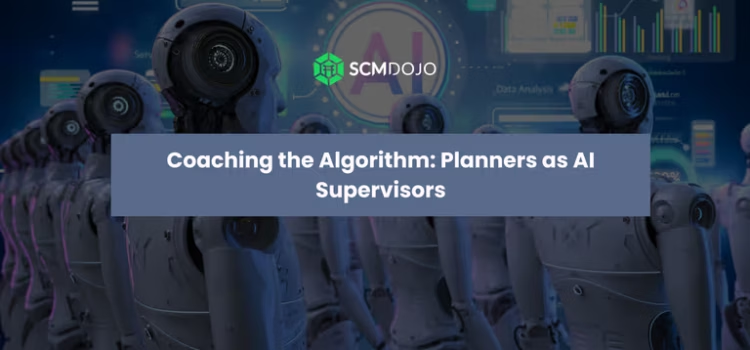
Planners as AI Supervisors
Most people think of AI as an assistant. But it works better when you treat it like a new employee. You need to train it in what you want and guide it, especially at first. But over time, machine learning will make these tools more useful and powerful, freeing you up for higher-level tasks.
Supply chain planning is about judgment, accountability, and adaptability. AI can accelerate your insights, but you, the human in the loop, set the direction. Strengthen your end-to-end planning expertise with SCMDOJO’s Inventory Planning and Control course designed to help planners master real-world optimization alongside AI support.