








The total cost of disruption is one of the most underestimated metrics in supply chain strategy and it is critical in wartime planning. Most procurement teams focus narrowly on unit price or even total cost of ownership, but they rarely quantify what happens when a supplier fails. This calculation should become a cornerstone of your wartime scenario planning.
The Framework: Six Dimensions of Disruption Cost
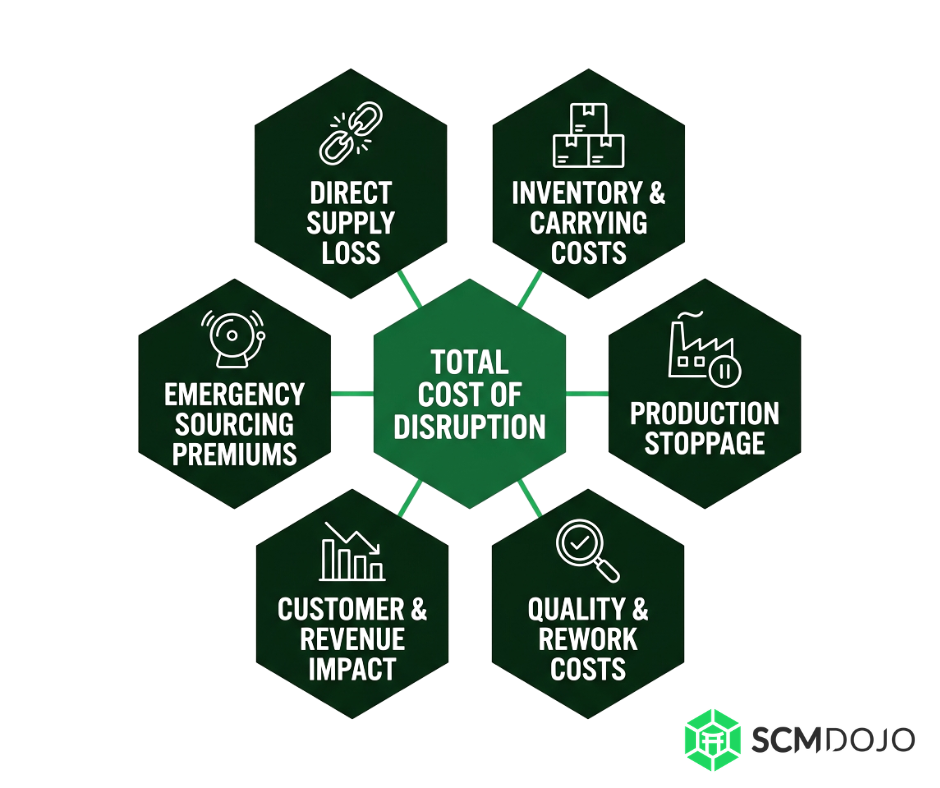
The diagram above captures the six interconnected cost dimensions that make up the true total cost of disruption. Most procurement teams only see one or two of these. The real cost lives in the compounding effect across all six.
- Direct Supply Loss — days without supply, safety stock depletion rate
- Inventory & Carrying Costs — excess inventory carrying cost, expedited logistics premiums
- Production Stoppage Impact — line shutdown costs per hour, labour reallocation inefficiency
- Quality & Rework Costs — scrap and rework labour, quality deviation penalties
- Customer & Revenue Impact — lost revenue per day, customer penalty clauses, brand/market share erosion
- Emergency Sourcing Premiums — spot market premiums, expedited freight costs
Step 1: Map the Criticality and Lead Time Profile
Before calculating cost, you need to know how long you can survive without the supplier.
Factor | Calculation | Example |
Current safety stock (days) | Inventory on hand ÷ daily demand | 14 days |
Normal lead time (days) | Order placement to receipt | 45 days |
Max acceptable disruption (days) | Safety stock buffer | 14 days |
True vulnerability window | Days before production stops | 14 days |
THE HARD TRUTH If you source from a single supplier with 45 days lead time and only 14 days of safety stock, you have a 14-day disruption window before impact hits production. Everything costs money within those 14 days. |
Step 2: Calculate Direct Supply Loss Cost
This is the immediate financial impact of not having the product.
FORMULA: Daily Revenue at Risk = (Annual Spend with Supplier ÷ 365) × (Product Contribution Margin %) |
Example Calculation
- Annual spend with supplier: $5M
- Daily spend equivalent: $5M ÷ 365 = $13,699/day
- Product contribution margin: 35% (the profit you lose)
- Daily revenue at risk = $13,699 × 0.35 = $4,795/day
RESULT If you lose supply for 14 days: $4,795 × 14 = $67,130 minimum loss |
Step 3: Quantify Inventory & Working Capital Escalation
When a supplier disrupts, you face forced choices: carry more safety stock, pay for expedited freight, or negotiate emergency supply.
FORMULA: Excess Inventory Cost = (Additional Safety Stock Qty) × (Unit Cost) × (Annual Carrying Cost Rate) |
Where carrying cost rate typically = 20–30% annually (includes storage, insurance, obsolescence, damage, and capital tied up).
Real Example from the SCMDOJO Knowledge Base
A company sourced a component from China for £1 at 70p (30% savings). But:
- Manufacturing lead time: 7 days → 3 months (order + manufacture + transit)
- Safety stock requirement: 2 weeks → 13 weeks (to cover the 3-month lead time)
- Excess inventory: 11 additional weeks of stock
Calculation
- Weekly demand: 1,000 units
- Excess weeks: 11
- Excess inventory: 11,000 units @ £0.70 = £7,700
- Annual carrying cost @ 25%: £7,700 × 0.25 = £1,925/year
KEY INSIGHT The 30p price savings was completely erased by hidden carrying costs, inspection costs, and extended inbound freight. |
Step 4: Calculate Production Stoppage Impact (The Big One)
When a critical supplier fails and you cannot produce, costs compound rapidly. This is typically the largest single cost category in a disruption event.
Component | What to Measure | Example |
Line shutdown cost/hour | Total hourly labour + overhead of idle production | $2,500/hour |
Revenue per hour of production | Revenue ÷ annual hours | $8,000/hour |
Contribution margin lost | Revenue per hour × margin % | $2,800/hour |
Downtime duration | Days without supply × 24 hours (worst case) | 14 days × 24 = 336 hours |
FORMULA: Production Stoppage Cost = (Hourly Revenue Loss + Hourly Overhead) × Hours of Downtime |
Example
- Hourly revenue loss: $8,000
- Hourly overhead cost: $2,500
- Downtime: 14 days × 24 hours = 336 hours
RESULT Total stoppage cost = ($8,000 + $2,500) × 336 = $3,528,000 |
Step 5: Factor in Quality, Rework, and Customer Penalties
Supplier disruptions do not just stop production they force compromises that create cascading costs.
Quality Escalation Costs
- Expedited sourcing from unvetted suppliers: poor quality, rework labour
- Customer warranty claims: if you ship lower-quality product due to shortage
- Inspection cost escalation: need to inspect expedited supply more rigorously
- Scrap and rework: percentage of expedited supply that does not meet specification
FORMULA: Quality Cost = (Emergency supply volume) × (% defect rate increase) × (Cost per rework) |
Customer Penalty Clauses
- Late delivery penalties: $X per day of delay
- Service level credits: if you miss SLA commitments
- Contract termination risk: loss of entire customer relationship
ACTION REQUIRED Document your contracts: Many procurement teams do not know the true penalty exposure in customer contracts. Pull those contracts and quantify the downside risk now before the disruption hits. |
Step 6: Emergency Sourcing & Spot Market Premiums
When a supplier fails, you do not have the luxury of negotiating. You pay market rates.
FORMULA: Emergency Cost = (Volume at risk) × (Emergency unit price − Normal unit price) |
Real-World Premiums
- Standard lead time supplier: Base price = $10/unit
- Expedited spot market: $15–18/unit (50–80% premium)
- Ultra-expedited (air freight): $22–25/unit (120–150% premium)
Example
- Monthly need: 50,000 units
- Normal cost: $10 × 50,000 = $500,000
- Spot market cost: $18 × 50,000 = $900,000
RESULT Premium cost = $400,000 for one month |
Step 7: Calculate Total Cost of Disruption — Integrated Model
This integrated model gives you the complete total cost of disruption in your supply chain in a single figure. Bring all dimensions together into one comprehensive metric.
TOTAL DISRUPTION COST FORMULA Total Disruption Cost = Direct Supply Loss + Inventory Carrying Cost Escalation + Production Stoppage (Labour + Overhead + Lost Contribution) + Emergency Expedited Freight + Quality Rework & Inspection + Customer Penalties & Lost Revenue + Supplier Diversification Investment (future mitigation) |
Worked Example Critical Supplier
Cost Category | Amount |
Direct supply loss (14 days @ $4,795/day) | $67,130 |
Excess inventory carrying cost (annual @ 25%) | $1,925 |
Production stoppage (336 hours @ $10,500/hr) | $3,528,000 |
Emergency expedited freight (50,000 units @ $8 premium) | $400,000 |
Quality rework (3% defect rate escalation) | $45,000 |
Customer late delivery penalties | $250,000 |
TOTAL DISRUPTION COST | $4,292,055 |
Business Case for Dual Sourcing
- Annual supplier contract cost: $5,000,000
- Annual premium for dual sourcing (15% cost increase): $750,000
- Cost of disruption: $4,292,055
- Break-even disruption frequency: Once every 5.7 years
KEY INSIGHT Given post-COVID supply chain volatility, most companies now experience disruptions more frequently than every 5.7 years, making dual sourcing economically justified. |
Step 8: Apply Probability Weighting (Risk Quantification)
Not every supplier carries equal risk. Weight your disruption cost by the probability it occurs.
FORMULA: Risk-Adjusted Disruption Cost = (Total Disruption Cost) × (Annual Probability of Disruption) |
Probability Factors
Risk Factor | Probability Adjustment |
Single source, no alternatives | +50% |
Located in natural disaster zone | +30% |
Geopolitical risk zone (tariff, conflict) | +35% |
Financial instability (declining revenue, layoffs) | +40% |
Long lead time (>60 days) | +25% |
Low safety stock capacity | +30% |
Quality/delivery history issues | +20% |
Example
- Base disruption cost: $4,292,055
- Probability factors: Single source (50%) + Tariff risk (35%) + Long lead time (25%) = 1.10x adjustment
RESULT Risk-adjusted cost = $4,292,055 × 1.10 = $4,721,261 This becomes your true risk exposure for that supplier. |
Step 9: Build Your Disruption Cost Dashboard
For wartime scenario planning, track these metrics daily in your war room.
SUPPLIER DISRUPTION COST TRACKER ELEMENTS · Supplier: [Name] | · Risk Level: [Critical/High/Medium] · Days to Stockout: [14] · Annual Disruption Cost: [$4.3M] · Risk-Adjusted Annual Exposure: [$4.7M] · Current Risk Factors Active: [Tariff uncertainty, Single source] · Dual Source Alternative Cost: [$750K/year premium] · Current Safety Stock Level: [14 days] → Target: [30 days] · Mitigation Status: [In Progress / Complete] |
Key Insights for Wartime Scenario Planning
Understanding the total cost of disruption in your supply chain requires looking beyond unit price.
The “single sourcing” trap
What looks like 30% cost savings often masks 2–3x hidden disruption costs. Executives resist dual sourcing because they only see the premium, not the risk offset.
Lead time is a hidden cost driver
Companies sourcing from Asia with 3-month lead times carry exponentially higher inventory costs than they realise. This compounds disruption exposure dramatically.
Quality escalates during crisis
Emergency sourcing from unvetted suppliers creates a secondary disruption rework, customer claims. Factor this in conservatively (assume 3–5% defect rate increase).
Customer contracts are your liability
Most procurement teams do not know the penalty exposure in their SLAs. Pull those contracts and quantify the downside risk before the next disruption.
Geopolitical multiplier
Tariffs, trade wars, and regulatory restrictions multiply the spot market premium. In 2018, tariff-sharing partnerships cut the burden in half this is a negotiable cost.
Frequency matters
COVID taught us that disruptions are now predictable within a 3–5 year window, not 10+ years. Your ROI calculation for mitigation needs to reflect realistic disruption frequency.
Recommended Actions
1. Identify your 20–30 critical suppliers those whose failure creates more than $1M in disruption cost
2. Calculate total disruption cost for each using the 9-step model above
3. Compare mitigation investment versus risk exposure to justify dual sourcing or nearshoring
4. Track total cost of disruption supply chain metrics as a KPI in your war room alongside unit price.
5. Revisit probability weighting quarterly as geopolitical conditions change
This shifts the conversation from cost reduction (tactical) to resilience ROI (strategic) which is exactly where procurement needs to operate in wartime scenarios.
READY TO GO DEEPER? Explore |
Frequently Asked Questions (FAQ Schema)
What is the total cost of disruption in supply chain?
The total cost of disruption is the complete financial impact of a supplier failure, including direct supply loss, inventory carrying cost escalation, production stoppage, quality and rework costs, customer penalties, and emergency sourcing premiums. For a critical single-source supplier, this typically ranges from $500,000 to over $4 million per disruption event.
How do you calculate supplier disruption cost?
Calculate supplier disruption cost in seven components: daily contribution margin at risk multiplied by days of downtime, plus excess inventory carrying costs, production stoppage costs (hourly revenue loss plus overhead multiplied by downtime hours), quality rework costs, customer penalty charges, and emergency sourcing premiums. Sum all components for the total disruption cost figure.
What is a good disruption cost threshold for justifying dual sourcing?
If your single-source disruption cost exceeds 5.7 times your annual dual sourcing premium, dual sourcing is economically justified. In practice, given that most organisations now experience supply disruptions every 3–5 years, any single-source supplier whose disruption cost exceeds 3–4 times the dual sourcing premium warrants immediate action.
How does geopolitical risk affect the total cost of disruption?
Geopolitical risk including tariffs, trade wars, and conflict zones increases the probability adjustment factor by 35% and amplifies spot market premiums by 50–150%. A supplier based in a high-risk region with long lead times and single-source status can carry a risk-adjusted disruption cost 2–3x higher than the base calculation.
What metrics should I track in a supply chain war room?
Track days to stockout, annual disruption cost per supplier, risk-adjusted annual exposure, active risk factors, dual source alternative cost, current versus target safety stock levels, and mitigation status. Review these metrics daily for critical suppliers and weekly for high-risk suppliers.
How do production stoppages factor into supply chain disruption costs?
Production stoppages are typically the largest cost component, often representing 70–80% of total disruption cost. Calculate by multiplying hourly revenue loss plus hourly overhead by total downtime hours. For a facility generating $8,000 per hour in revenue, a 14-day stoppage costs over $3.5 million in production impact alone.
About the Author- Dr. Muddassir Ahmed
Dr. Muddassir Ahmed is a globally recognized supply chain expert, thought leader, and keynote speaker. As the Founder & CEO of

SCMDOJO, he has built one of the world’s leading platforms dedicated to empowering supply chain professionals with cutting-edge knowledge, practical tools, and access to expert insights. With over 19 years of leadership experience spanning the UK, Europe, the Middle East, and Southeast Asia, Dr. Ahmed has held key roles at Bridgestone, Doncasters Group, Eaton, and Volvo Cars, managing multi-million-dollar supply chain operations.
His expertise spans all facets of supply chain management, with a particular focus on leveraging technology and innovation to optimize processes and build resilient supply chains.
Recognized among the Top 10 Supply Chain Influencers in the World by Supply Chain Digital, Dr. Ahmed has been instrumental in shaping industry best practices through his extensive research, vlogs, and thought leadership. Holding a PhD in Management Science from Lancaster University Management School, he is also a certified Six Sigma Black Belt.
His platform, SCMDOJO, serves a vibrant community with over 51,000 monthly visitors. Moreover, he has 72,000 newsletter subscribers, and a social media following exceeding 105,000 supply chain professionals
A sought-after keynote speaker and thought leader, sharing his insights on industry trends, best practices, and the future of supply chain management. Dr. Ahmed delivers high-impact talks on supply chain excellence, digital transformation, and strategic leadership. His mission is clear: to help supply chains thrive
You can follow him on LinkedIn, Facebook, Twitter