One of the most important decisions a distributor makes is choosing among different foodservice operations management platforms. The software you choose can affect order-entry speed, truck-loading accuracy, and invoice-to-cash speed. For most distributors, orders still come in overnight by text, email, and voicemail, and someone has to process them before picking can begin.
In 2026, distributor software falls into three types. AI order capture and customer ordering is the focus of some tools. Others are full ERPs for finance and traceability.
This guide will help you to compare the top seven platforms. We evaluate them on order capture, operational coverage, integrations, and pricing so you can see which one suits your distribution business.
What is a foodservice operations management platform?
A foodservice operations management platform is software that helps a food distributor take orders from restaurants, cafés, and other venues, and fulfill them accurately. Fulfillment covers picking, packing, delivery, invoicing, and getting paid. Platforms in this category fall into three groups:
- Ordering and sales layers give customers an online store or app and automate incoming orders. They push those orders into an ERP but leave stock, picking and invoicing to it.
- Operations platforms handle order capture and the day-to-day back office together. They usually connect to a separate accounting system.
- Distribution ERPs run the whole business, including finance, purchasing, and traceability. They tend to be more complex and take longer to implement.
Many distributors combine tools from more than one group. A common pairing is an operations platform alongside accounting software, or an AI order capture tool feeding an existing ERP.

How we compared these platforms
Each platform was assessed on six criteria that matter most to foodservice distributors in 2026:
- Order capture: how well it turns emails, texts, voicemails, and PDFs into clean sales orders
- Operational coverage: whether it runs inventory, picking, delivery, and invoicing, or relies on another system
- Fresh and perishable fit: support for daily price changes, catch weights, and customer-specific pricing
- Integrations: connections to ERPs and accounting software such as QuickBooks
- Implementation and support: time to go live and the level of ongoing help
- Pricing transparency: whether pricing is published or quote-only
The 5 best foodservice operations management platforms for distributors
1. Fresho
Best for: Produce, meat, poultry, seafood, and general foodservice distributors that want AI order capture and their full daily operation in one system.
Fresho is an order and operations management system designed specifically for fresh food wholesalers and distributors. It is based on over 20 years of experience in fresh food wholesale. The platform is based on actual distribution processes: daily price changes, customer-specific price lists, next morning delivery runs, and high volumes of orders. In addition to teams in the UK, Australia, and New Zealand, Fresho has an office in Brooklyn, New York, USA.
Distributors can connect Fresho to ERP/accounting software to use it end-to-end or run it in parallel with the software they already use. Fresho integrates with QuickBooks, enabling automatic synchronization of invoices and credit notes to QuickBooks Online and QuickBooks Desktop. Customer and product records stay synced between the two, and daily payment payouts speed up bank reconciliation. Fresho is a member of the Intuit Developer Platform, and the QuickBooks integration is included in the one-off setup cost. Fresho also connects to Produce Pro and works with NetYield. A few Hunts Point Produce Market distributors are combining Fresho with Produce Pro.
Limitations: Fresho is built for fresh food wholesale, so it is less suited to distributors whose catalogs are mostly dry goods or non-food. It connects to accounting software rather than replacing a general ledger. Distributors needing deep grower accounting or lot-level traceability may pair it with a specialist ERP.
2. Choco
Best for: Distributors with a capable ERP who mainly want to automate order intake and add sales tools.
Choco is an AI-driven food/beverage distribution platform. It is based in the US, the UK, Europe, and the GCC. It started as an app for ordering food from a restaurant and has now reached the distributors. Its OrderAgent, which was launched in 2023, handles orders received by phone, text, email, photos, and documents and converts them into data ready for ERP. Choco also has an AI-powered digital storefront and CustomerHub, a foodservice CRM that identifies churn risks and growth opportunities. Choco claims it integrates with over 200 ERP systems, including QuickBooks, and claims it is not a marketplace.
Limitations: Choco focuses on ordering, sales, and customer management. Inventory, picking, delivery, and invoicing stay in the distributor’s ERP, so total cost includes both systems. Pricing is not published.

3. Pepper
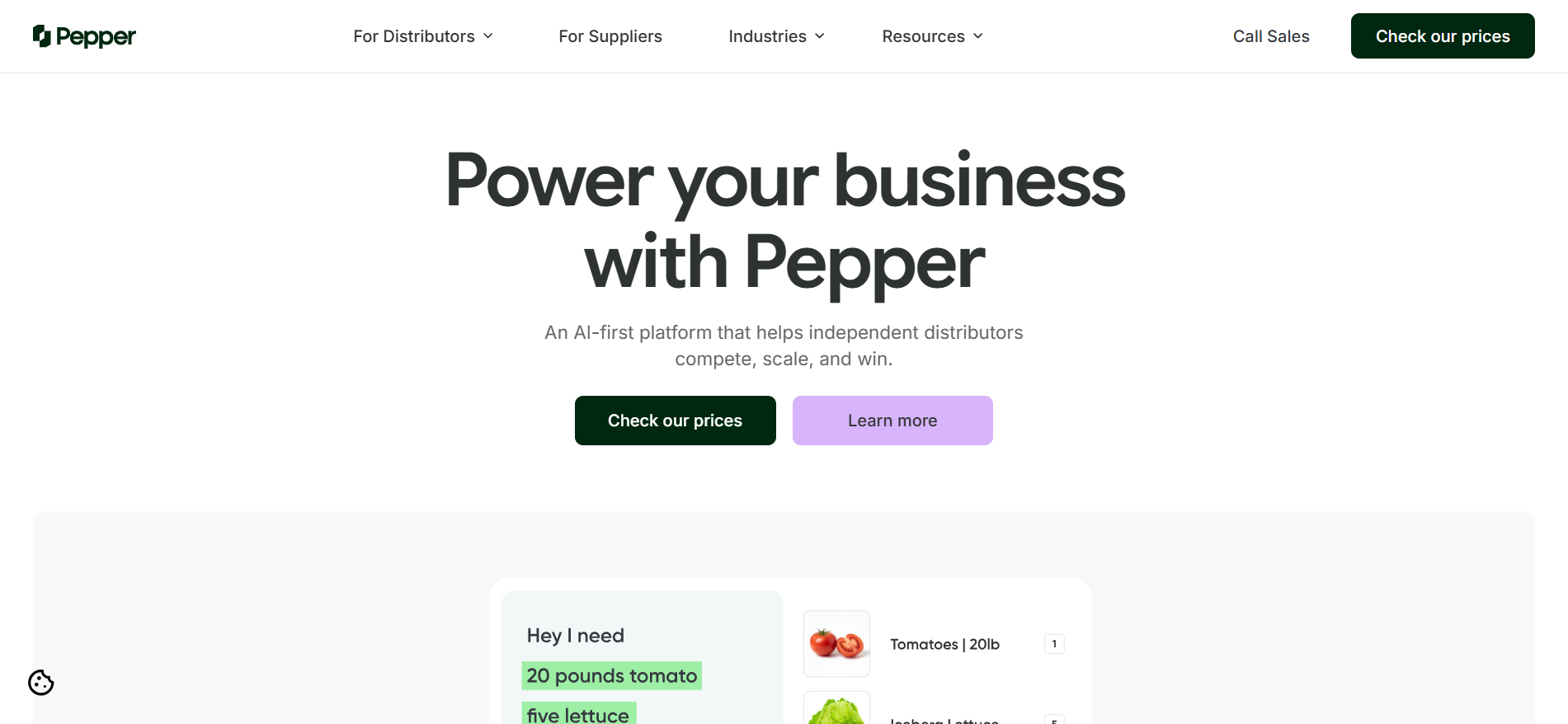 Best for: Independent distributors that want a branded eCommerce storefront, sales rep tools, and payments on top of their ERP.
According to Pepper, it’s a go-to-market platform for independent food distributors, and it has raised a $50 million Series C to grow its platform. It offers eCommerce, an Intelligent Inbox feature that converts texts, emails, and voicemails into orders for staff to review, DSR (sales rep) tools, promotional tools, and payments. Pepper caters to broadline, produce, seafood, meat, and beverage distributors. It is available in a few packages (Lite, Pro, and Enterprise), and its deep ERP integrations are available in its Enterprise tier.
Limitations: Pepper is built as an overlay on existing ERPs. Distributors still rely on their underlying system for stock, picking, and invoicing. Enterprise pricing is by quote.
4. Cut+Dry
Best for: Distributors focused on moving customers to digital ordering and getting paid faster.
Cut+Dry is an eCommerce solution for foodservice distributors for restaurants and food manufacturers. Distributor features include online ordering, catalog search, multiple order guides, product recommendations, and online invoicing. It also provides automated reminders, autopay, secure digital payments, flexible credit terms, delivery tracking, and AI-powered sales and marketing tools. Cut+Dry is a restaurant ordering and payment app for suppliers.
Limitations: Cut+Dry is an ordering and receivables layer rather than a warehouse or operations system. Its value depends on customers adopting digital ordering, which can be slow with operators who prefer phone or text.
5. NECS entrée
Best for: Broadline and specialty distributors that want an established, food-specific ERP.
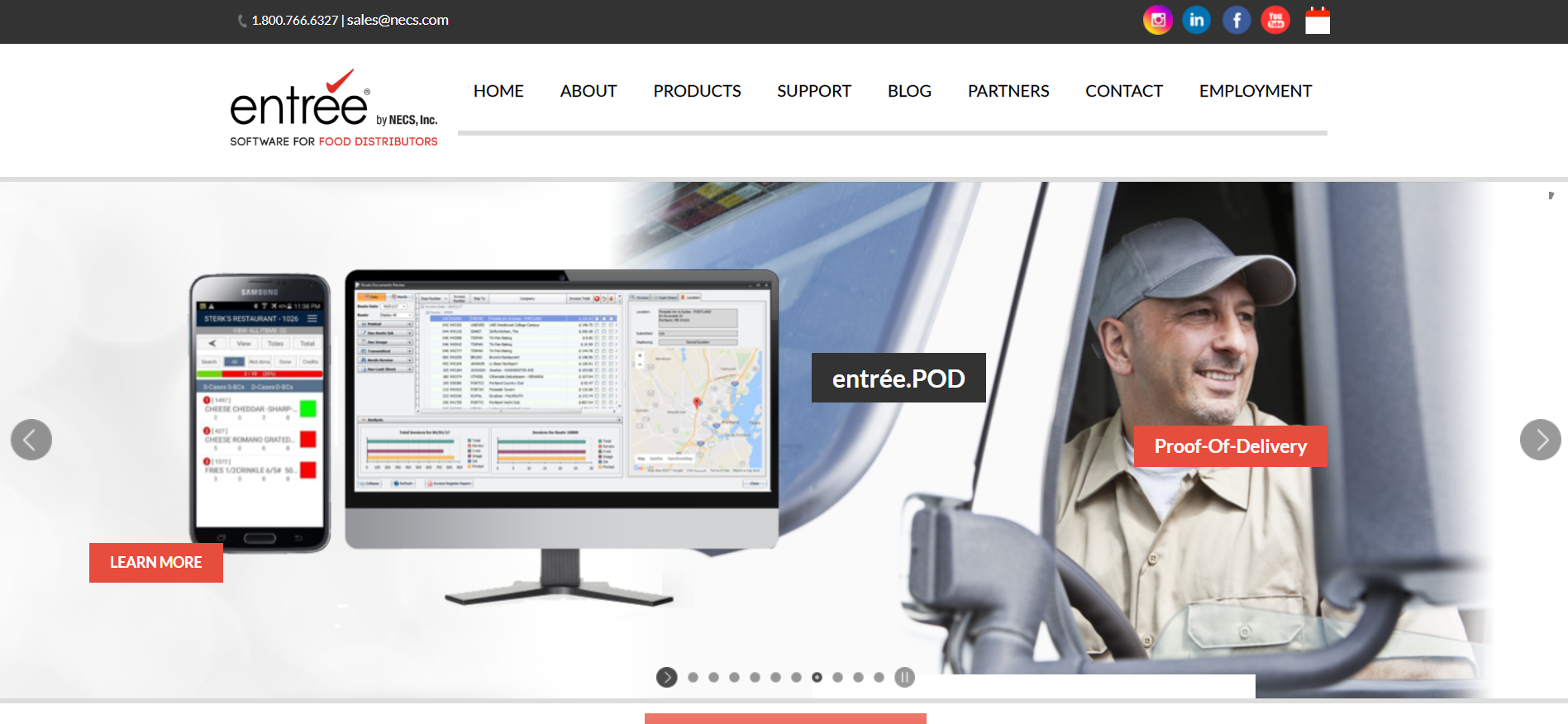
NECS entré is an ERP designed for food distributors. According to NECS, over 500 distributors are active, ranging from small locally based companies to large national ones. It includes broadline, meat, seafood, produce, cheese, specialty dairy, and ethnic specialty segments. The main ERP processes are inventory management, procurement, pricing, accounting, and reporting. Optional modules include warehouse management, proof of delivery, eCommerce, and field sales.
Limitations: As a full ERP, entrée requires a larger implementation than an operations platform. Its modern order capture and customer-facing ordering depend on add-on modules. Pricing is by quote.

Which platform fits your distribution business?
- Fresh produce, meat, or seafood distributor with orders arriving through every channel: You get AI order capture and day-to-day operations together, connected to your accounting software, without an ERP project.
- Happy with your ERP but losing hours to manual order entry: Choco, or Fresho OrderPilot as a standalone capture layer feeding your existing system.
- ERP works, but customers want an app and reps want better tools: Pepper or Cut+Dry.
- Broadline or multi-category distributor needing a full food ERP: NECS entrée.
- Large produce operation needing deep traceability: Produce Pro, optionally paired with an order capture tool.
- Seafood-only distributor or processor: NetYield, optionally paired with Fresho for order capture.
What to check before choosing a platform
- Test order capture on real orders. Send vendors a week of genuine voicemails, texts, and emails, not tidy sample data.
- Count the systems you’ll run. An ordering layer, an ERP, and an accounting package mean three vendors and several integrations. An operations platform can reduce that number.
- Confirm accounting integration. Check which records sync (invoices, credit notes, payments, customers, products) and whether the integration costs extra.
- Ask who owns customer data. Confirm that your catalog and pricing stay private to your customers.
- Compare time to go live. Ask for a realistic go-live date and what onboarding support is included.
Frequently asked questions
What is the best foodservice operations management platform for distributors?
For fresh food distributors, Fresho is the strongest all-round option in 2026. It combines AI order capture with inventory, picking, delivery, invoicing, and payments in one platform. Distributors that only want to automate order intake into an existing ERP may prefer Choco. Seafood specialists may prefer NetYield.
What is the difference between an operations platform and an ERP?
An operations platform such as Fresho covers the order lifecycle and daily fulfillment: ordering, picking, delivery, invoicing, and payments. It connects to separate accounting software. A distribution ERP such as NECS entrée or Produce Pro also runs finance, purchasing, and traceability, and usually takes longer to implement.
Do distributors still need AI order capture if customers can order online?
Yes, in most cases. Some customers will always order by phone, text, or email, often late at night. AI order capture tools such as Fresho OrderPilot convert those orders automatically, so every order is digitized regardless of how it arrives.
Which foodservice distribution platforms integrate with QuickBooks?
Fresho syncs invoices, credit notes, customers, products, and payments with QuickBooks Online and QuickBooks Desktop. The integration is included in the setup fee. Choco also lists QuickBooks among the 200-plus ERPs it connects to.
How long does it take to implement a foodservice operations platform?
It depends on the type of platform. Fresho recommends two to four weeks of AI training for OrderPilot and assigns a dedicated launch specialist through to go-live. Full ERP replacements typically take considerably longer because they involve finance, inventory, and data migration.