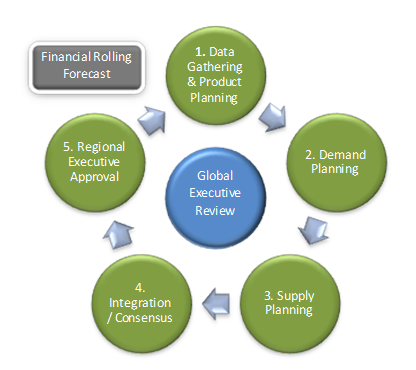
There has been growing interest in the Sales and Operations Planning process over the last two decades. The sales-and-operations-planning (S&OP) process is used by many companies to coordinate efforts of different functional units, including Sales, Marketing, Finance, HR (occasionally), and Operations, for medium-term supply-chain planning, an important hierarchy in 5 Levels of Supply Chain Planning. This process entails two main stages: 1) Demand Planning to determine the supply requirement, and 2) supply planning to meet these supply requirements.
S&OP is a business process that links the corporate strategic plan to daily operations plans and enables companies to balance demand and supply for their products (Gregory, 1999; Dwyer, 2000; Wight, 1999). Many view S&OP as a process to build consensus-based operations plan to meet the forecast demand, while others suggest that it be used as a real-time technique to adjust quickly to changing market and operating situations (Smith, 2004).
In either case, because S&OP generally creates plans for the next 1-18 months, it is often applied to product families rather than to individual stock keeping units (SKUs) Sales and Operations Planning (Dwyer, 2000).
So, Why S&OP?
Like me whoever has worked in manufacturing and distribution must have heard about the problems where sales can’t provide an accurate forecast or sometimes any forecast! So, planning guys do their own thing and use historical sales to create their own demand forecast to get the production running or don’t produce at all!
I know I am making it too simple, and real problems are far too many and too complex, from back orders, unhappy customers, late deliveries, rising inventories, warehouse space issues, and so on.
I think you should get the story so far by now. S&OP is a process to help you deliver better customer service, lower inventory, shorter lead times, more stable production rates, and better management of an overall business. Lastly, it gives an awesome team building and communication mechanism.
And for that reason, I have created a comprehensive on-demand course “How to Run an S&OP Process – Benefits, Steps & Barriers”, with free S&OP Process Self-Assessment Tool.
Check out SCMDOJO Highly Rated Course on How to Run a S&OP Process – Benefits, Process Steps & Overcome Barriers
I’ve also seen in some businesses, that for some bizarre reason, financial controllers do the inventory forecasting. I don’t know how they do it, but they do it. Inventory is owned by us as supply chain people. Since we do Inventory Planning, so it’s our inventory forecast! This is where the Sales and Operations Planning Process comes in, to align the two numbers.
Why is Sales and Operations Planning (S&OP) Important?
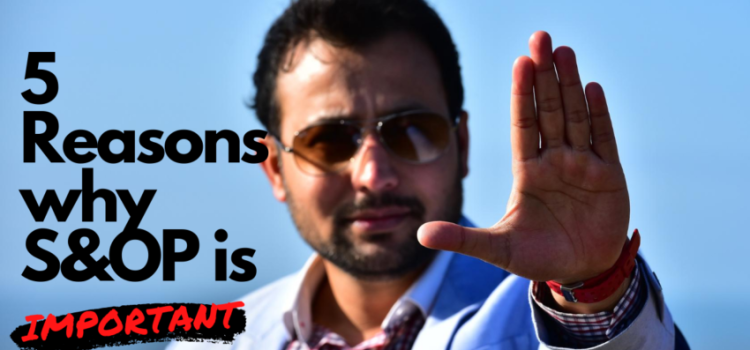
S&OP is arguably the least understood supply chain process in the management team. One notable benefit is it offers vital communication links for top management to manage the different planning phases within a business process effectively. The primary goal is to create an overall business process that integrates all functional planning activities efficiently. Here are the five reasons why Sales and Operations Planning is important in revolutionizing your business.
- Balances Supply and Demand
- Cross-functional involvement
- No Surprises
- One set of Numbers
- Key Business Communication Tool.
1) Balances Supply and Demand
With the S&OP process integrated into your business, you can almost always balance your demand and supply as all key personnel is up-to-date on inventory, production capacity, and likely sales. This process also aids top management to work out profit margins for the business. For instance, in cases where a particular product cannot meet the demand from customers, information obtained from the S&OP process can be provided to the Sales and Marketing to promote other alternative supply. The example highlights S&OP’s powerful ability to balance supply and demand through collaboration to meet the end-user needs.

2) Cross-Functional Involvement
The provision of cross-functional collaboration leads to better planning amongst the major stakeholders in your business process. The S&OP process helps you understand, commit, and create the necessary support to bring success. Another significant benefit is it also adds better integration amongst functional parts in your business process. As soon as you sort the collaboration and development among the top levels of the functional areas, it translates into a comprehensive plan that is in line with the business vision.To strengthen cross-functional S&OP inputs from Sales and Marketing, see ZoomInfo’s comparison of AI sales software for an overview of tools that improve forecasting, lead prioritization, and pipeline visibility.
3) No Surprises
Without a detailed Sales and Operations Planning process, the expectation level would rely on “somehow the job will be completed.” In essence, the job does get completed, but it comes at a price. The outcomes are usually faced with organizational slack like excess capacity, excess inventory, long lead times, panicked operations, poor customer service, and poor focus to new prospects. With a detailed Sales and Operations Planning process, you get low to zero surprises as decisions would be made by appointed personnel to deliver the best possible outcomes within the organization.
4) One Set of Numbers
The biggest benefit in my experience is the ability to run a business with one set of. Here key departments like Finance, Production, Sales, and Marketing all agree on projected amounts and the ability to meet them. S&OP pushes the certainty of teamwork with top management leading the cultural transformation to achieve the laid down goals. A common tactic is investing significant time in creating a suitable Sales and Operations Planning process for your business and then step back and allow the process to run with budget allocation or performance measurement systems in place.
5) Key Business Communication Tool
Sales and Operations Planning provides a defined communication method that serves as Key Business Communication Tools towards achieving set goals, enhanced communication protocol, and transparency. S&OP offers you top management on your business and the needed visibility to partake in critical interactions involving Finance, Production, Sales, Marketing, and HR some times. Under S&OP, each sub-process maintains a schedule that eliminates any clash over who is in control.
In Conclusion,
The final reward for any S&OP process is to unify all demand and supply events required for a successful business. Reviewing your business performance against set business goals is necessary to create better plans where needed. Overall, every business must consider integrating the S&OP process for steady growth and improvement and achieve gradual maturity.
Gaining maturity in the S&OP process takes time, so patience is a virtue
If you have experience, other benefits of the Sales and Operations Planning process, please do share in your comments.
And lastly, you can use my experience, and utilize this course “How to Run a S&OP Process – Benefits, Process Steps & Overcome Barriers” to take the S&OP process to the next level.
In below video, I have shown some portion of my above-mentioned course
This S&OP course is based on Dr. Muddassir’s experience over the past 15 years working as a Sales and Operations Planning leader on large, complex initiatives with global corporations and provides specific details for those that are hands-on, as well as the bigger picture items to consider for those in leadership roles. This sales and operations planning course offer case examples, tips & tricks, Sales & Operations Planning (S&OP) process tools, and format. This course essentially answers the question: How Do You Run an S&OP Process Everyone.
Further Recommended Reading on Sales and Operations Planning Process,
Top 7 Best Sales and Operations Planning Books to Keep Within Reach
References:
Gregory, A. (1999), “Moving forward in harmony with S&OP”, Works Management, Vol. 52 No. 4, pp. 34-7.
Dwyer, J. (2000), “Box clever with planning”, Works Management, Vol. 53 No. 4, pp. 30-2.
Wight, O. (1999) Oliver Wight Sales & Operations Planning Survey.
Smith, F. (2004), “Plan with the big ‘S’”, MSI Magazine, pp. 42-4.
Frequently Asked Questions: Sales and Operations Planning (S&OP)
What is the Sales and Operations Planning (S&OP) process?
S&OP is a medium term business process that balances demand and supply. It links a company’s corporate strategic plan to its daily operations by coordinating efforts across different departments like Sales, Marketing, Finance, and Operations.
Why is S&OP important for a business?
Without S&OP, businesses often suffer from siloed planning, leading to excess inventory, unhappy customers, and late deliveries. S&OP provides a unified framework to deliver better customer service, lower inventory levels, shorter lead times, and more stable production rates.
How does S&OP help balance supply and demand?
The process ensures that all key personnel are constantly updated on inventory levels, production capacity, and expected sales. If a specific product cannot meet customer demand, this information is quickly shared with Sales and Marketing so they can proactively promote alternative solutions.
What does it mean to run a business with “One Set of Numbers”?
One of the biggest benefits of S&OP is that it forces key departments, such as Finance, Production, Sales, and Marketing, to agree on a single set of projected figures. This eliminates conflicting departmental forecasts and aligns everyone toward the exact same organizational goals.
What is the typical timeframe for an S&OP plan?
S&OP generally creates and manages operational plans looking ahead for the next 1 to 18 months. Because of this medium term horizon, planning is often applied to entire product families rather than individual stock keeping units (SKUs).
About the Author- Dr Muddassir Ahmed
Dr. Muddassir Ahmed is a globally recognized supply chain expert, thought leader, and keynote speaker. As the Founder & CEO of SCMDOJO, he has built one of the world’s leading platforms dedicated to empowering supply chain professionals with cutting-edge knowledge, practical tools, and access to expert insights. With over 19 years of leadership experience spanning the UK, Europe, the Middle East, and Southeast Asia, Dr. Ahmed has held key roles at Bridgestone, Doncasters Group, Eaton, and Volvo Cars, managing multi-million-dollar supply chain operations.
His expertise spans all facets of supply chain management, with a particular focus on leveraging technology and innovation to optimize processes and build resilient supply chains.
Recognized among the Top 10 Supply Chain Influencers in the World by Supply Chain Digital, Dr. Ahmed has been instrumental in shaping industry best practices through his extensive research, vlogs, and thought leadership. Holding a PhD in Management Science from Lancaster University Management School, he is also a certified Six Sigma Black Belt.
His platform, SCMDOJO, serves a vibrant community with over 51,000 monthly visitors. Moreover, he has 72,000 newsletter subscribers, and a social media following exceeding 105,000 supply chain professionals
A sought-after keynote speaker and thought leader, sharing his insights on industry trends, best practices, and the future of supply chain management. Dr. Ahmed delivers high-impact talks on supply chain excellence, digital transformation, and strategic leadership. His mission is clear: to help supply chains thrive
You can follow him on LinkedIn, Facebook, Twitter