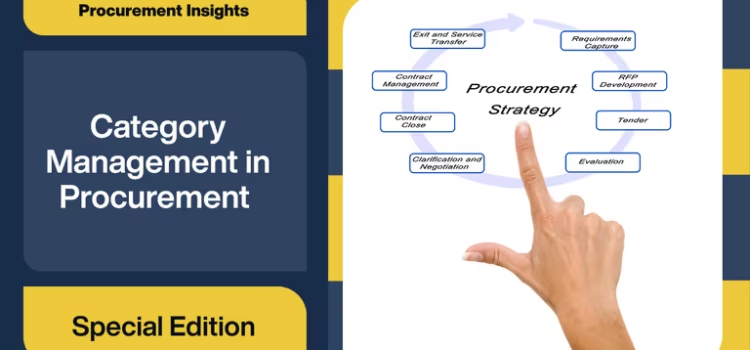
Category Management and Commodity Management are often used interchangeably in procurement, but they have distinct differences in their scope and strategic focus.
Here’s a breakdown:
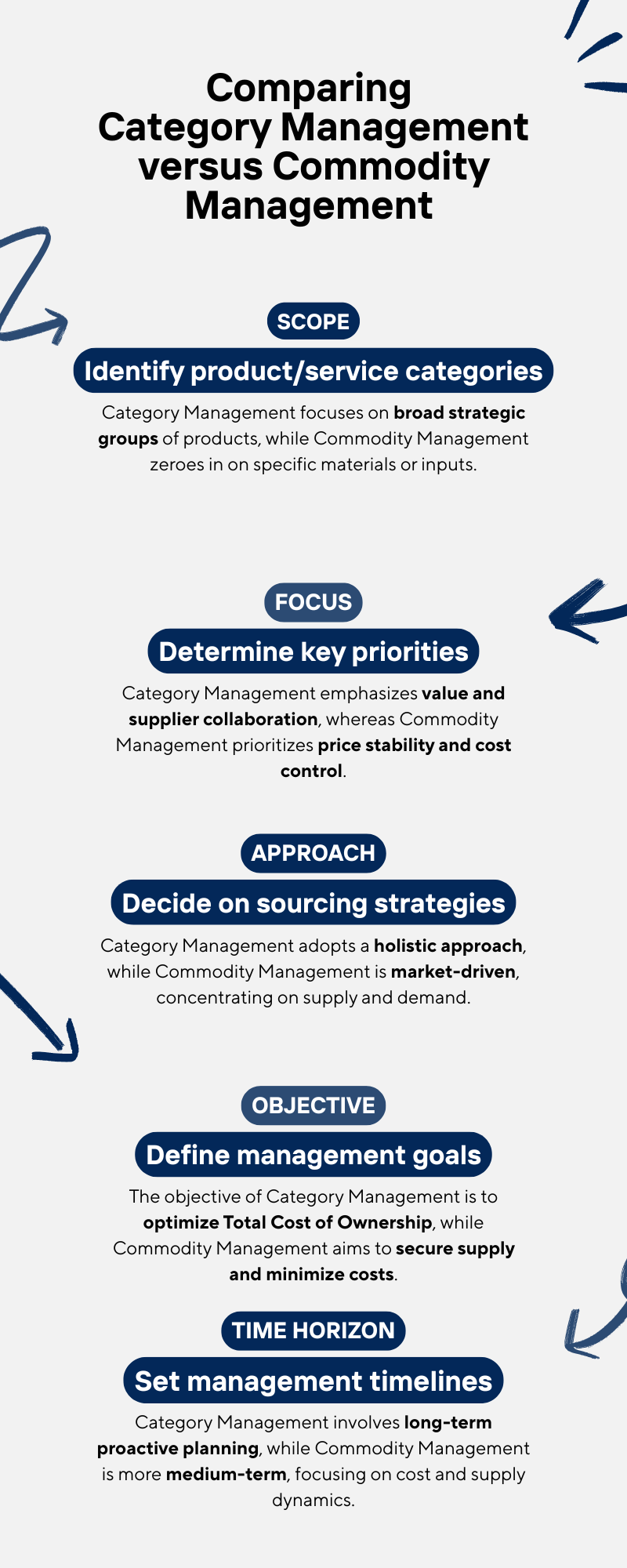
To explain in more detail:
Commodity Management
Focus: Primarily on specific, often raw or semi-finished materials that are typically standardized and purchased in large quantities. Think steel, oil, plastics, basic chemicals, or common electronic components.
Goal: To achieve the lowest possible cost for these specific goods while ensuring supply security and quality.
Strategy: Heavily relies on market intelligence, hedging strategies, volume leverage, competitive bidding, and understanding supply and demand dynamics for that particular commodity. It’s about optimizing the purchase of a single item or a very closely related group of items.
Key Activities:
- Market analysis of specific commodities (price trends, supply/demand, geopolitical factors).
- Supplier selection and negotiation for the commodity.
- Risk management related to commodity price volatility.
- Volume aggregation across different business units for a single commodity.
- Developing specifications for a commodity.
- Time Horizon: Often more short to medium-term, reacting to market fluctuations.
Category Management
Focus: Broader than commodity management. It encompasses a “category” of spend, which is a grouping of goods and services that a business procures, often serving a similar internal business need or coming from a similar supply base. Categories can be direct (e.g., specific engine components) or indirect (e.g., IT services, marketing, facilities management, travel).
Goal: To maximize overall value for the business from a specific spend category. This includes cost reduction, but also quality improvement, innovation, risk mitigation, improved supplier relationships, and operational efficiency across the entire lifecycle of the category.
Strategy: Develops a comprehensive, long-term strategy for managing all aspects of a particular spend category. This involves understanding business requirements, market dynamics, supplier capabilities, and internal stakeholder needs. It’s about optimizing the entire value chain for that category.
Key Activities:
- Defining the category scope and spend analysis.
- Understanding internal business needs and requirements for the category.
- In-depth market analysis for the entire category (suppliers, technologies, innovations, competitive landscape).
- Developing long-term category strategies (e.g., insource/outsource, strategic partnerships, new technologies).
- Supplier relationship management across multiple suppliers within the category.
- Managing demand and specifications within the category.
- Driving innovation from the supply base within the category.
- Risk management across the category.
- Time Horizon: Typically long-term (3-5 years) with a strategic roadmap.
Analogy:
Think of it like building a car:
Commodity Manager: Might focus specifically on sourcing the best steel for the chassis, optimizing its cost and supply.
Category Manager: Would look at the entire “chassis” category, considering not just the steel, but also the design, manufacturing process, assembly, new lightweight materials, and how it integrates with other car components, and then develop a multi-year strategy for optimizing the entire chassis value.
In essence, Category Management is a more holistic, strategic, and value-driven approach that often includes commodity management principles as a component for specific parts of the category. Commodity management is more tactical and focused on optimizing individual inputs.
Based on the SCMDOJO Academy course list, best practices, and ebooks, here are the relevant resources for learning Category and Commodity Management.
Mastering Maintenance, Repair, and Operations (MRO)
Learn Maintenance, Repair, and Operations (MRO) essentials—covering history, best practices, predictive maintenance, inventory, supplier management, challenges, and future trends.
This high-quality course is created with James E. Martin, CSP . James brings over 35 years of experience as a supply chain professional, working across diverse industries and categories with a focus on indirect spend. He is a Certified Sourcing Professional through the Sourcing Industry Group and has developed extensive practical expertise in supply chain management

To Supercharge Category Management, Learn From
- Procurement Toolbox # 1: Category Management by Richard Beaumont
- Supplier Relationship Management by Maryna Trepova
- Strategic IT Procurement by James E. Martin, CSP
- How to Create A Supply Chain Strategy by Dr. Muddassir Ahmed
- Total Cost of Ownership & Serve by Corey Weekes CPIM CIRM CSCP
- Understanding Supplier & Market Analysis by Maryna Trepova
To Supercharge Commodity Management, Learn From
- Negotiation Tricks & Pitfalls by Richard Todd
- Negotiation Tools by Janice Marquardt
- Developing a Negotiation Strategy by Richard Todd
- Proven Techniques of Lead Time Reduction in Advanced Procurement by Manoj Yermalkar CIPP,CIPM,CISCM,CISCP,PGDIB,GDMM
- Advanced E-Auction by Janice Marquardt
Best Practices for both Category & Commodity Management
- Procurement Strategy Template
- Procurement KPI Dashboard
- Supplier Excellence Manual
- Indirect Procurement Best Practices Assessment
Expert eBooks for both Category & Commodity Management
- Decoding Supplier Quotes: A Procurement Guide to Cost Analysis by Ravi Nishant
- Project Cost Estimating and Management (PCEM) by Ravi Nishant
- Activity Based Costing in Procurement by Ravi Nishant
- PhD Thesis – Enhanced Supplier Development Framework by Dr. Muddassir Ahmed
About the Author- Dr. Muddassir Ahmed
Dr. Muddassir Ahmed is a globally recognized supply chain expert, thought leader, and keynote speaker. As the Founder & CEO of SCMDOJO, he has built one of the world’s leading platforms dedicated to empowering supply chain professionals with cutting-edge knowledge, practical tools, and access to expert insights. With over 19 years of leadership experience spanning the UK, Europe, the Middle East, and Southeast Asia, Dr. Ahmed has held key roles at Bridgestone, Doncasters Group, Eaton, and Volvo Cars, managing multi-million-dollar supply chain operations.
His expertise spans all facets of supply chain management, with a particular focus on leveraging technology and innovation to optimize processes and build resilient supply chains.
Recognized among the Top 10 Supply Chain Influencers in the World by Supply Chain Digital, Dr. Ahmed has been instrumental in shaping industry best practices through his extensive research, vlogs, and thought leadership. Holding a PhD in Management Science from Lancaster University Management School, he is also a certified Six Sigma Black Belt.
His platform, SCMDOJO, serves a vibrant community with over 51,000 monthly visitors. Moreover, he has 72,000 newsletter subscribers, and a social media following exceeding 105,000 supply chain professionals
A sought-after keynote speaker and thought leader, sharing his insights on industry trends, best practices, and the future of supply chain management. Dr. Ahmed delivers high-impact talks on supply chain excellence, digital transformation, and strategic leadership. His mission is clear: to help supply chains thrive
You can follow him on LinkedIn, Facebook, Twitter