In today’s hyper-competitive logistics landscape, warehousing in supply chain management has evolved from a passive storage function into one of the most strategically critical components of the entire value chain. Whether you run a small distribution centre or manage a global network of fulfilment hubs, the efficiency, safety, and intelligence of your warehouse operations can determine whether your business thrives or loses ground to competitors.
The global warehousing and storage market has expanded dramatically in the wake of e-commerce growth, supply chain disruptions, and the relentless demand for next-day even same-day delivery. In modern warehousing in supply chain management, customers expect speed, accuracy, and transparency, and all three begin inside the warehouse.
This guide draws on insights from The Definitive Guide to Warehousing” by Dr. Muddassir Ahmed (SCMDOJO) and the Warehouse Self-Assessment Tool two comprehensive professional resources to give you a practical, expert-backed roadmap for understanding, evaluating, and improving your warehouse operations.
‘An inefficient warehouse will cost you time, money, and customer satisfaction. It is no longer a luxury, but a necessity to transform your warehouse from a simple storage facility into a strategic asset that drives efficiency, accuracy, and profitability.’ The Definitive Guide to Warehousing
From Storage Rooms to Strategic Assets: The Evolution of Warehousing
Historically, warehouses were passive repositories places where goods sat until they were needed. Inventory management relied on paper-based systems, and visibility was limited. This approach created bottlenecks, inaccuracies, and unnecessary costs throughout supply chains.
The shift began with the introduction of barcode scanners and early Warehouse Management Systems (WMS), which improved picking speeds and inventory accuracy. The real transformation, however, came with the explosion of e-commerce and globalisation. Modern warehouses are now dynamic hubs fully integrated into the broader supply chain leveraging automation, robotics, IoT sensors, and AI-powered analytics.
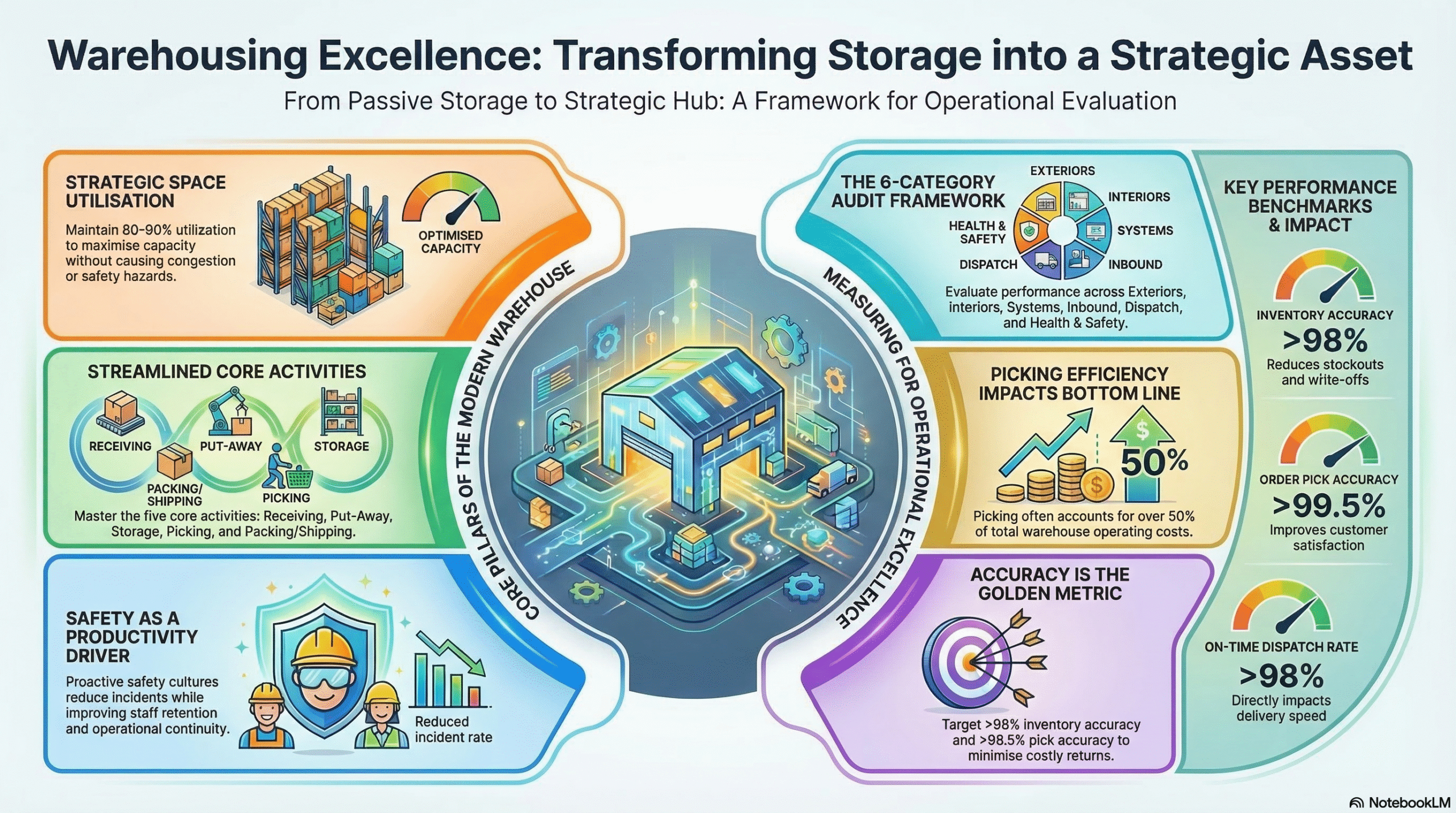
The Definitive Guide to Warehousing identifies five key pillars of the modern warehouse:
- Solid Foundations — core principles of operations, design, and inventory management
- Strategic Space Utilisation — layout optimisation to maximise efficiency and minimise travel time
- Streamlined Processes — best practices for receiving, picking, packing, and shipping
- Safety First — creating a safe work environment to minimise accidents and injuries
- Embracing Technology — automation, robotics, and data analytics for competitive advantage
Understanding these pillars is the starting point for any warehouse improvement programme.

Types of Warehouses in Modern Supply Chains
Not all warehouses are created equal. Choosing the right type of warehouse or combination of types is a foundational supply chain decision. Here are the primary warehouse types and the roles they play:
| Warehouse Type | Primary Role | Best Suited For |
| Distribution Warehouse | Sorts and routes goods to retailers/customers | Retail, FMCG, consumer goods |
| Fulfilment Centre | Picks, packs, and ships directly to end consumers | E-commerce, direct-to-consumer brands |
| Public Warehouse | Shared third-party storage on flexible terms | Seasonal businesses, SMEs |
| Contract Warehouse | Dedicated space with customised services | High-volume shippers, 3PL clients |
| Private Warehouse | Owned and operated by the business | Large enterprises with steady volume |
| Cold Storage Warehouse | Temperature-controlled environments | Food & beverage, pharmaceuticals |
| Cross-Docking Facility | Minimal storage, direct transfer from inbound to outbound | Just-in-time supply chains |
| Production Warehouse | Holds raw materials and WIP near production lines | Manufacturing operations |
Beyond core storage and distribution, modern warehouses also offer value-added services (VAS) kitting, light assembly, custom labelling, and packaging customisation that allow businesses to differentiate their customer experience without investing in separate facilities.
Mastering the 5 Core Warehouse Activities
Regardless of warehouse type, five core activities define daily operations. Mastering each one is essential to achieving operational excellence in warehousing in supply chain management:
1. Receiving and Put-Away
Every item that enters your warehouse must be received, verified, and placed in the correct location. A well-designed inbound process includes pre-notification of incoming goods, a vehicle booking system, quality inspection upon arrival, and a clear standard operating procedure (SOP) for put-away. The Warehouse Self-Assessment Tool specifically evaluates 18 separate inbound and inspection criteria — from dock area cleanliness to FIFO rotation compliance to help operations managers identify gaps before they become costly errors.
2. Storage and Inventory Management
Storage efficiency is not simply about fitting as much product as possible into a given space. The Definitive Guide to Warehousing recommends maintaining space utilisation between 80 and 90% enough to maximise capacity without creating congestion that slows picking and creates safety hazards. ABC analysis, cycle counting, and a robust excess and obsolete (E&O) inventory strategy are all critical tools for maintaining inventory accuracy and controlling carrying costs.
3. Order Picking
Picking is typically the most labour-intensive and costly warehouse activity, often accounting for over 50% of total warehouse operating costs. Key picking strategies include single-order picking, batch picking, zone picking, and cluster picking each with its own efficiency profile depending on order volumes, SKU count, and warehouse layout. The Dispatch and Housekeeping section of the Warehouse Self-Assessment Tool includes 23 detailed criteria covering pick path optimisation, replenishment scheduling, fast-track order processes, and ergonomics.
4. Packing and Shipping
Once orders are picked, packing accuracy and outbound logistics determine whether customers receive the right goods in the right condition at the right time. Efficient dispatch processes require clear pick instructions, accurate stock location systems, and well-maintained outbound documentation. The self-assessment tool evaluates whether fast-moving items are placed in the most accessible locations, whether items that sell together are co-located to minimise travel, and whether heavier items are picked first all factors that directly affect both throughput and workforce safety.
5. Inventory Control and Returns
Ongoing inventory accuracy depends on regular cycle counting, stock-take procedures, and real-time WMS data. Returns management a growing challenge in the e-commerce era requires dedicated quarantine areas, clear non-conformance logging, and agreed lead times for returning or disposing of non-conforming products. These processes are all evaluated within the Inbound and Inspection module of the self-assessment tool.
Warehouse Layout Optimisation: Designing for Efficiency
The physical design of your warehouse has a direct and lasting impact on operational efficiency. Poor layout decisions create unnecessary travel distances, bottlenecks at receiving and dispatch docks, and unsafe pedestrian-vehicle conflicts. The Definitive Guide to Warehousing outlines 17 space-saving strategies, including:
- Implementing vertical storage solutions (high-bay racking) to maximise cubic space
- Creating clear, dedicated pedestrian and vehicle aisles with sufficient width for MHE
- Positioning fast-moving (A-class) SKUs closest to dispatch areas to minimise pick travel time
- Using slotting analysis and ABC classification to dynamically allocate storage locations
- Consolidating part-pallets to reduce wasted pick face locations
The Warehouse Self-Assessment Tool includes specific criteria for interior design performance from adequate aisle widths and racking inspection schedules, to optimal natural lighting utilisation and floor surface condition. These are not cosmetic concerns: a well-designed interior directly reduces accidents, improves pick accuracy, and supports staff wellbeing.
Technology as a Competitive Advantage in Warehousing
One of the most significant themes in modern warehousing in supply chain management is the intelligent application of technology. The Systems, Planning and Equipment section of the Warehouse Self-Assessment Tool covering 23 separate criteria evaluates how well technology is being deployed across warehouse operations.
Key technologies evaluated include:
- Warehouse Management Systems (WMS) — the digital backbone of modern warehouse operations, providing real-time inventory visibility, location management, and reporting
- RFID and Barcode Scanning — enabling fast, accurate goods identification throughout the product lifecycle
- Voice Recognition Technology — hands-free picking solutions that improve speed and accuracy
- Automated data backups — ensuring operational continuity in the event of system failure
- Contingency planning for system downtime, equipment failure, and supply disruption
The Definitive Guide to Warehousing goes further, exploring automation and robotics including Autonomous Mobile Robots (AMRs), Automated Storage and Retrieval Systems (AS/RS), and collaborative robots (cobots) as well as AI-powered demand forecasting, IoT-enabled real-time tracking, and digital twin technology for warehouse planning. These are not distant future trends; they are being deployed today in warehouses across every sector.
Warehouses that leverage advanced WMS capabilities, combined with RFID and scanning systems, consistently outperform competitors in order accuracy, fulfilment speed, and inventory carrying cost reduction.
Warehouse Safety: Non-Negotiable in Supply Chain Management
Warehouses are high-risk workplaces. Forklift accidents, falling objects, manual handling injuries, and fire hazards are among the most common causes of warehouse-related injuries and fatalities. Effective warehouse safety is not just a legal obligation it is a direct driver of productivity, workforce retention, and operational continuity.
The Definitive Guide to Warehousing devotes extensive coverage to common warehouse accidents and their prevention, safe material handling practices, compliance with safety regulations, and business continuity planning. The Warehouse Self-Assessment Tool provides a dedicated Health and Safety section, and safety considerations are woven throughout every functional category from exterior security barriers and pedestrian-vehicle segregation, to interior fire exit visibility, first aid provision, and racking inspection schedules.
Key safety assessment areas within the tool include:
- Exterior: Separate routes for trucks and pedestrians, security camera installation, adequate external lighting, safe storage of LPG and diesel
- Interior: Clearly visible evacuation plans, fire and intruder alarm testing, first aid box availability, handrails on stairways, floor surface condition
- Equipment: Licensed MHE operators, pre-operational equipment checks, defect reporting procedures, equipment parking protocols
- Health and Safety: Comprehensive H&S assessment module evaluating PPE compliance, incident reporting, and regulatory adherence
A proactive safety culture does not happen by accident. It requires documented procedures, regular audits, and a management commitment to continuous improvement exactly what the self-assessment tool is designed to support.
Sustainable Warehousing: The Green Imperative
Sustainability has moved from CSR checkbox to strategic priority in supply chain management. Warehousing operations have a significant environmental footprint energy consumption from lighting and climate control, packaging waste, and transportation emissions are all within the warehouse manager’s sphere of influence.
The Definitive Guide to Warehousing addresses sustainable warehousing practices including energy-efficient design (LED lighting, natural light optimisation), waste reduction and recycling programmes, renewable energy adoption, and optimised transport and logistics to reduce carbon emissions. The self-assessment tool’s interior evaluation specifically includes criteria for LED lighting use and the optimisation of natural light through warehouse design a simple but impactful sustainability measure.
As ESG reporting requirements tighten and customer expectations evolve, warehouses that can demonstrate sustainable credentials will hold a genuine competitive advantage.
The Future of Warehousing in Supply Chain Management
The warehousing industry is in the midst of a profound transformation. The Definitive Guide to Warehousing identifies the following as the most significant emerging trends shaping the future of the sector:
- E-commerce and Omni-Channel Fulfilment — the demand for faster, more flexible fulfilment is driving investment in micro-fulfilment centres, dark stores, and urban distribution hubs
- Supply Chain Resilience — post-pandemic lessons have accelerated interest in warehouse flexibility, inventory buffering strategies, and supplier diversification
- Data and Predictive Analytics — WMS-integrated analytics platforms are enabling predictive maintenance, demand-driven replenishment, and real-time performance dashboards
- Robotics Integration — AMRs, goods-to-person systems, and robotic picking arms are moving from pilot to mainstream deployment
- Digital Twins — virtual replicas of warehouse operations enabling simulation-based planning and scenario testing before physical changes are made
- AI Integration — machine learning algorithms optimising everything from slotting decisions to workforce scheduling
- Planogramming and Zone Management — data-driven SKU placement strategies that reduce pick travel time and improve ergonomics
The warehouses that will lead their industries in 2030 are being designed and improved today. The gap between warehouse leaders and laggards is widening and the tools, guides, and self-assessment frameworks exist to help every operation improve.
How to Use the Warehouse Self-Assessment Tool
The Warehouse Self-Assessment Tool is one of the most practical resources available to warehouse and supply chain managers seeking an objective picture of their current performance. The tool evaluates warehouse performance across six functional categories:
- Exteriors — 13 criteria covering security, access, external grounds, and lighting
- Interiors — 23 criteria covering layout, safety signage, racking condition, lighting, and security
- Systems, Planning and Equipment — 23 criteria covering WMS, technology, MHE, and contingency planning
- Inbound and Inspection — 18 criteria covering receiving processes, quality control, and FIFO compliance
- Dispatch and Housekeeping — 23 criteria covering slotting, picking methods, stock location, and replenishment
- Health and Safety — dedicated safety assessment criteria
Scoring is conducted on a 5-point Likert scale (1 = Very Unsatisfied, 5 = Very Satisfied), with N/A options for criteria that do not apply to your operation. Results are compiled on a Dashboard that reveals performance scores by category, immediately highlighting where operational improvement effort will deliver the greatest return.
The self-assessment is designed to be completed by warehouse managers, operations leaders, or third-party auditors. It works equally well as an internal improvement tool and as a supplier evaluation framework for procurement and supply chain teams assessing 3PL partner performance.
Supporting Data Tables
Table 1: Warehouse Self-Assessment Tool — Category Overview
| Assessment Category | No. of Criteria | Key Focus Areas | Score Range |
| Exteriors | 13 | Security, access control, external lighting, vehicle separation | 13–65 |
| Interiors | 23 | Layout, safety signage, racking, lighting, floor condition | 23–115 |
| Systems, Planning & Equipment | 23 | WMS, RFID, MHE checks, contingency plans, ABC analysis | 23–115 |
| Inbound & Inspection | 18 | Receiving SOPs, QC areas, FIFO, quarantine, dock management | 18–90 |
| Dispatch & Housekeeping | 23 | Slotting, pick paths, replenishment, fast-track orders | 23–115 |
| Health & Safety | Dedicated module | PPE, incident reporting, H&S compliance | Variable |
| TOTAL | 100+ | Full warehouse operational performance | Combined dashboard score |
Table 2: Key Warehouse KPIs and Why They Matter
| KPI | What It Measures | Benchmark Target | Impact on Supply Chain |
| Inventory Accuracy | Alignment between system records and physical stock | >98% | Reduces stockouts, overstocking, and write-offs |
| Order Pick Accuracy | % of orders picked without errors | >99.5% | Reduces returns, improves customer satisfaction |
| Warehouse Space Utilisation | % of usable storage capacity in use | 80–90% | Maximises ROI on real estate; avoids congestion |
| On-Time Dispatch Rate | % of orders dispatched on schedule | >98% | Directly impacts on-time delivery performance |
| Receiving Accuracy | % of inbound goods correctly received and logged | >99% | Prevents downstream inventory errors |
| Cost per Order Fulfilled | Total warehouse cost divided by orders shipped | Benchmark vs. industry | Key efficiency and profitability metric |
| Cycle Count Accuracy | % accuracy of regular partial stock counts | >97% | Maintains ongoing inventory integrity without full stock-takes |
Table 3: Warehouse Technology Adoption — From Basic to Advanced
| Maturity Level | Technologies in Use | Typical Characteristics |
| Basic | Paper-based or spreadsheet systems, manual barcode scanning | Limited visibility, high error rates, labour-intensive processes |
| Developing | Entry-level WMS, basic scanning, email-based comms | Improved accuracy, some reporting capability, reactive management |
| Intermediate | Full WMS with real-time inventory, RFID, scanning software | Real-time visibility, KPI tracking, some automation of processes |
| Advanced | WMS integrated with ERP, voice picking, automation, analytics | Data-driven decisions, reduced labour dependency, predictive capability |
| World-Class | AI, robotics, IoT, digital twins, fully automated fulfilment | Industry-leading accuracy, speed, and cost efficiency; scalable operations |
Table 4: Common Warehouse Safety Risks and Mitigation Strategies
| Risk Category | Common Causes | Prevention Measures |
| Forklift/MHE Accidents | Unlicensed operators, poor pedestrian separation, inadequate training | Licensed operators only, segregated aisles, speed controls, pre-op checks |
| Manual Handling Injuries | Incorrect lifting technique, excessive loads, poor ergonomics | Training, ergonomic pick face design, heavier items at mid-height |
| Falling Objects | Overloaded racks, damaged racking, poor pallet condition | Regular racking inspections, load limits enforced, broken pallet removal |
| Fire Hazards | Improper chemical storage, inadequate fire alarm testing | Fire alarm testing, clear fire exits, no-smoking signage, extinguisher maintenance |
| Slip/Trip Hazards | Wet/damaged floors, cluttered aisles, poor lighting | Floor maintenance, aisle discipline, LED lighting, cleaning schedules |
| Security Incidents | Inadequate access control, no CCTV, poor perimeter security | Sign-in systems, CCTV, security barriers, stock theft monitoring |
Key Takeaways
After reading this guide and exploring the resources referenced throughout, the following core principles should anchor your approach to warehousing in supply chain management:
- Warehousing in supply chain management is strategic, not just operational. Modern warehouses are competitive differentiators. Investment in layout, technology, and process is an investment in customer experience and supply chain resilience.
- You cannot improve what you do not measure. The Warehouse Self-Assessment Tool provides a structured, objective framework for scoring your current performance across six critical functional areas from safety and security to technology and dispatch.
- Space utilisation of 80–90% is the sweet spot. Under-utilised warehouses waste real estate costs. Over-stuffed warehouses create safety risks, congestion, and picking errors. Optimal slotting and layout design are key.
- Picking efficiency determines your cost per order. Pick path optimisation, ABC-based slotting, and the right picking methodology for your SKU profile can dramatically reduce labour costs and improve throughput.
- Safety is not a compliance checkbox it is an operational priority. Warehouses that invest in safety culture, regular audits, and well-maintained equipment experience fewer incidents, lower insurance costs, and better staff retention.
- Technology adoption is a journey, not a destination. Whether you are implementing your first WMS or exploring robotics and AI, every step up the technology maturity curve delivers measurable returns in accuracy, speed, and cost.
- Sustainability is becoming a supply chain expectation. Energy efficiency, waste reduction, and eco-friendly warehouse design are no longer optional extras they are features that customers, investors, and regulators increasingly demand.
- Use expert resources to accelerate your improvement journey. The Definitive Guide to Warehousing and the Warehouse Self-Assessment Tool available through SCMDOJO provide the knowledge framework and diagnostic tools every supply chain professional needs to drive meaningful, lasting warehouse improvement.
Resources Referenced in This Article
➔ The Definitive Guide to Warehousing — A Comprehensive Resource for Logistics and Supply Chain Professionals (Dr. Muddassir Ahmed, SCMDOJO)
➔ Warehouse Self-Assessment Tool — Six-category operational performance audit tool with Likert-scale scoring and dashboard visualisation (SCMDOJO)
➔ Related guides: Warehouse Safety Audit Tool, WMS Integration Guide, Inventory Optimization Tool, Stocktaking Procedure Guide — all available at SCMDOJO.com
➔ Related video: Mastering Warehouse Optimization The Essential Basics
Frequently Asked Questions: Modern Warehousing and Supply Chain Management
What are the core pillars of a modern warehouse?
A modern warehouse is built on five key pillars: solid foundations in design and inventory management, strategic space utilization to minimize travel time, streamlined processes for daily operations, a strict safety first culture, and the intelligent integration of technology and automation.
What is the ideal space utilization rate for a warehouse?
Experts recommend maintaining warehouse space utilization between 80% and 90%. This range maximizes your storage capacity and real estate investment while leaving enough room to avoid congestion, picking delays, and safety hazards.
Why is order picking considered the most critical warehouse activity?
Order picking is usually the most labor intensive and expensive warehouse activity, frequently accounting for more than 50% of total operating costs. Implementing optimal picking strategies like batch picking or zone picking can significantly reduce travel time and boost overall profitability.
How does warehouse layout impact overall efficiency?
The physical design of a facility directly dictates operational flow. A poorly planned layout causes unnecessary travel, dock bottlenecks, and pedestrian hazards. Conversely, an optimized layout utilizes vertical storage, places fast moving goods near dispatch areas, and creates clear pathways to improve speed and safety.
What is the purpose of a Warehouse Self Assessment Tool?
This tool gives supply chain managers an objective, data driven picture of their current operational performance. By scoring a facility across critical categories like exterior security, inbound inspection, dispatch, and health and safety, managers can pinpoint exact vulnerabilities and prioritize improvements that deliver the highest return on investment.
About the Author- Dr. Muddassir Ahmed
Dr. Muddassir Ahmed is a globally recognized supply chain expert, thought leader, and keynote speaker. As the Founder & CEO of SCMDOJO, he has built one of the world’s leading platforms dedicated to empowering supply chain professionals with cutting-edge knowledge, practical tools, and access to expert insights. With over 19 years of leadership experience spanning the UK, Europe, the Middle East, and Southeast Asia, Dr. Ahmed has held key roles at Bridgestone, Doncasters Group, Eaton, and Volvo Cars, managing multi-million-dollar supply chain operations.
His expertise spans all facets of supply chain management, with a particular focus on leveraging technology and innovation to optimize processes and build resilient supply chains.
Recognized among the Top 10 Supply Chain Influencers in the World by Supply Chain Digital, Dr. Ahmed has been instrumental in shaping industry best practices through his extensive research, vlogs, and thought leadership. Holding a PhD in Management Science from Lancaster University Management School, he is also a certified Six Sigma Black Belt.
His platform, SCMDOJO, serves a vibrant community with over 51,000 monthly visitors. Moreover, he has 72,000 newsletter subscribers, and a social media following exceeding 105,000 supply chain professionals
A sought-after keynote speaker and thought leader, sharing his insights on industry trends, best practices, and the future of supply chain management. Dr. Ahmed delivers high-impact talks on supply chain excellence, digital transformation, and strategic leadership. His mission is clear: to help supply chains thrive
You can follow him on LinkedIn, Facebook, Twitter