
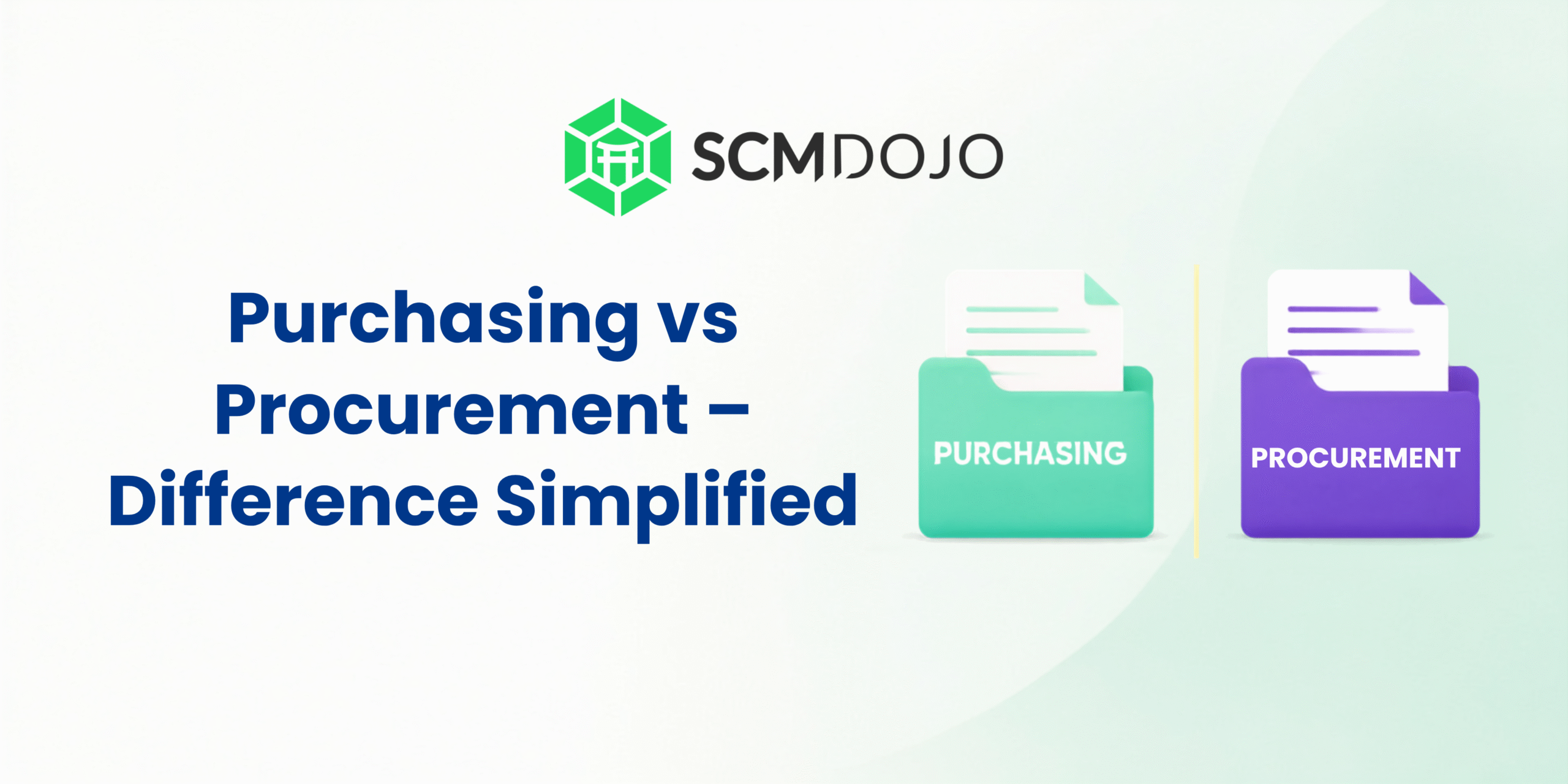
The question of purchasing vs procurement is one of the frequently asked questions. In this blog, we have explained the difference between purchasing and procurement.
THE EVOLUTION OF PURCHASING TO PROCUREMENT AND THEIR RESPECTIVE DEFINITIONS.
Purchasing surfaced in our world in first gained prominence during World War 2. It was done as a clerical function dealing with buying raw materials, commodities, and supplies for organizations and businesses. Fast forward to the 1960s and 1970s, it continued to gain traction within organizations but was still considered a clerical task. It was not until the advent of Procurement in the 2000s that the role of purchasing became a strategic function evolving into Procurement as we know it today. However, the difference exists; keep reading to find out!
Purchasing refers to acquiring or directly buying goods, commodities, and services. It involves ordering, raising purchase orders, receiving, and payments.
Procurement, on the other hand, is the process of acquiring goods, works, and services for organizational use. It involves identifying needs, sourcing, selection, negotiation, ordering, receiving, and payments.
Both have a common goal which is the acquisition of goods but have different approaches to them in organizational settings. It is worth noting that Procurement or Purchasing is a component of the Supply Chain that involves the entire physical process from ordering and obtaining the raw materials, including all process steps in between, until the finished product reaches the end consumer. Purchasing or procurement plays a role in the products’ supply chain by acquiring raw materials for production.
In the course Introduction of Procurement by our expert Maryna Trepova, the first lesson explains very much in detail purchasing and procurement differences. We strongly recommend this course to all aspiring supply chain professionals and managers in general in any business.

THE DIFFERENCE BETWEEN PURCHASING vs PROCUREMENT
Over the years, the terms “Procurement” and “Purchasing” have been used interchangeably. However, they are not the same. Let’s take a look at the difference between them:
Broadly speaking, the Purchasing process is less complicated and pretty much means what it implies. In contrast, Procurement involves many individual steps and processes which can be argued as time-consuming, unnecessary, and costly.
Purchasing includes:
- Ordering, making requests for the good or service needed.
- Raising purchase orders to the supplier or vendor from which the intended goods are to be bought from
- Receiving of ordered goods as per the purchase order
- Payments are made after the goods have been supplied and met the purchase order requirements.
Procurement involves:
- Planning & Identification – this is the identification of the need for the goods or service – requests require approval from either head of the department/organization or the CEO. It involves emails; memo’s detailing the business need and impact for the good, service, or work.
- Sourcing Suppliers – here, invitations are sent out to suppliers or vendors to respond to accordingly.
- Supplier Selection & Contracting – this is where the appropriate vendor or supplier is selected after critical evaluation by the procurement team and is then offered a contract to supply or provide the goods or services as expected.
- Contract Management – a stage where a contract is completed between the relevant parties for all to fulfil contractual obligations to avoid misunderstanding.
- Receiving and Storing – this is the receipt of the final order with quality inspection by the organization and audit department carried out. This ensures the product delivered conforms to the purchase order.
- Payment & Evaluation. Once procurement of the product/service is completed, payment to the Supplier/vendor is completed. That is managing the Procure-to-Pay Process.
In a few organizations, there is an evaluation process completed to identify success and weakness to be worked upon.
As you can clearly see, purchasing is far simpler compared to Procurement, which can have a lot more potential problems.
Another area of difference in the purchasing vs procurement debate is the roles and responsibilities involved. Purchasing is limited to a clerical function with the role of just ordering or buying of goods or services directly whilst with procurement, all aspects of the strategic function that it is must be followed with the additional assurance that value for money, creating value, cost savings and cost avoidance within an organization are identified and evidenced.
“Procurement has evolved from a clerical role to a tactical role and now to a more strategic one.”
The next area of difference between procurement and purchasing is the involvement of people. Purchasing tends to involve few or limited people thus is less cumbersome or bureaucratic.
Whereas with Procurement, every stage involves several people, each contributing to a part of the process, without whom the chain will fail. Thus, the need for excellent communication skills, transparency, and networking amongst stakeholders for success, can be assessed from these 21 Authentic Procurement Interview Questions and Answers Guide
The Purchasing process does not necessarily involve competition as purchases can be considered one-off each time as there is the freedom to research and change vendors each time a purchase is required. The onus is solely with the buyer and is non-contractual. Procurement seems to create competition amongst suppliers as contracts are up for grabs. But this is advantageous for buyers as the competition allows for supplier innovation and a healthy business environment.
Finally, another difference between Procurement and purchasing is their focus. Purchasing is mainly focused on how to get goods and services. In contrast, Procurement focuses on the need for the goods or services with a focus on avoiding unnecessary costs or resources since it’s very strategic function is to drive cost saving for the organization.
So, in summary, purchasing and procurement differences are so great in their definition and application that using the terms interchangeably should be limited if not avoided altogether for anyone considering becoming a key player within Supply Chain.
I am sure you will find below expert views useful to understand “How to manage your boss who isn’t a procurement expert” and “what is Indirect Procurement?” by Richard Beaumont or read our blog
What is Indirect Procurement? – All You Need To Know
Note: This article is co-authored with Ahasu Isaac (Twitter: @isaac_ahasu)
Ahsau graduated from Ho Technical University in Ghana with an HND in Procurement and Supply chain management. I also hold an IPED Diploma in Project Management and World Bank Certificates in Public Procurement, E-Procurement, and Contract Management. Ahasu is also the founder of the Young Procurement Professionals Network where the goal is to train and mentor young and upcoming professionals in the field of Procurement and Supply chain to be ethically upright in their duties.
Frequently Asked Questions (FAQs)
What is the fundamental difference between purchasing and procurement?
Purchasing is the transactional act of buying goods and services specifically the ordering, receiving, and paying phases. Procurement is a much broader, strategic process that encompasses everything from identifying a business need and sourcing suppliers, to negotiating contracts and evaluating supplier performance.
What specific steps are involved in the purchasing process?
Because it is a more straightforward function, purchasing generally involves:
- Making requests for a needed good or service.
- Raising purchase orders (POs) and sending them to vendors.
- Receiving the goods and ensuring they match the PO.
- Processing payments to the supplier.
What steps make up the procurement process?
Procurement is a multi-step, strategic lifecycle that includes:
- Planning & Identification: Formally identifying the business need and securing leadership approval.
- Sourcing: Sending invitations to potential suppliers to bid.
- Selection & Contracting: Evaluating vendors, selecting the best fit, and drafting a formal contract.
- Contract Management: Ensuring all parties fulfill their contractual obligations.
- Receiving & Storing: Auditing delivered goods for quality and compliance.
- Payment & Evaluation: Managing the Procure-to-Pay process and evaluating the supplier’s performance for future improvements.
How does stakeholder involvement differ between the two?
Purchasing involves very few people, making it a faster, less bureaucratic process. Procurement, however, requires a chain of stakeholders across different departments (from the CEO approving the budget to the audit team checking quality). This requires excellent communication, networking, and transparency to prevent the chain from failing.
Do purchasing and procurement handle supplier competition differently?
Yes. Purchasing is often non-contractual, meaning a buyer can simply research and switch vendors for one-off purchases without a formal bidding process. Procurement actively fosters supplier competition by putting long-term contracts up for bid, which drives market innovation and ensures the buyer gets the best possible value for their money.
Why shouldn’t these terms be used interchangeably?
While both deal with the acquisition of goods, using the terms interchangeably undermines the strategic value of procurement. Procurement has evolved from a simple clerical role (purchasing) into a tactical function designed to drive organizational cost savings, mitigate risk, and build resilient supply chains.
About the Author- Dr Muddassir Ahmed
Dr. Muddassir Ahmed is a globally recognized supply chain expert, thought leader, and keynote speaker. As the Founder & CEO of SCMDOJO, he has built one of the world’s leading platforms dedicated to empowering supply chain professionals with cutting-edge knowledge, practical tools, and access to expert insights. With over 19 years of leadership experience spanning the UK, Europe, the Middle East, and Southeast Asia, Dr. Ahmed has held key roles at Bridgestone, Doncasters Group, Eaton, and Volvo Cars, managing multi-million-dollar supply chain operations.
His expertise spans all facets of supply chain management, with a particular focus on leveraging technology and innovation to optimize processes and build resilient supply chains.
Recognized among the Top 10 Supply Chain Influencers in the World by Supply Chain Digital, Dr. Ahmed has been instrumental in shaping industry best practices through his extensive research, vlogs, and thought leadership. Holding a PhD in Management Science from Lancaster University Management School, he is also a certified Six Sigma Black Belt.
His platform, SCMDOJO, serves a vibrant community with over 51,000 monthly visitors. Moreover, he has 72,000 newsletter subscribers, and a social media following exceeding 105,000 supply chain professionals
A sought-after keynote speaker and thought leader, sharing his insights on industry trends, best practices, and the future of supply chain management. Dr. Ahmed delivers high-impact talks on supply chain excellence, digital transformation, and strategic leadership. His mission is clear: to help supply chains thrive
You can follow him on LinkedIn, Facebook, Twitter






kickscao
kickscao
Lots of useful information here. Thanks for sharing your experience.